Giant Crocodile Nicknamed 'Lucy's Hunter' Terrorized Early Human Ancestors
Newly identified species prowled Ethiopian rivers 3 million years ago when Lucy's species walked the Earth.
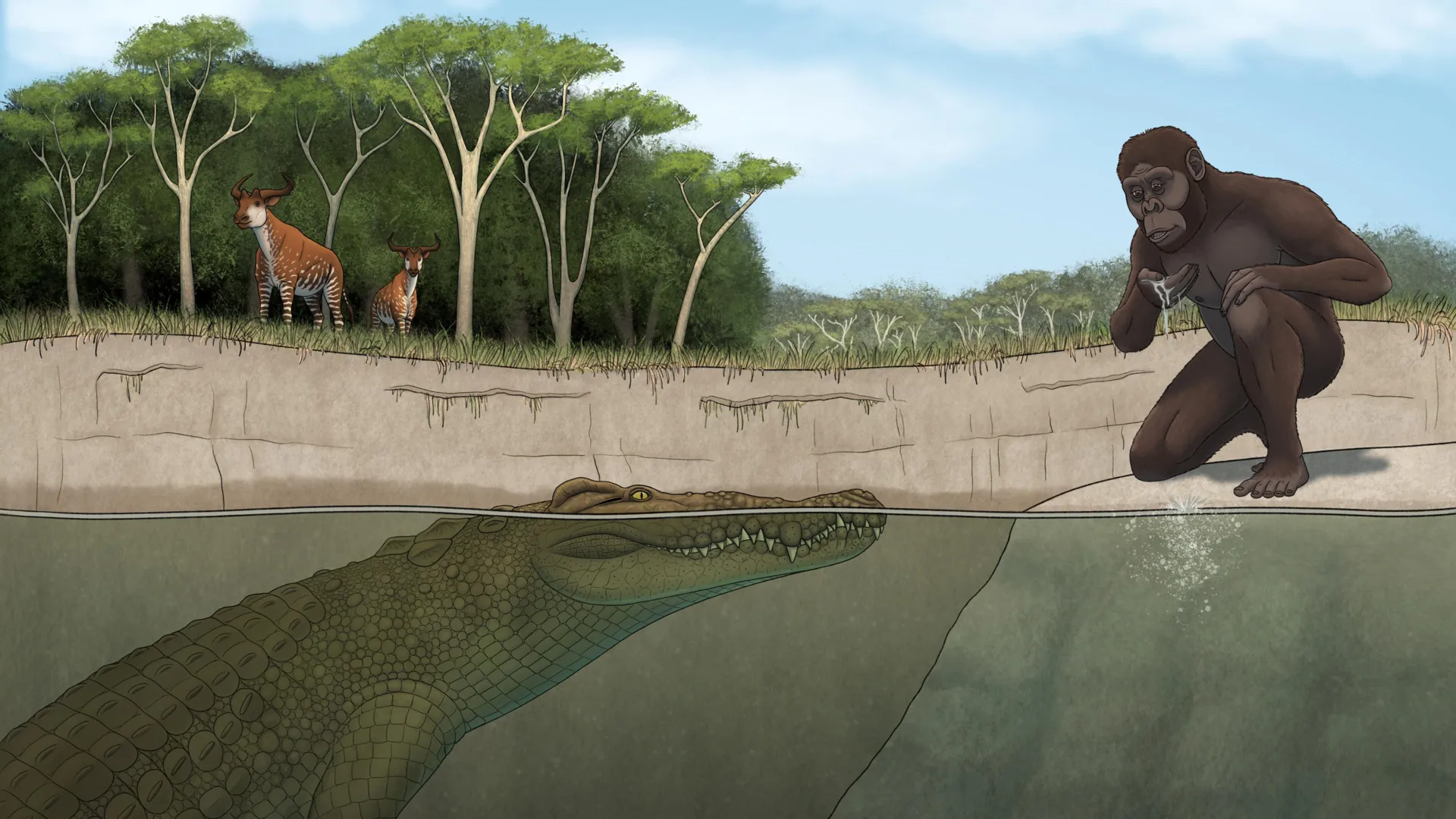
More than 3 million years ago, the famous early human ancestor Lucy and her relatives faced a formidable predator lurking in the rivers and lakes of East Africa. A University of Iowa-led research team has identified this ancient threat as a previously unknown crocodile species, formally naming it Crocodylus lucivenator, meaning "Lucy's hunter."
The massive reptile lived between 3.4 million and 3 million years ago in what is now Ethiopia, sharing the same time period and region with Lucy's species, Australopithecus afarensis. The crocodile measured roughly 12 to 15 feet long and weighed between 600 and 1,300 pounds, making it the largest predator in its ecosystem and a significant threat to early human relatives.
Christopher Brochu, professor in the Department of Earth and Environmental Sciences at Iowa and the study's corresponding author, emphasized the danger this predator posed. "It was the largest predator in that ecosystem, more so than lions and hyenas, and the biggest threat to our ancestors who lived there during that time," Brochu explained. "It's a near certainty this crocodile would have hunted Lucy's species."
The newly identified species possessed several distinctive features that set it apart from other ancient crocodiles. Most notably, it had a prominent hump located in the middle of its snout, similar to structures found in modern American crocodiles but not seen in Africa's Nile crocodiles. Researchers believe this hump may have played a role in courtship displays, with males lowering their heads to show off the feature to potential mates.
The crocodile was an ambush predator that spent much of its time concealed in water, waiting for animals to approach for a drink. Its environment included shrublands, wetlands, rivers, and tree-lined waterways of the Hadar landscape, where Lucy's fossilized remains were discovered in 1974. The study, published in the Journal of Systematic Palaeontology, provides new insights into the dangerous world that early human ancestors navigated millions of years ago.