Webb 'Digital Twin' Strips Starlight to Reveal an Exoplanet Hidden in Old Images
A Caltech and Northwestern team built a physics-based model of Webb's camera that boosts planet-detection sensitivity two to 15 times and uncovered a world sitting unnoticed in archived data.
Astronomers have found a way to scrub the glare of a star out of James Webb Space Telescope images so thoroughly that a planet previously hidden in the archive has now appeared, and the technique could pull more worlds out of data the telescope has already collected.
The method, described in a Nature paper published online November 4, is called Physics-based Learning for Imaging Planets, or FLIP. It rests on a "digital twin": a detailed computer simulation of Webb's Near Infrared Camera, or NIRCam. By recreating how the camera operates, the researchers can pin down tiny imperfections that distort how starlight spreads through the optics, then subtract much of that glare. In tests on known planets, the approach achieved two to 15 times greater detection sensitivity than conventional methods.
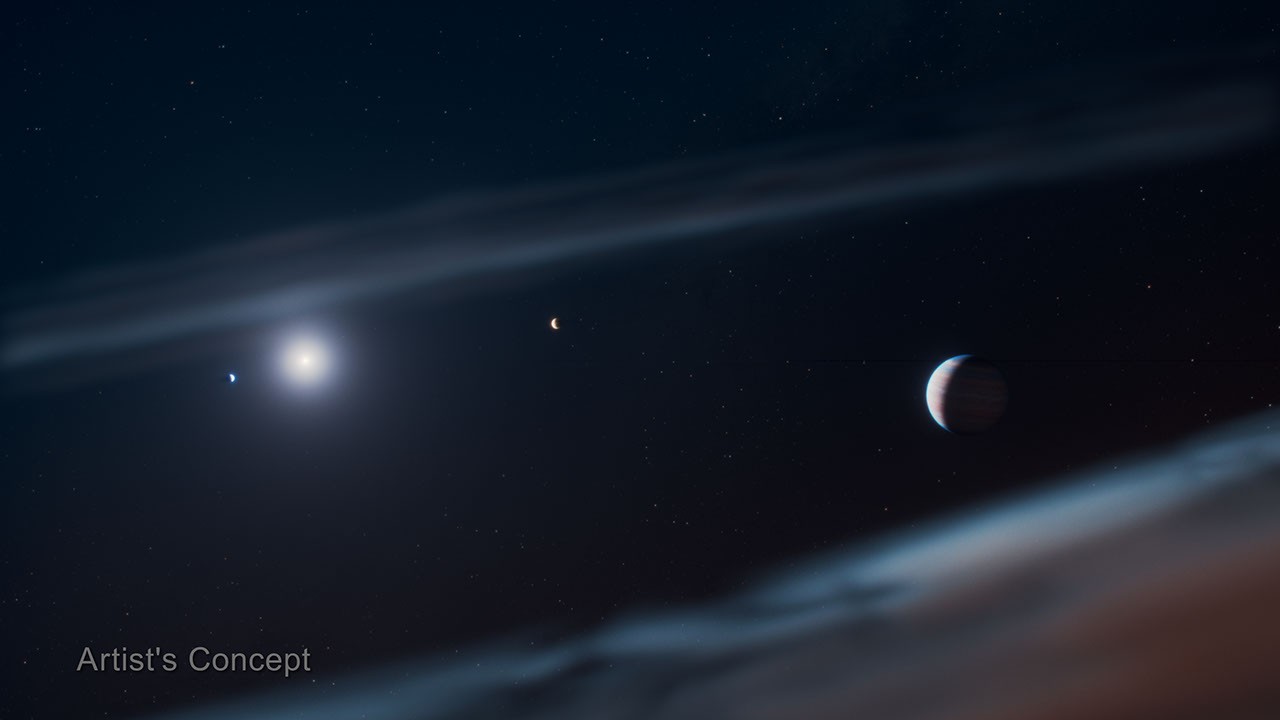
Directly photographing an exoplanet is hard because the planet is faint and sits next to a star that can be millions of times brighter. Even a slight distortion changes how a star appears in an image, and any leftover glare can swamp a planet's signal. "What's exciting is that we're showing how computation can help overcome limitations of the telescope itself," said Katie Bouman, a Caltech professor and co-author. "By combining a physical model of the instrument with optimization techniques from machine learning, we have been able to remove starlight much more precisely."
The route there was not straightforward. Lead author Rodrigo Ferrer-Chavez, a graduate student at Northwestern University working in the lab of astronomer Jason Wang, first tried training machine learning models to predict the pattern of starlight in the data. That failed. The team instead used computational tools borrowed from machine learning to carry out detailed physical calculations, adjusting millions of variables, "much like turning an enormous collection of control knobs," until the simulated telescope matched what Webb actually recorded. "You basically see the glare of the star disappearing in very bizarre ways," Ferrer-Chavez said. "It gets dimmer and very deformed until at the end you get a pretty clean image and, if you're lucky, there's a blob there, which is a glowing planet."
The finding changes what the archive might hold. "We now have a tool that lets us discover and study planets that we were not able to 'see' before, even if that planet was already in an image in the JWST archive," Ferrer-Chavez said. Planets once considered out of reach for direct imaging could be identified without a single new observation. Wang noted that Webb is optically stable to the nanometer level, "which just sounds pretty awesome, but that's still limiting," and that the technique is not tied to Webb. Because of some specific design choices, it "could be used on any telescope."
The team plans to refine FLIP and test it with other instruments, including the Nancy Grace Roman Space Telescope, whose Coronagraph Instrument was developed by researchers at Caltech, JPL and IPAC, and with ground-based telescopes. The researchers also see a role in future missions, notably NASA's proposed Habitable Worlds Observatory, which would be the first telescope designed specifically to search for evidence of life on planets orbiting other stars. Hardware coronagraphs will still do much of the work of blocking starlight, but FLIP offers a second layer of correction applied after the photons have been collected.