Caltech Robot Builds a Structure in Orbit Without Human Hands, a First
The ASTRA experiment, riding on a small satellite, has added a third truss bay to a planned 1.4-meter reflector antenna in a step toward kilometer-scale structures in space.
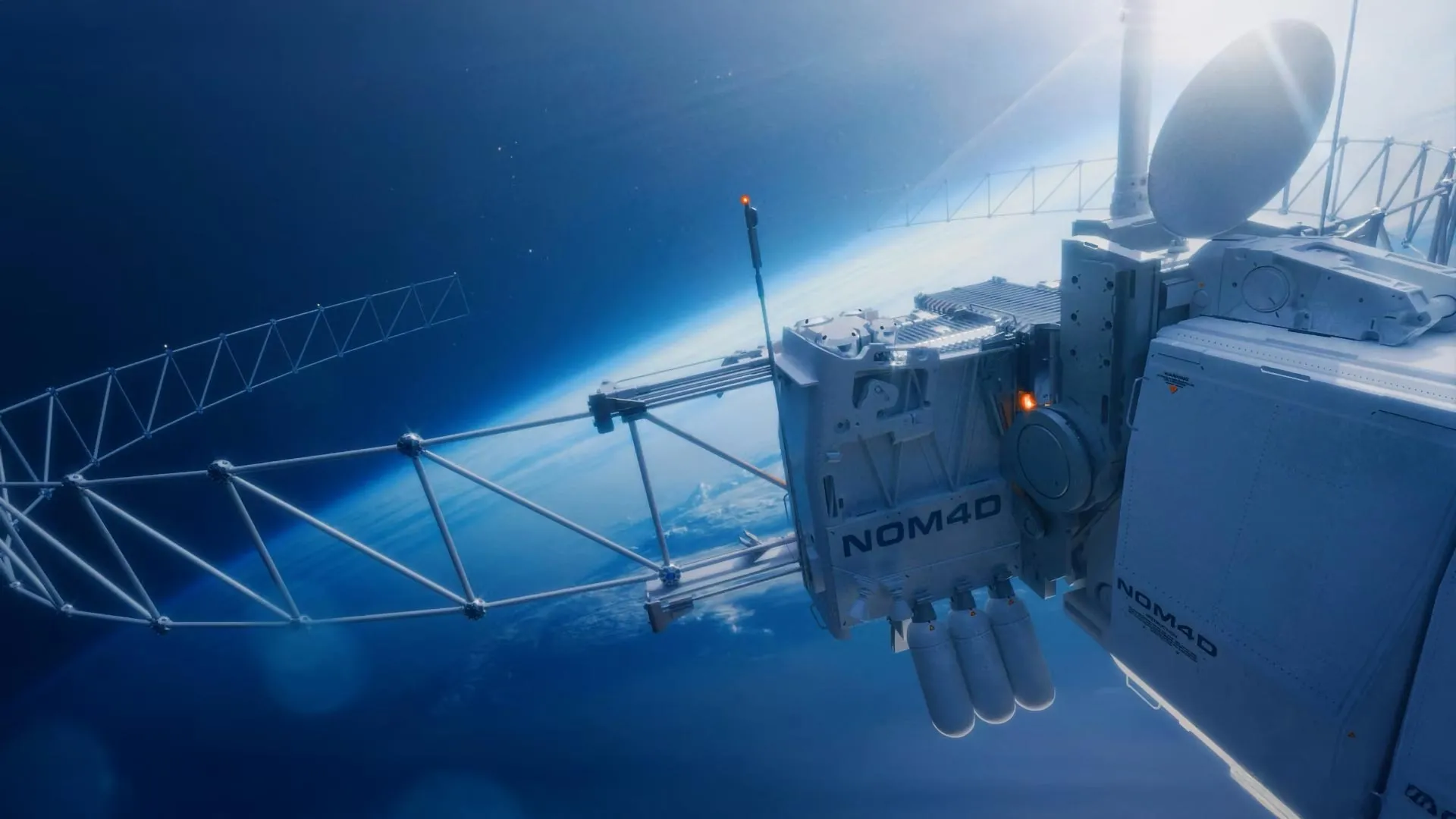
A robot built at Caltech has assembled part of a structure in orbit with no human involved, which the project's leader says is the first time that has been done. The experiment, called Autonomous In-Space Tensioned Reflector Assembly, or ASTRA, is led by Sergio Pellegrino, Caltech's Joyce and Krent Kresa Professor and a senior research scientist at NASA's Jet Propulsion Laboratory.
"This is the first time that a structure has been autonomously constructed in space," Pellegrino said.
ASTRA launched on March 30, 2026, aboard SpaceX's Transporter-16 rideshare mission from Vandenberg Space Force Base in California, carried on Momentus Inc.'s Vigoride 7 spacecraft. The hardware is about one cubic meter. The goal is a reflector antenna 1.4 meters across made of 11 connected truss bays. Two pre-assembled bays were deployed, and the robot built a third. The team does not expect to finish all 11 bays before the mission ends in December.
The work is funded by DARPA's Novel Orbital and Moon Manufacturing, Materials, and Mass-efficient Design program, known as NOM4D, which was established in 2022. The reflective film was co-invented by Caltech and the University of Pennsylvania, led by Professor Igor Bargatin. Team members named in the release include Charles Sommer, Alan Truong, Tara Venkatadri and Jaden Suh, now an assistant professor at UT Austin.
Controlling the robot is slow work. The team has about seven or eight communication windows per day, each lasting around 15 minutes, so every command sequence has to be planned and checked in advance.
The real target is far larger than the demo. DARPA program manager Andrew Detor defined "very large" as hundreds of meters or even kilometers across. "Nothing approaching that scale can be achieved today," he said, because anything that must fit inside a rocket fairing is limited by the rocket. Building in orbit removes that limit. Giant antennas, telescopes and solar arrays are the obvious uses.
A second NOM4D project is testing a different approach: the University of Illinois Urbana-Champaign is hardening carbon tubes using a module on the International Space Station. ASTRA's remaining weeks will show whether a robot can keep adding bays reliably, which is the question a kilometer-scale structure depends on.
If the technique matures, it could change how large structures are launched. Instead of folding a telescope mirror to fit inside a fairing, engineers could launch compact parts and have robots join them in orbit, replacing, repairing or enlarging them over time. The experiment also tests software that lets a robot work with long gaps between human commands, a skill future lunar and orbital construction would need.