Hidden Charcoal in a Cave Bison's Black Lines Finally Dates France's Font-de-Gaume Art — and It Was Painted Across 7,000 Years
Scientists believed the black pigments were pure mineral oxides, making radiocarbon dating impossible. Two non-destructive techniques found charcoal running through the lines, and the samples came back with wildly different ages.
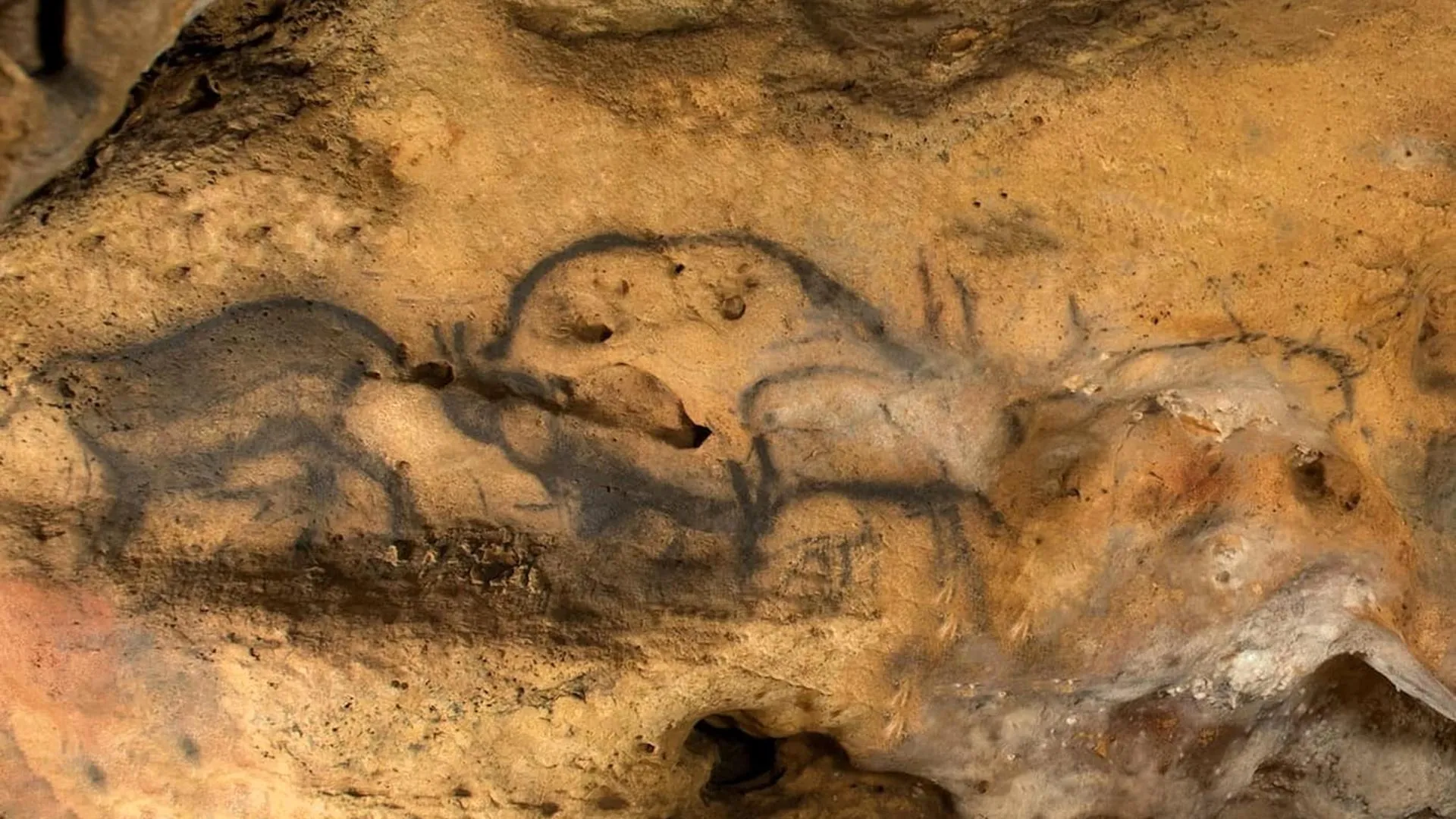
For more than a century, the painted animals of Font-de-Gaume cave in France's Dordogne region carried an asterisk: nobody could say when they were made. A team led by Ina Reiche of the French National Center for Scientific Research has now put firm dates on two of them, and the answer upended a basic assumption about how the cave was used.
The obstacle had always been chemistry. Radiocarbon dating works by measuring carbon-14, a radioactive form of carbon that decays at a known rate after an organism dies. Charcoal, being burned organic material, dates beautifully. Mineral pigments do not — they contain no carbon to measure. Researchers had long assumed that the black paintings of the Dordogne, the region that also holds Lascaux, were made entirely from iron and manganese oxides, naturally occurring minerals that produce a deep black but carry no organic carbon. That assumption made the art effectively undatable. It had also never actually been tested.
Reiche's team examined two black figures at Font-de-Gaume: a bison and a second image usually described as a mask or a face. They used Raman microspectrometry, which shines light on a sample and reads how its molecules vibrate to produce a chemical fingerprint, and hyperspectral imaging, which records fine differences in reflected light at every point in an image. Neither technique damages the artwork. Both found traces of charcoal in the black pigment — and, critically, the charcoal was distributed evenly along the painted lines. That even distribution mattered more than its presence. Contamination from later graffiti, torch smoke or a century of visitors would have shown up in patches. This was part of the original paint.
With charcoal confirmed, the researchers obtained exceptional authorization to remove extremely small samples for carbon-14 measurement — enough carbon for a reliable reading, as little as possible off an irreplaceable image. The bison came back at 13,461 to 13,162 calibrated years before present, placing it firmly in the Upper Paleolithic and slightly later than earlier estimates had guessed. (CalBP means calibrated years before 1950; the calibration corrects for the fact that atmospheric carbon-14 has fluctuated over time with solar activity and shifts in Earth's magnetic field.)
The mask produced something stranger. Samples taken from different parts of the same figure returned three separate age ranges. One section dated to between 15,981 and 15,121 calBP. Another fell far later, between 8,993 and 8,590 calBP — a gap of roughly 7,000 years. Whoever finished that figure was working millennia after whoever started it, in a cave that had apparently been revisited, remembered and reworked across an almost unimaginable span of human time.
The method is the larger prize. If black pigments across the Dordogne turn out to contain charcoal that earlier researchers assumed away, archaeologists gain a way to date not just when a cave was decorated, but when people came back — turning static galleries into sequences of visits stretched over thousands of years.