43 Helmets Pulled From the Sea Off Spain Were Called Roman for 30 Years. They Turn Out to Be Medieval War Gear
Snagged in fishermen's nets in 1990 near Benicarló, the corroded iron hoard was long filed away as ancient Roman. New radiocarbon dating places it in the late 1300s and early 1400s.
For more than three decades, a haul of corroded iron helmets dredged from the seabed off eastern Spain sat in the archaeological record under the wrong label. Long believed to be relics of the ancient Roman world, the 43 helmets have now been definitively reclassified as late medieval war gear, a discovery that rewrites the story of one of the western Mediterranean's most intriguing underwater finds.
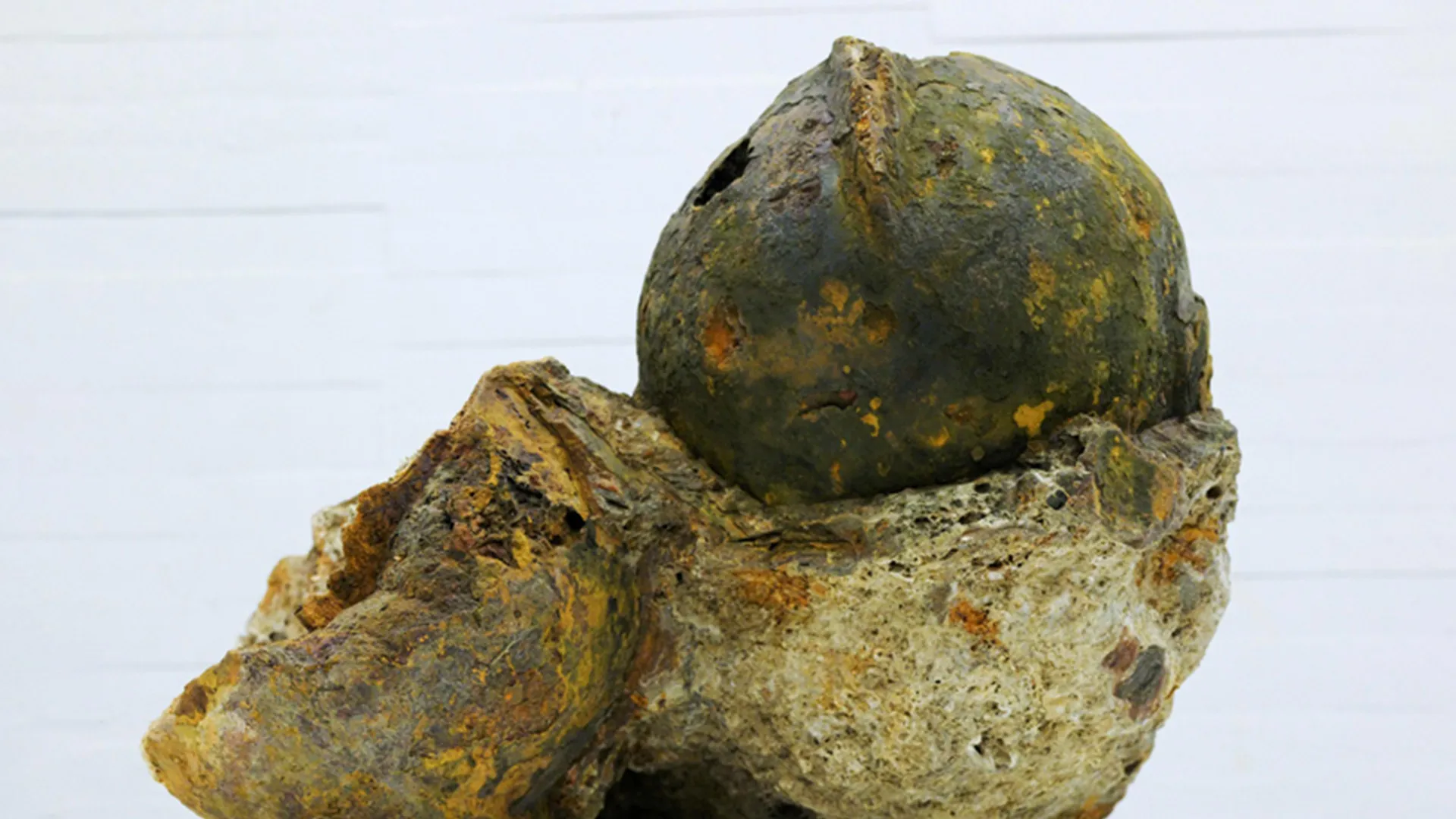
The objects first surfaced in 1990 at the Piedras de la Barbada underwater site near Benicarló, in the province of Castellón, when local fishermen accidentally snagged two large, heavily concreted metallic blocks in their nets. Encased in centuries of marine accretion, the lumps were eventually understood to contain a cache of iron helmets, and for years the assumption held that they belonged to antiquity. A new analysis, led by researchers at the University of Alicante, has overturned that assumption entirely.
The key came from textiles, not metal. Five fabric samples preserved inside the helmets were radiocarbon dated by accelerator mass spectrometry in two independent laboratories. Four of the results converged on a coherent late medieval window centered between the late 14th and early 15th centuries — roughly the years 1370 to 1410 — rather than the Roman era. The helmets themselves take forms consistent with that period: hemispherical iron calottes, some bearing longitudinal crests, and one faceted, ogival piece reminiscent of the late medieval kettle-hat tradition.
At least 43 helmets have been identified so far, though researchers caution the true number may be higher, with some pieces still locked inside the concreted blocks. Even at that count, the surviving collection already represents the largest known hoard of medieval helmets ever found in the western Mediterranean — a remarkable concentration of arms for a single underwater site.
For historians, the reclassification does more than fix a date. A trove of that size points to large-scale commerce in weaponry, evidence of a trading and communication network across the medieval Mediterranean far more complex than previously appreciated. The helmets may have been cargo lost in transit, bound for a market or a garrison somewhere along the coast when they slipped beneath the waves. Their three-decade misidentification is also a quiet lesson in the limits of assumption: a find can sit in plain sight for a generation, mislabeled, until the right method — in this case, a few threads of ancient cloth — finally tells the truth. Further excavation of the remaining concreted blocks could yet raise the count of helmets and deepen the picture of how arms moved across the medieval Mediterranean, turning a chance catch in a fisherman's net into a window on a forgotten trade.