Harvard Physicists Watch Particles That Can Move Only as a Pair
In a tilted chain of ultracold atoms, an empty site and a doubly filled one traveled together as a single quantum object, even though neither can move alone.

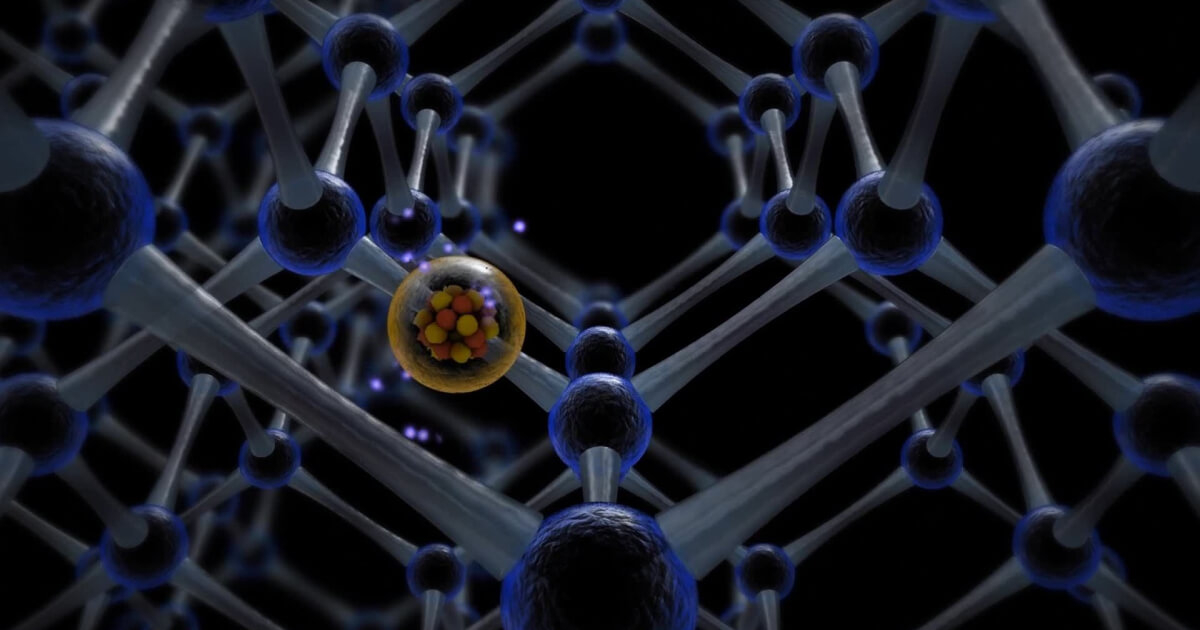
Physicists at Harvard University and other institutions have directly watched an unusual kind of quantum object move: a bound pair whose two halves are stuck in place on their own but can travel when joined.
The work, published in Nature Physics, is the first direct observation of an individual dipole excitation moving in a fracton system, a setting where certain disturbances cannot move by themselves while particular combinations of them can.
The team trapped atoms in an optical lattice, a pattern of laser light that holds them in evenly spaced sites. They began with exactly one atom per site, isolated a chain of about 10, and tilted it with a strong magnetic field gradient. "The chain looks like a staircase with one atom on each step," said Sooshin Kim, the study's first author. "On such a steep staircase, an atom cannot hop to a neighboring step by itself."
Two atoms, however, can hop in opposite directions at the same moment, which keeps their center of mass unchanged. The researchers realized that a hole, meaning an empty site, next to a doublon, a site holding two atoms, should form a pair that glides along the chain as a single quasiparticle.
To create one, they aimed a tightly focused spot of light at a single step, raising its energy slowly in a method they nicknamed the elevator. At just the right height, an atom from the neighboring step moved over to join it. After releasing the pair, the scientists froze the atoms at chosen moments, photographed them with a quantum gas microscope, and repeated the process hundreds of times.
"We found that a single dipole performs a quantum walk," Kim said. "It spreads along the chain in both directions like a wave, interferes with itself, and even partially returns to its starting point, in good agreement with the exact solution of the model." That showed the pair is a stable, coherent object.
The researchers also watched pairs collide. Although each is built from two parts, they interacted strongly and avoided occupying neighboring links in the chain, as if surrounded by a hard shell.
Kim said the experiment offers a ground-up view of quantum systems with built-in limits on motion, which connect to questions such as why some quantum systems fail to settle into thermal equilibrium. Now at POSTECH in South Korea, Kim hopes to return to the original goal of studying the exotic low-energy phases that theory predicts such matter should form.