Physicists Create a 'Fractional Fermi Sea,' Confirming a Quantum Prediction 35 Years in the Making
Using ultracold cesium atoms in a quantum wire, an Innsbruck team realized a bizarre new phase of matter that breaks the textbook rule for how particles fill energy levels.
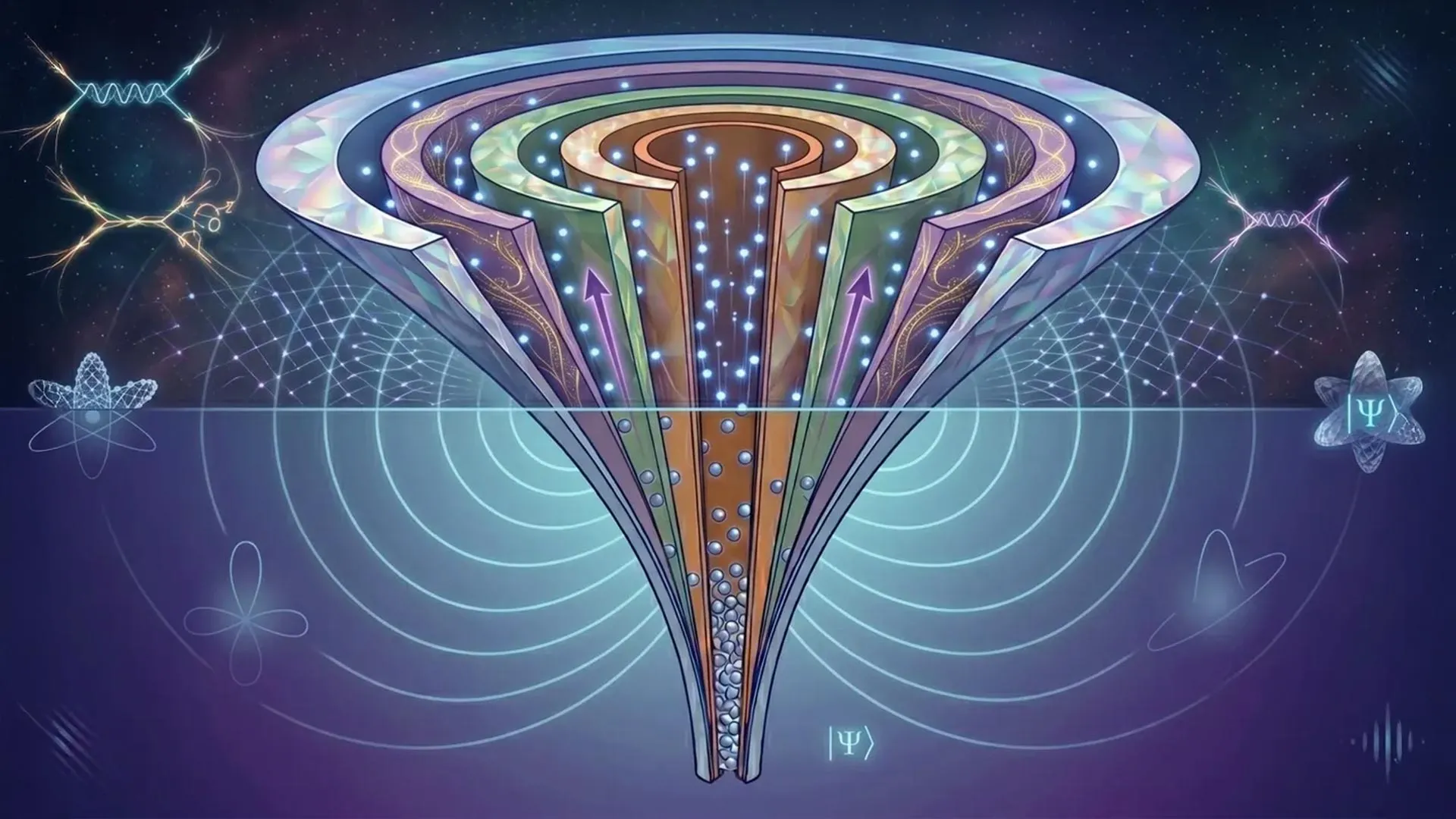
Physicists at the University of Innsbruck have coaxed a cloud of ultracold atoms into a strange new state of matter called a "fractional Fermi sea," experimentally confirming a prediction that quantum theory made more than three decades ago but that had never been seen in a laboratory.
To understand what is new, start with the ordinary version. In any ordinary metal, electrons stack into available energy levels from the bottom up, filling each one before moving to the next — a structure physicists call a Fermi sea, with a sharp surface separating filled levels from empty ones. The rule governing that stacking is the Pauli exclusion principle, which says two identical fermions cannot occupy the same state. It is one of the bedrock rules of quantum mechanics and explains everything from the periodic table to why matter takes up space.
The fractional Fermi sea keeps the sharp outer boundary of that structure but violates the rule inside it. Energy levels are only partially filled, with fractional rather than whole-number occupancy. That behavior is permitted by a 1991 framework devised by Nobel laureate Duncan Haldane, whose theory of "generalized exclusion statistics" extends the Pauli principle to allow particles that behave somewhere between bosons and fermions. For 35 years the idea remained a theoretical curiosity; now it has a physical realization.
The Innsbruck team built its exotic state out of ultracold cesium atoms chilled to a few billionths of a degree above absolute zero and squeezed into an effectively one-dimensional channel, a so-called quantum wire. Instead of simply heating the gas, the researchers cyclically flipped the interactions between the atoms — swinging them between strongly repulsive and strongly attractive — and found that this drove the system into a highly excited yet remarkably ordered arrangement rather than the disordered mush that heating usually produces. The theoretical underpinning was published in Physical Review Letters in early June.
Crucially, the resulting phase is not a rehash of the well-studied Tomonaga-Luttinger liquid that normally describes electrons confined to one dimension. It displays its own characteristic ripples, known as Friedel oscillations, and a distinct pattern of how correlations fade with distance — signatures the researchers say mark it as a genuinely new type of critical quantum phase. "It has a hidden order that becomes visible," the team noted, describing structure that emerges only when the system is driven far from equilibrium.
Beyond bragging rights for confirming a long-standing prediction, the work matters for quantum simulation — the effort to use tightly controlled atoms to mimic materials that are too complex to calculate directly. A new, well-characterized phase gives physicists a fresh tool for exploring how matter organizes itself under extreme quantum conditions, and hints that other predicted-but-unseen states may be within reach using similar driving techniques.
In plain terms: scientists cooled atoms to near absolute zero and shook their interactions until they locked into a brand-new form of matter that theory predicted in 1991 but no one had ever built. It bends one of the most basic rules of quantum physics and gives researchers a new way to study how matter behaves at its most extreme.