China's JUNO Detector Delivers First Results, Sharpening the Neutrino Mass Mystery
Featured on the cover of Nature, the giant underground observatory measured key neutrino properties with record precision after just two months of data — and put itself on track to crack one of physics' biggest puzzles.
The Jiangmen Underground Neutrino Observatory, or JUNO, has delivered its first major physics results, measuring fundamental properties of neutrinos with record precision and marking a milestone in the decades-long quest to understand the universe's most elusive particles. The debut analysis was featured as the cover article of Nature on June 10.
Built deep beneath Jiangmen in southern China and led by the Institute of High Energy Physics of the Chinese Academy of Sciences, JUNO is the world's first next-generation, large-scale, high-precision neutrino detector to begin operation. Using just 59 days of data collected between August and November 2025, the international collaboration measured two key neutrino oscillation parameters and slashed the associated uncertainties by a factor of 1.6 compared with the combined results of previous experiments over decades.
Neutrinos are ghostly, nearly massless particles that stream through ordinary matter — and through our bodies — by the trillions every second, almost never interacting. They come in three "flavors" and oscillate, or morph, from one type into another as they travel, a quantum behavior that reveals they have tiny but nonzero masses. Pinning down those masses and how the flavors mix is one of the central unsolved problems in particle physics.
JUNO's ultimate goal is to determine the "mass ordering" — the still-unknown ranking of the three neutrino masses from lightest to heaviest. While this first analysis focused on oscillation parameters rather than the ordering itself, the precision achieved in only two months gives physicists confidence that the detector is on track to settle the question in the years ahead. Collaboration members said the early data show the detector is performing as well as, or better than, it was designed to.
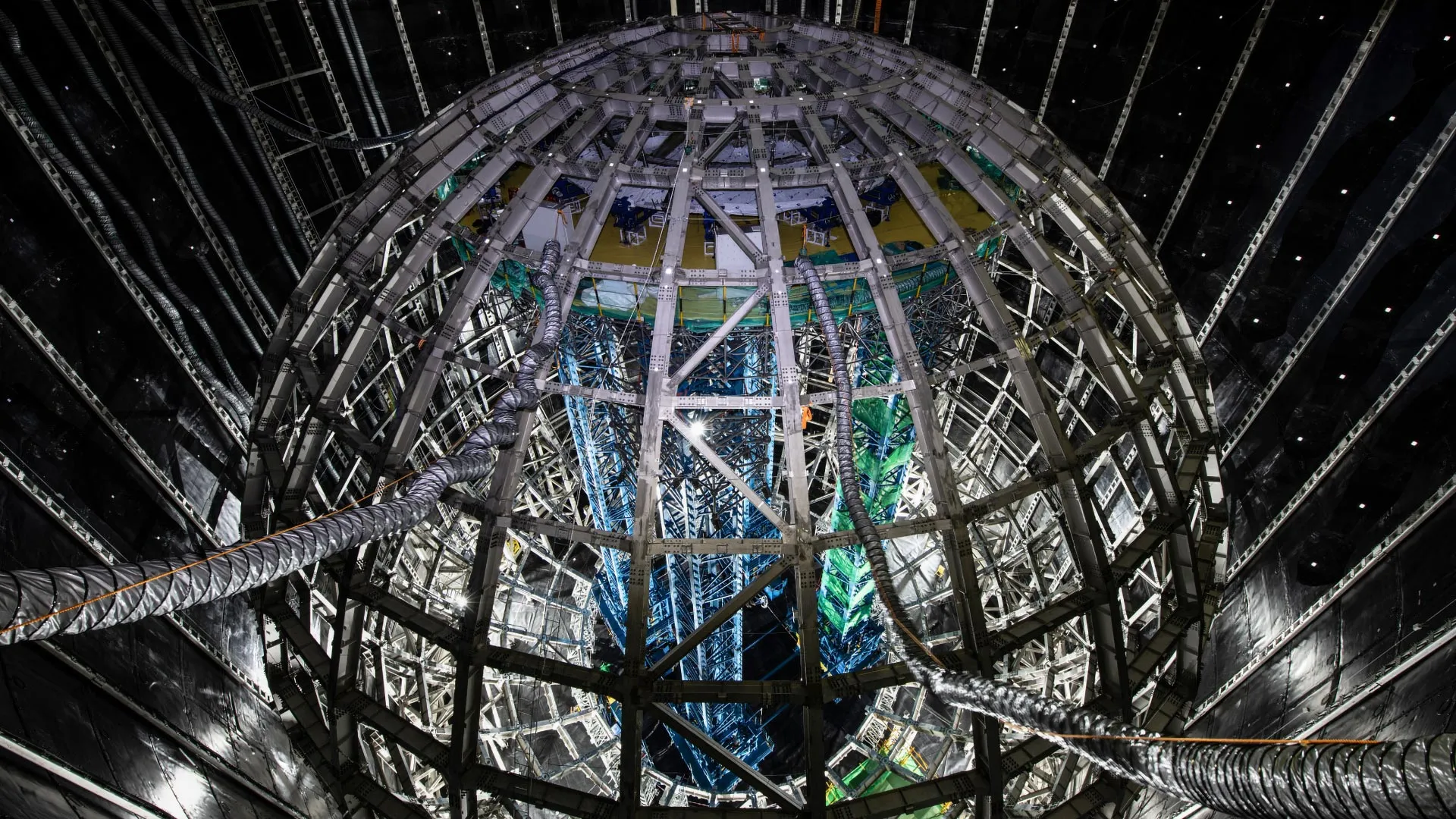
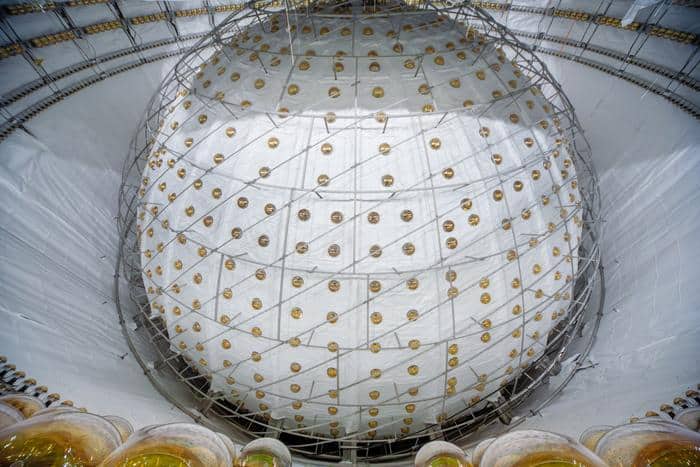
At the heart of the experiment is a colossal acrylic sphere about 35 meters across, filled with 20,000 tons of liquid scintillator and watched by tens of thousands of ultrasensitive light sensors. When a neutrino occasionally interacts in the fluid, it produces faint flashes of light that the sensors capture, allowing scientists to reconstruct the particle's energy and behavior with extraordinary fidelity. The detector sits more than 700 meters underground to shield it from the constant rain of cosmic rays.
Resolving the neutrino mass ordering would ripple far beyond particle physics, informing models of how the universe evolved, why matter prevailed over antimatter after the Big Bang, and the behavior of exploding stars. With its first results already setting records, JUNO has announced itself as a flagship of global physics — and a marker of China's growing prominence at the frontier of fundamental science.