NASA’s Curiosity Drove Into a Martian Valley Floored With Honeycombs — Thousands of Them, Running Out of Sight
The polygonal fractures in Valle Grande measure two to three inches across and climb a 20-foot butte. Scientists have three competing explanations and no answer yet.
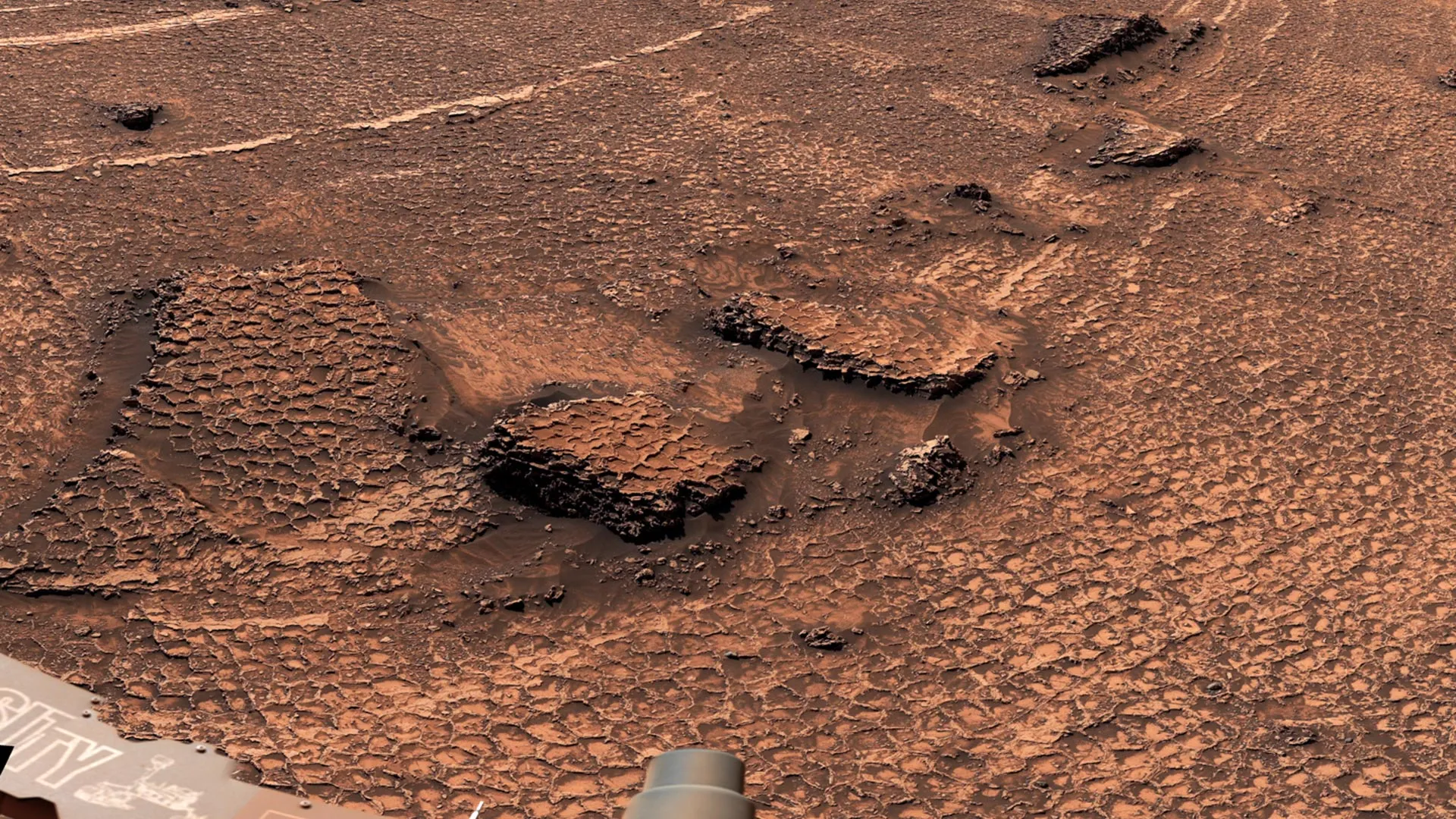
NASA's Curiosity rover has driven into a Martian valley whose floor is covered, edge to edge, in a honeycomb of cracks — and the mission team says it is unlike anything the rover has photographed in fourteen years on the surface.
The site is a valley the team calls Valle Grande, on the flank of Mount Sharp, the three-mile-high mountain Curiosity has been climbing since 2014. The rover captured the images on June 19 and 20, 2026, on sols 4,930 and 4,931 of the mission. The individual cells of the pattern are small, roughly 4 to 8 centimeters — two to three inches — across. What makes them remarkable is the extent. They run to the limit of the rover's cameras in every direction, and they do not stop at the ground: the same polygons climb the face of a 20-foot butte the team nicknamed "Miraflores."
"We've seen a lot of fascinating landscapes through Curiosity's eyes, but this sea of polygons took our breath away," said Ashwin Vasavada, the mission's project scientist at NASA's Jet Propulsion Laboratory, which is managed by Caltech.
Polygonal cracking is not itself exotic — it is one of the most common patterns in geology, and on Earth it shows up in dried lakebeds, in permafrost and in cooling lava. That is precisely the problem. The team has identified three plausible mechanisms and cannot yet separate them. The first is thermal cycling: rock repeatedly warmed and cooled across the enormous day-night temperature swings on Mars, fracturing along a regular grid. The second is compression, in which the weight of accumulating sediment squeezed water out of the layers below and the material contracted as it drained. The third is straightforward mud cracking, the same process that scores a drying puddle on Earth.
The distinction matters far beyond the aesthetics. Each mechanism implies a different water history for this part of Mount Sharp, and Mount Sharp is a stratigraphic record — its layers preserve the transition of Mars from a wetter world to the dry one Curiosity drives across now. A mud-crack origin would mean standing water sat here. A thermal origin would mean it did not. Reading the difference correctly is the difference between two very different chapters in the planet's climate history.
The fact that the polygons continue up the side of Miraflores is a significant clue in its own right, because it means the pattern was imprinted on material that was later exposed vertically by erosion, rather than forming on a surface that has always been horizontal. Curiosity is continuing to work the site, and the analysis is ongoing.
Originally reported by ScienceDaily.