NASA Fires Lithium-Fed Mars Thruster to a Record 120 Kilowatts at JPL
The magnetoplasmadynamic engine ran 25 times more powerful than the thrusters now flying on the Psyche mission, hitting tungsten temperatures above 5,000°F and marking the highest-power electric propulsion test ever conducted in the United States.
Engineers at NASA's Jet Propulsion Laboratory have successfully fired up an experimental lithium-fed electromagnetic thruster at power levels never before achieved by an American electric propulsion system, a milestone the agency says brings the United States meaningfully closer to dispatching crewed missions to Mars.
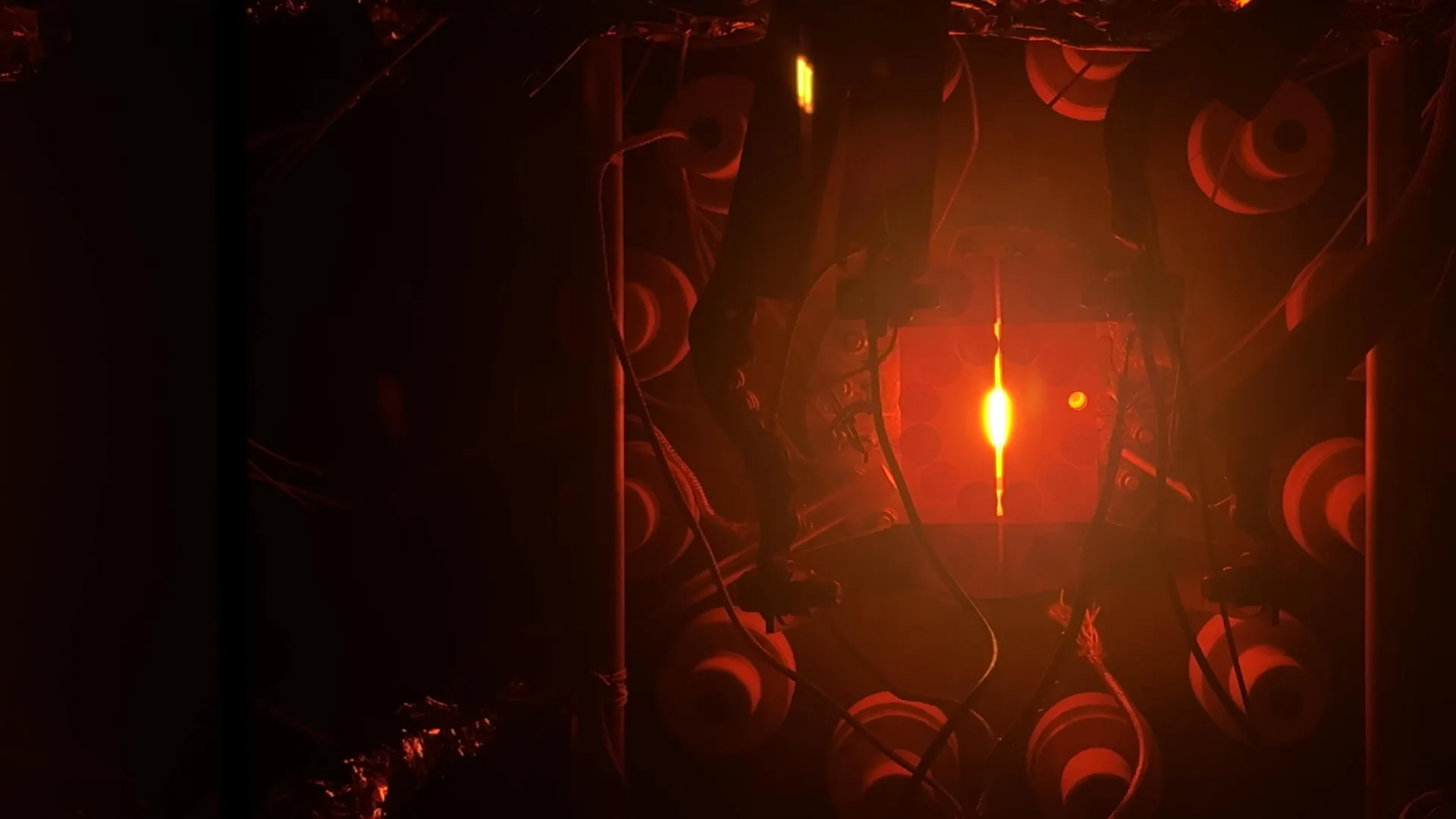
The test, conducted on February 24, 2026, in a vacuum chamber at JPL's Southern California campus and made public this month, drove the prototype magnetoplasmadynamic (MPD) thruster to 120 kilowatts during five separate ignition cycles. That is roughly 25 times the power of the Hall-effect thrusters now flying aboard NASA's Psyche asteroid mission, and a critical step toward the multi-megawatt propulsion systems engineers believe will be needed to push astronauts to Mars on a timetable shorter than 12 months. During each firing, the tungsten cathode at the thruster's heart glowed bright white at temperatures above 5,000 degrees Fahrenheit — roughly half the temperature of the surface of the sun.
"It's a huge moment for us because we not only showed the thruster works, but we also hit the power levels we were targeting," said James Polk, a senior research scientist at JPL and the project's principal investigator. "This is the first time in the United States that an electric propulsion system has operated at this kind of power." NASA Administrator Jared Isaacman, who toured the JPL facility earlier this spring, called the result "exactly the kind of leap we need to make Mars a real destination, not a perpetual brochure."
MPD thrusters differ from conventional ion engines in a critical way. Where ion thrusters accelerate xenon atoms through electrostatic grids, an MPD engine pushes propellant — in this case lithium vapor — through a crossed electric and magnetic field, slinging the resulting plasma out the nozzle at velocities approaching 50 kilometers per second. That high exhaust velocity translates into exceptional fuel efficiency, meaning a Mars-bound spacecraft can carry far less propellant for the same delta-v. Lithium was chosen for its low ionization energy and dense storage characteristics; the metal is heated until it vaporizes and is then injected into the thruster's discharge chamber.
The technology is not new — the Soviet Union flew small MPD experiments in the 1970s, and Princeton University has run lithium-fed test rigs for decades — but no nation has ever scaled the concept to power levels relevant for human spaceflight. JPL is leading the current effort in partnership with Princeton, NASA's Glenn Research Center in Cleveland, and the Marshall Space Flight Center in Huntsville, Alabama. The team's stated goal is to reach 500 kilowatts to 1 megawatt per thruster within the next several years, with a crewed Mars vehicle expected to require a cluster delivering between 2 and 4 megawatts of continuous thrust over more than 23,000 hours of operation.
That operational lifetime is the program's hardest open problem. Electrode erosion is the dominant failure mode for high-power MPD engines, and a Mars-class mission requires a thruster that can survive nearly three years of near-continuous firing without unscheduled maintenance. JPL's February test ran for less than an hour, and the team will spend the next year conducting endurance runs and modeling cathode wear. Funding is the other open question: the program is being financed through NASA's Space Technology Mission Directorate, whose budget faces possible cuts in the administration's fiscal 2027 request. But Isaacman, in remarks last month at the Humans to Mars Summit in Washington, said NASA would "protect this line" because, in his words, "chemical rockets cannot get astronauts to Mars and back in a window the human body can tolerate. Electric propulsion is not optional. It is the path."