100-Million-Year-Old Snake Had Hind Legs and Mysterious Lost Bone
Najash rionegrina fossil reveals early snakes were large predators with wide mouths, not small burrowers as previously thought.
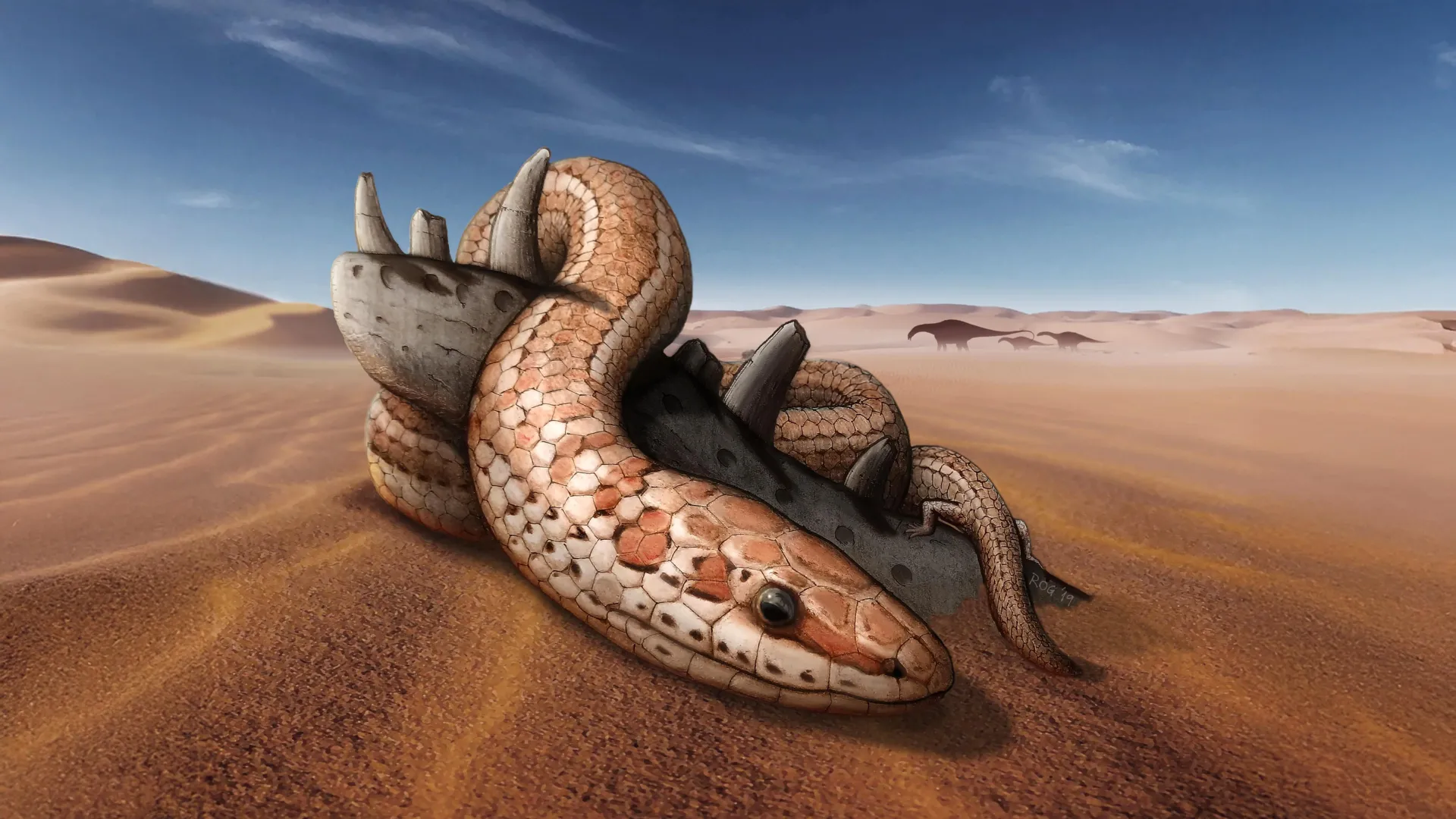
A remarkably preserved fossil from Argentina has revolutionized scientists' understanding of snake evolution, revealing that these early serpents retained hind legs and possessed a crucial skull bone that has almost completely vanished in modern species. The specimen belongs to Najash rionegrina, an ancient snake that lived nearly 100 million years ago during the Cretaceous period. Advanced imaging techniques have allowed researchers to examine the creature's skull in unprecedented detail, discovering features that fundamentally challenge previous theories about how snakes evolved from their lizard ancestors.
The fossil's most significant revelation concerns the jugal bone, also known as the cheekbone, which forms part of the skull's structural framework in most vertebrates. This bone has been almost entirely lost in modern snakes, leaving scientists to debate its original configuration and evolutionary significance. The Najash specimens provide direct evidence of how this bone was arranged in early snakes, resolving a 160-year-old anatomical mystery that had relied heavily on speculation and indirect evidence. Fernando Garberoglio from the Fundación Azara at Universidad Maimónides in Buenos Aires, who led the study, emphasized that this discovery corrects fundamental misunderstandings about snake skull evolution.
Perhaps equally important, the findings challenge the prevailing theory that snakes evolved from small, burrowing lizards. Instead, the evidence from Najash suggests that snake ancestors were large-bodied animals with wide mouths, adapted for capturing substantial prey rather than living underground. This interpretation aligns with other anatomical features found in early snake fossils, including robust vertebrae and well-developed skull structures that would have supported powerful jaw muscles. The discovery suggests that the evolutionary transition to the streamlined, limbless form of modern snakes was a gradual process that occurred over millions of years.
The research team used micro-computed tomography (micro-CT) scanning to peer inside the fossil without damaging it, allowing them to reconstruct the skull's three-dimensional structure with extraordinary precision. This technique revealed not only the arrangement of bones but also the pathways of nerves and blood vessels that once supplied the living animal. The level of detail provided insights into how early snakes processed sensory information and how their skulls were adapted for their particular lifestyle and feeding habits.
The Najash fossils come from Northern Patagonia and represent an ancient southern lineage that once lived across the former supercontinent of Gondwana. These early snakes appear to be related to only a small number of unusual snake species still living today, providing a direct link between ancient and modern serpent diversity. The study's co-author Michael Caldwell from the University of Alberta noted that this research fundamentally changes scientific understanding of snake skull evolution and provides crucial insights into one of the most successful vertebrate body plans in evolutionary history.