Webb Finds the Coolest 'Lava World' Yet That Still Seems to Have an Atmosphere
HD 3167 b circles its star once a day, 154 light-years away, and is cooler on its day side than bare rock should be. That points to an atmosphere, and maybe a glimpse of what the newborn Earth looked like.

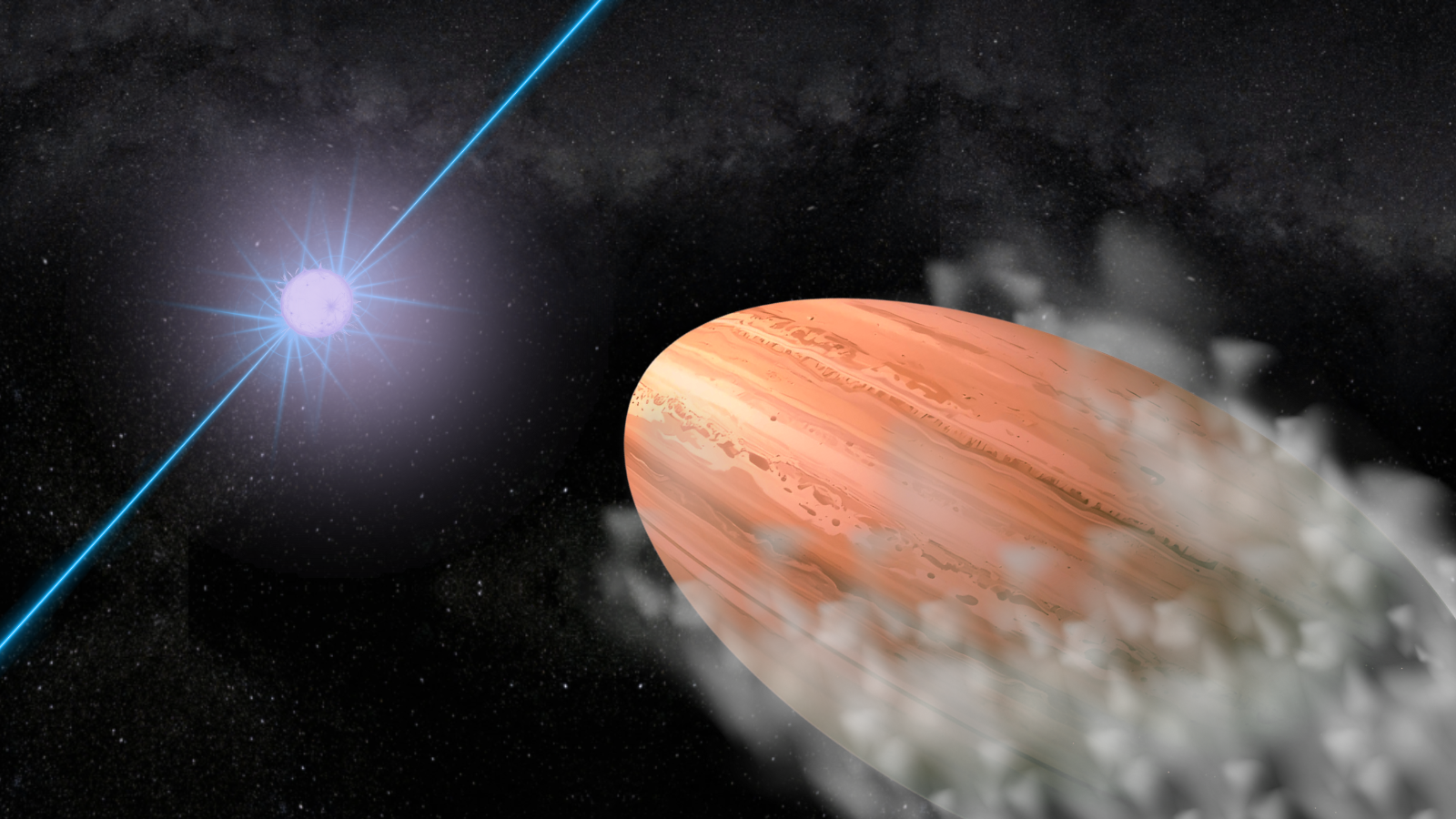
Astronomers using the James Webb Space Telescope have found strong evidence of an atmosphere on a rocky planet so close to its star that its surface is probably molten rock. It is the coolest of these "lava worlds" found so far with signs of an atmosphere, and scientists say it could help pin down the temperature at which rocky planets start holding on to air.
The planet, HD 3167 b, is a super-Earth 154 light-years away in the constellation Pisces. It orbits its star once every Earth day. The study, led by University of Chicago graduate student Brandon Park Coy, was published in The Astrophysical Journal Letters.
The result runs against intuition. A planet that close to its star is blasted by stellar wind and high-energy light, which should strip away any atmosphere. "What's so surprising is that the closer a rocky planet orbits its star, the harder it should be to have an atmosphere," said Edwin Kite, a UChicago associate professor of geophysical sciences and co-author. "But it seems that many of these lava worlds do." Of the more than 6,300 known exoplanets, most are not rocky, and only a handful of rocky ones appear to have atmospheres. Webb has found that most rocky planets around small stars are just bare rock. But five rocky planets with atmospheres have now turned up, and all of them are extremely hot.
The team measured the planet's heat by watching it slip behind its star, an event called a secondary eclipse. The drop in mid-infrared light when the planet disappears shows how much heat the planet itself gives off. A bare rock facing its star should be as hot as physics allows for its distance and how much light it reflects. An atmosphere moves heat from the day side to the night side, the way Venus's thick air keeps its temperature almost even all the way around. Clouds can also bounce starlight away. HD 3167 b's day side is noticeably cooler than the maximum, which the researchers say is strong evidence that it has an atmosphere.
Scientists don't yet know what that atmosphere is made of. They had expected the air on these planets to be vaporized rock. But Coy said there are growing signs that some lava worlds hold heavier gases such as carbon dioxide, carbon monoxide or water. HD 3167 b may have a surface rich in silicates, similar to the minerals in Earth's mantle. The finding is the first from a Webb program led by Megan Weiner Mansfield of the University of Maryland that is studying 10 ultra-hot lava worlds. The program is looking for a critical temperature above which rocky planets start keeping thick atmospheres, perhaps with clouds of rock vapor that reflect starlight and cool the surface. A cooler planet with an atmosphere helps narrow down where that line falls.
The planets are far too hot for life, but they may say something about our own beginnings. Early in the solar system, collisions between growing planets kept young Earth so hot that its whole surface was a magma ocean. "We think early Earth might have looked a lot like a lava world," Coy said. Studying HD 3167 b, he said, offers a window into conditions during Earth's first couple of million years.