UCLA Light-Powered AI Spots Deepfakes With 97.8% Accuracy, Checking 15 Videos at Once
A hybrid digital-optical processor uses light instead of heavy computing to score videos, and it held up at 94.8% on Google Veo 3 fakes it had barely seen.

Engineers at UCLA have built a deepfake detector that does much of its thinking with light. The hybrid digital-optical system analyzed 15 videos at the same time and identified manipulated clips with 97.79% average accuracy, according to a study in the journal eLight.
The work was led by Parnian Ghapandar Kashani, Dr. Shiqi Chen and Professor Aydogan Ozcan, with the UCLA departments of electrical and computer engineering and bioengineering and the California NanoSystems Institute. The team set out to replace the most computationally demanding step in deepfake detection with optics, which can process many inputs in parallel.
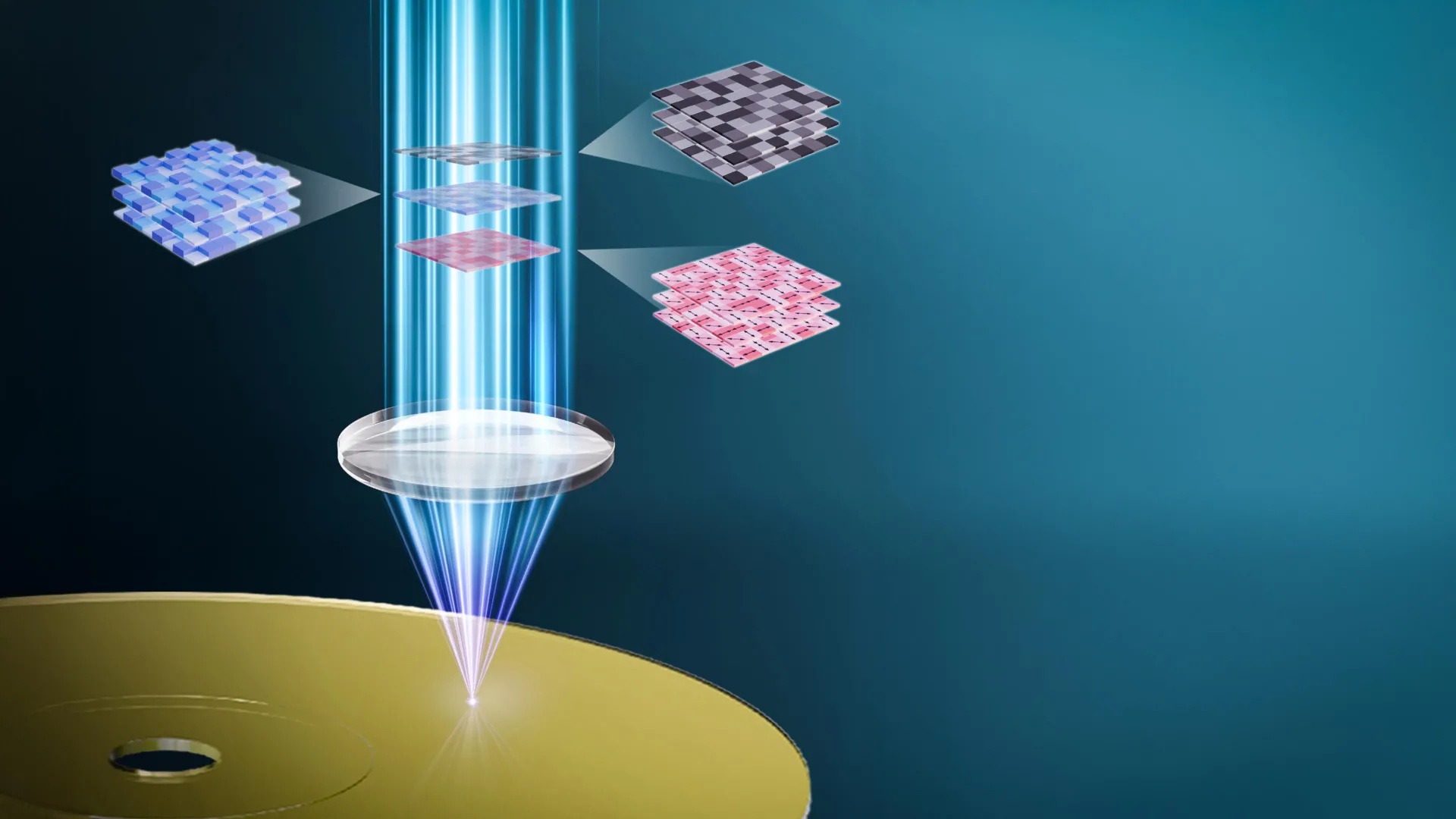
Here is how it works. A lightweight digital encoder first pulls out spatial, spectral and temporal features from each video. Those features are turned into phase patterns shown on a programmable spatial light modulator, a device that shapes a beam of light. The shaped wavefront then travels through a passive optical decoder, a fixed set of optical elements that needs no power to compute. Paired detectors at the end read out an authenticity score for each video.
The numbers are strong. The system had 99.86% sensitivity, meaning it caught nearly every manipulated clip, with a false-negative rate of about 0.14%. Its specificity was 95.72%, which measures how well it correctly cleared genuine videos. When the researchers pushed it to handle 18 videos in a single pass, accuracy fell to 96.13%, showing a trade-off between throughput and precision.
A harder test was videos from a generator the system had not been built around. On deepfakes made with Google's Veo 3, with only minimal fine-tuning, the detector reached 94.80% accuracy. That matters because new video generators keep appearing, and a detector trained on yesterday's fakes often stumbles on tomorrow's.
The researchers point to several advantages beyond speed. The optical decoder needs little energy, which could cut the power bill for scanning large volumes of video. Because the decoder's parameters are physically built into the hardware, they are harder to copy or reverse-engineer. The team also says the design resists adversarial attacks, in which a forger tweaks a video slightly to fool a detector, and can be adapted as new generators emerge.
The system is a laboratory demonstration, not a product. Detection accuracy in a controlled test can drop when the system meets the messy variety of real social media video, with its compression, filters and edits. The authors have not said how soon the technology could move into commercial use.
Even so, the approach points to a different way of fighting synthetic media. Most current detectors run on conventional chips and scale poorly as video volume grows. Using light to run many checks at once could let platforms and newsrooms screen far more content for the same energy cost. With realistic AI video now widely available, the ability to check many clips quickly and cheaply is likely to matter as much as raw accuracy.