Strange New Matter State May Hide Deep Inside Uranus and Neptune
Advanced computer simulations reveal carbon and hydrogen could form exotic "superionic" structures in ice giant interiors, reshaping planetary science understanding.
Deep beneath the surfaces of ice giant planets like Uranus and Neptune, scientists may have discovered a bizarre new state of matter where atoms behave in completely unexpected ways. Advanced computer simulations conducted by Carnegie scientists suggest that carbon and hydrogen under crushing planetary pressures can form a strange hybrid phase that is part solid, part fluid, with profound implications for understanding these distant worlds.
The research, led by Cong Liu and Ronald Cohen at Carnegie Science, used machine-learning enhanced quantum simulations to model conditions ranging from nearly 5 million to 30 million times Earth's atmospheric pressure, combined with temperatures between 6,740 and 10,340 degrees Fahrenheit. These extreme conditions, found deep within ice giant interiors, cannot be replicated in Earth-based laboratories, making computer modeling essential for understanding planetary physics.
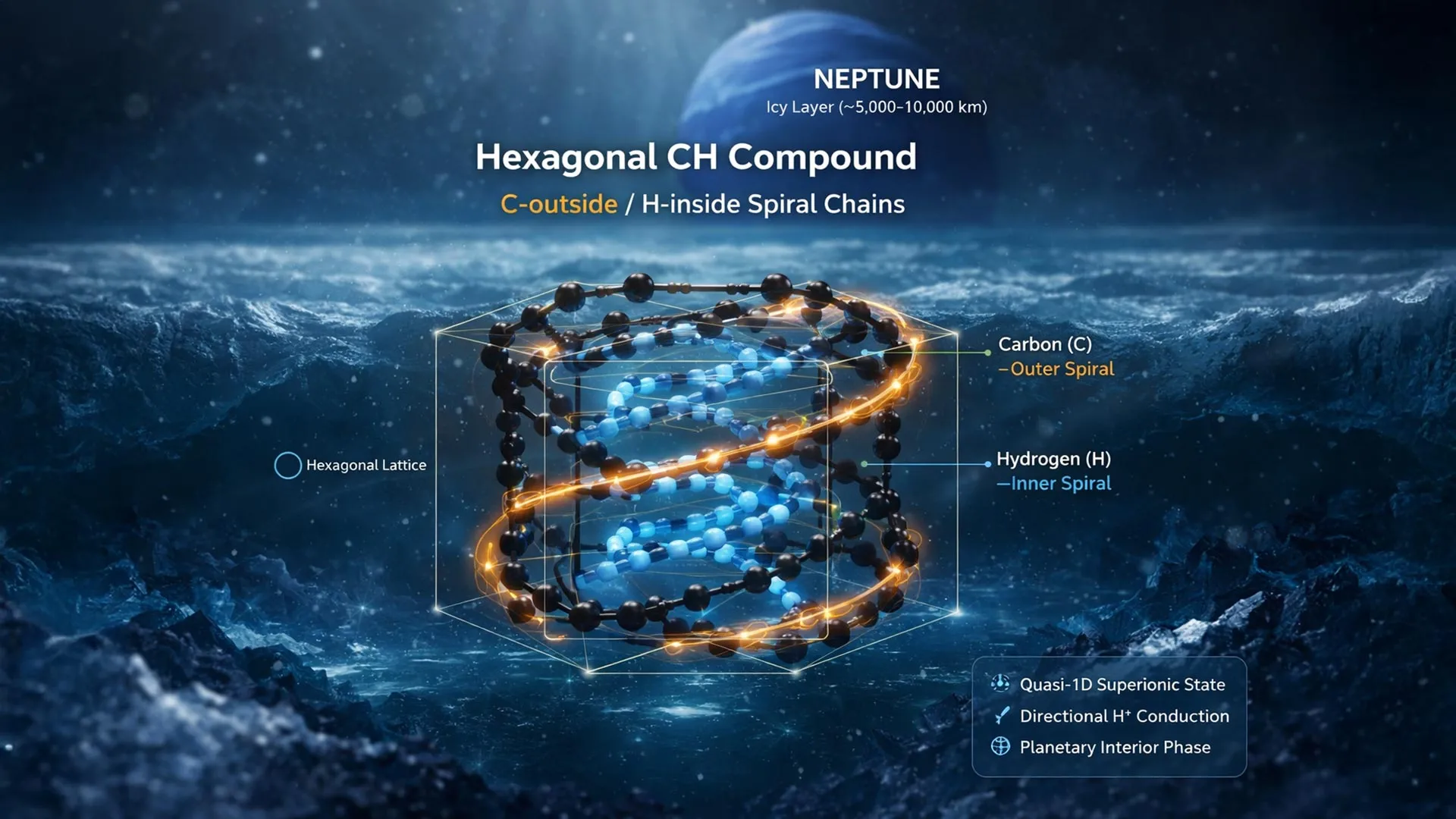
The simulations revealed a striking atomic arrangement where carbon atoms form an ordered hexagonal framework while hydrogen atoms move through it along spiral-like pathways. This creates what scientists call a "quasi-one-dimensional superionic state," where one type of atom remains locked in a crystal structure while another moves freely through it. "This newly predicted carbon-hydrogen phase is particularly striking because the atomic motion is not fully three-dimensional," explained Cohen. "Instead, hydrogen moves preferentially along well-defined helical pathways embedded within an ordered carbon structure."
This unusual state of matter could fundamentally alter how heat and electricity flow within ice giant planets, potentially explaining their mysterious magnetic fields. Unlike Earth's relatively simple magnetic field generated by liquid iron in its core, Uranus and Neptune have complex, tilted magnetic fields that have puzzled scientists for decades. The directional movement of charged hydrogen atoms in superionic structures could create the electrical currents necessary to generate these unusual magnetic configurations.
The findings also have broader implications for understanding the more than 6,000 known exoplanets, many of which are believed to be ice giants similar to Uranus and Neptune. By combining astronomical observations with advanced theoretical modeling, scientists are building a more complete picture of how planets form and evolve throughout the universe. The discovery of superionic states in planetary interiors represents a significant step forward in planetary science, revealing that even familiar chemical compounds can behave in extraordinary ways under extreme conditions.