Scientists Discover Bizarre New Matter State Hidden Inside Uranus and Neptune
Advanced simulations reveal carbon and hydrogen forming a strange hybrid phase where atoms behave part solid, part fluid under crushing planetary pressures.
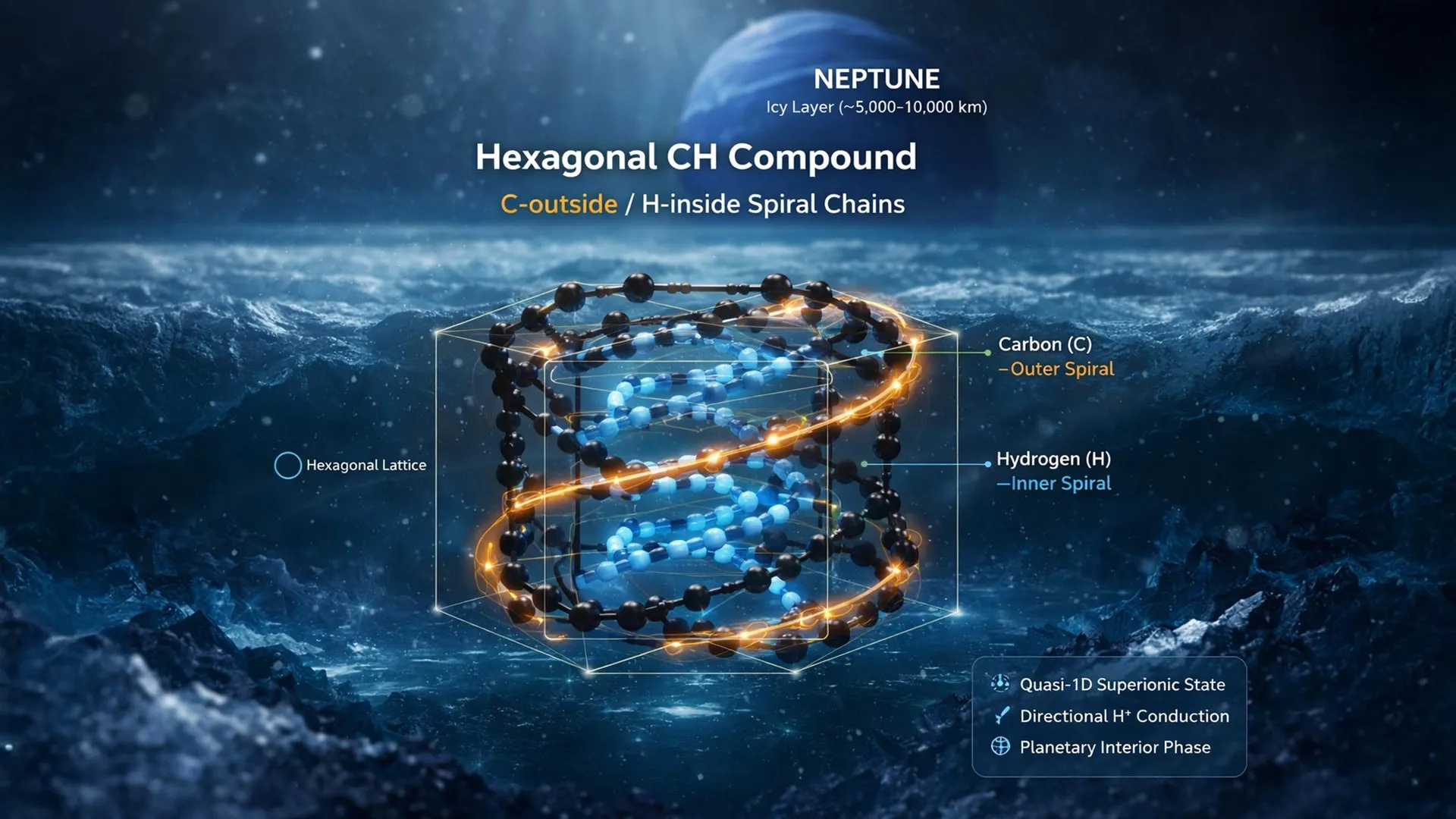
Deep inside the ice giant planets Uranus and Neptune, scientists have discovered evidence of a previously unknown state of matter where atoms behave in ways that challenge conventional understanding of physics. Using advanced computer simulations, researchers from Carnegie Science found that carbon and hydrogen can form an unusual "superionic" structure under the extreme pressures and temperatures found in these distant worlds' interiors. This breakthrough discovery could fundamentally reshape how scientists understand planetary formation and the mysterious magnetic fields of ice giants.
The research team, led by Cong Liu and Ronald Cohen at Carnegie Science, used high-performance computing and machine-learning tools to simulate conditions ranging from nearly 5 million to 30 million times Earth's atmospheric pressure. Under these crushing forces, combined with temperatures between 6,740 and 10,340 degrees Fahrenheit, carbon hydride transforms into a remarkable quasi-one-dimensional superionic state. In this exotic form of matter, carbon atoms lock into an ordered hexagonal framework while hydrogen atoms spiral through it along helical pathways, creating a material that behaves partly like a solid and partly like a liquid.
This superionic behavior represents a fundamental departure from normal matter states, where atoms typically remain either fixed in crystal structures or move freely as in liquids and gases. The discovery emerged from detailed quantum simulations that modeled how individual atoms interact under the extreme conditions found more than 6,000 miles beneath the surfaces of Uranus and Neptune. These conditions exist in the "hot ice" layers that comprise much of these planets' interiors, regions previously thought to contain conventional forms of water, methane, and ammonia.
The implications extend far beyond planetary science, potentially explaining the unusual magnetic fields of ice giants that have puzzled researchers for decades. Unlike Earth's relatively orderly magnetic field, Uranus and Neptune exhibit complex, tilted magnetic fields that don't align with their rotation axes. The directional movement of hydrogen atoms through the carbon framework could create unique electrical conductivity patterns that generate these mysterious magnetic phenomena. Cohen explained that this atomic motion is "not fully three-dimensional" but instead follows "well-defined helical pathways embedded within an ordered carbon structure."
This discovery opens new frontiers in materials science and planetary formation theory, as researchers now recognize that exotic states of matter may be common throughout the universe. With more than 6,000 exoplanets discovered so far, understanding how materials behave under extreme conditions becomes crucial for interpreting observations of distant worlds. The findings also suggest that similar superionic states might exist in other planetary environments, potentially affecting everything from heat transport to magnetic field generation across numerous celestial bodies throughout the cosmos.