Scientists Discover Bizarre Hybrid Matter Inside Uranus and Neptune
Deep inside ice giant planets, carbon and hydrogen atoms form an unusual 'superionic' state where hydrogen spirals through rigid carbon frameworks. The discovery could explain these worlds' mysterious magnetic fields.

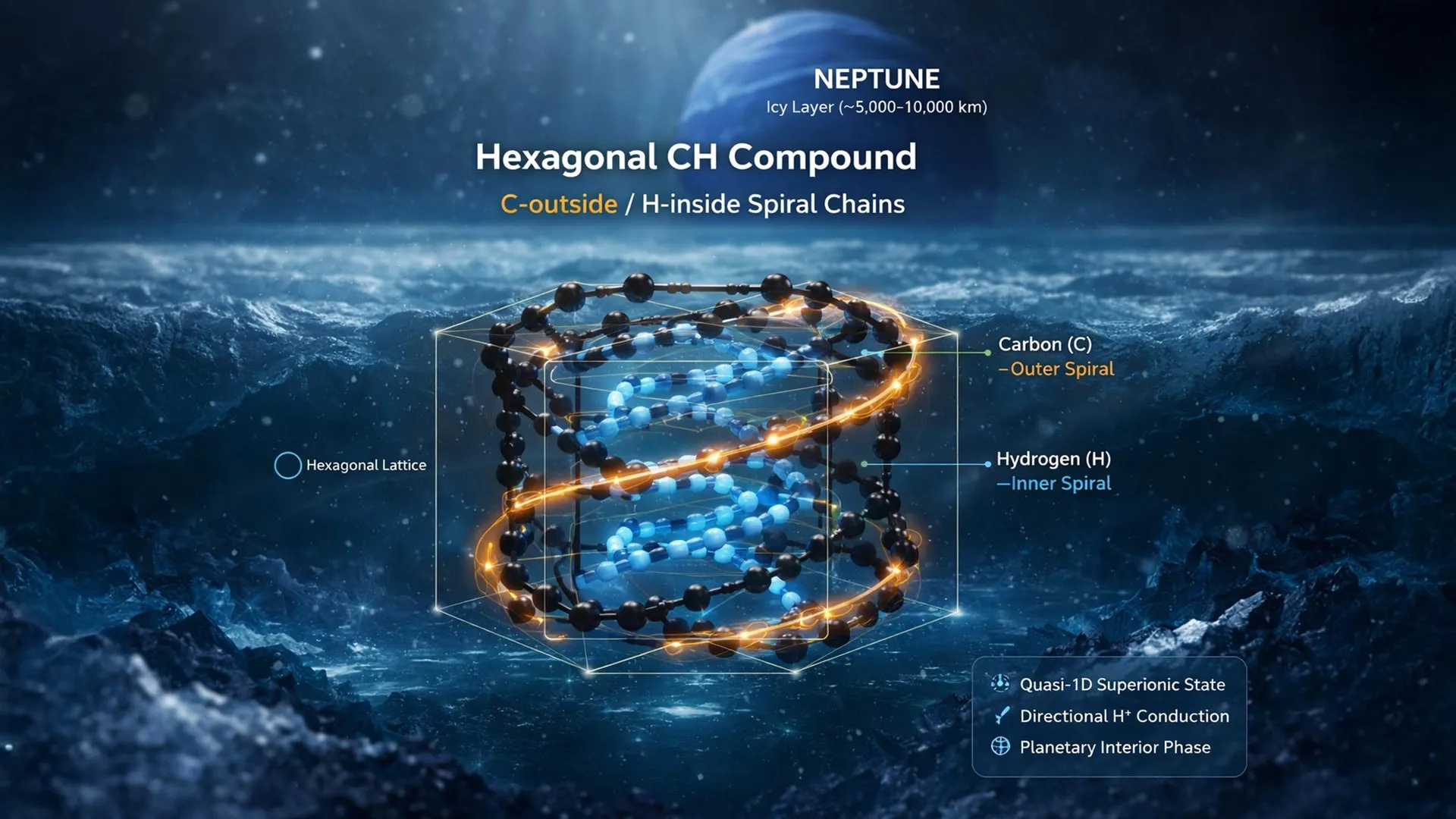
Scientists have uncovered evidence of a previously unknown state of matter that may exist deep within the ice giant planets Uranus and Neptune. Using advanced computer simulations, researchers from Carnegie Science have identified a bizarre hybrid phase where carbon and hydrogen atoms behave in ways that challenge conventional understanding of matter. Under the crushing pressures and scorching temperatures found in these distant worlds' interiors, these elements form what scientists call a 'superionic' state—part solid, part fluid—where hydrogen atoms move through a rigid carbon framework in spiral patterns.
The research, conducted by Carnegie scientists Cong Liu and Ronald Cohen, employed quantum simulations to model conditions ranging from nearly 5 million to nearly 30 million times Earth's atmospheric pressure, with temperatures between 6,740 and 10,340 degrees Fahrenheit. These extreme conditions exist in the 'hot ice' layers that sit beneath the hydrogen and helium atmospheres of Uranus and Neptune, above their solid cores. The simulations revealed that carbon atoms form an ordered hexagonal framework while hydrogen atoms travel through it along helical pathways, creating a quasi-one-dimensional superionic structure.
This unusual atomic behavior could provide crucial insights into the mysterious properties of ice giant planets. Scientists have long struggled to explain the irregular magnetic fields observed around Uranus and Neptune, which differ significantly from the more predictable magnetic fields of gas giants like Jupiter and Saturn. The directional movement of hydrogen atoms in the newly discovered superionic state could influence how heat and electricity flow through these planets' interiors, potentially contributing to their unique magnetic characteristics.
The discovery has broader implications for understanding planetary formation and evolution throughout the universe. With more than 6,000 exoplanets discovered so far, many of which are likely ice giants similar to Uranus and Neptune, this research provides valuable insights into the internal processes that shape these distant worlds. The findings also demonstrate how extreme conditions can produce exotic states of matter that don't exist naturally on Earth, expanding our understanding of physics and materials science.
Superionic materials represent a fascinating category of matter where some atoms remain locked in crystal structures while others move freely, combining properties of both solids and liquids. Cohen emphasized the significance of the directional hydrogen movement, noting that 'this newly predicted carbon-hydrogen phase is particularly striking because the atomic motion is not fully three-dimensional.' The research opens new avenues for studying how materials behave under extreme conditions and could inform future space exploration missions to the outer solar system.