Scientists Discover Bizarre New Matter State Hidden Inside Ice Giant Planets
Advanced simulations reveal carbon and hydrogen can form a strange hybrid phase under crushing pressures inside Uranus and Neptune, potentially explaining their mysterious magnetic fields.
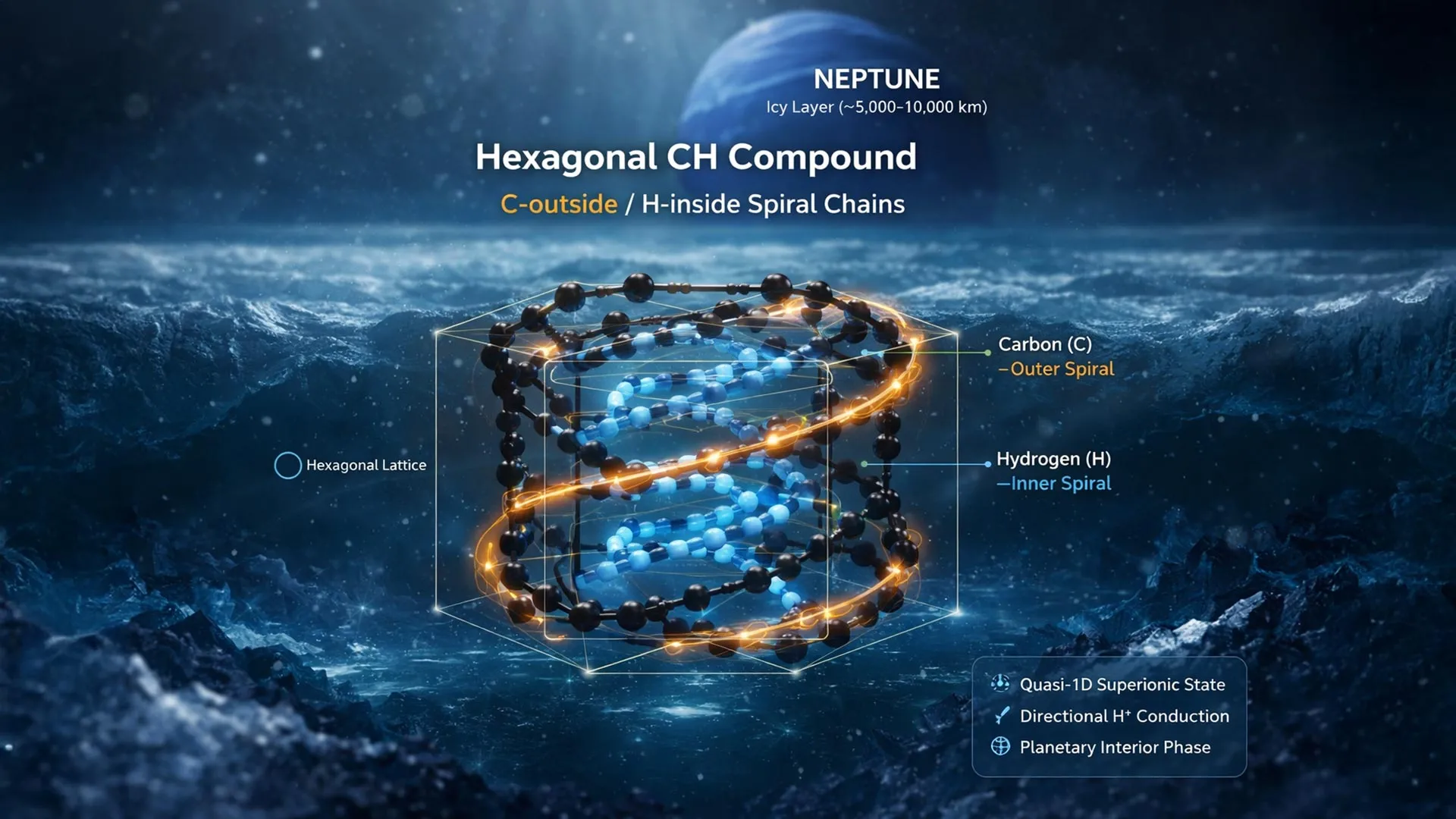
Deep inside planets like Uranus and Neptune, scientists may have uncovered a bizarre new state of matter where atoms behave in completely unexpected ways. Advanced computer simulations conducted by Carnegie scientists Cong Liu and Ronald Cohen suggest that carbon hydride could take on an unusual quasi-one-dimensional superionic state under the crushing pressures and scorching temperatures found far beneath the surfaces of these distant ice giant worlds.
The research, published in Nature Communications, reveals that carbon atoms can form an ordered hexagonal framework while hydrogen atoms move through it along spiral-like paths. This creates what scientists call a superionic material, which behaves partly like a solid and partly like a liquid. One type of atom remains locked in place within a crystal structure, while another type moves freely through it in helical pathways.
The team used high-performance computing and machine-learning tools to run detailed quantum simulations of carbon hydride under extreme conditions. They modeled pressures ranging from nearly 5 million to nearly 30 million times Earth's atmospheric pressure, combined with temperatures between 6,740 and 10,340 degrees Fahrenheit. These conditions mirror what exists in the "hot ice" layers that scientists believe make up much of the interior of ice giant planets.
"This newly predicted carbon-hydrogen phase is particularly striking because the atomic motion is not fully three-dimensional," explained Ronald Cohen, the study's co-senior author. "Instead, hydrogen moves preferentially along well-defined helical pathways embedded within an ordered carbon structure." This directional movement of hydrogen atoms could significantly affect how heat and electricity flow through the planet's interior.
The discovery could help explain some of the mysterious properties of Uranus and Neptune, particularly their unusual magnetic fields. The directional flow of charged hydrogen atoms through the carbon framework could generate electrical currents that contribute to these planets' magnetic field generation. More broadly, this research demonstrates how extreme conditions in planetary interiors can create exotic forms of matter that don't exist anywhere on Earth, expanding our understanding of both planetary science and fundamental physics.