Something the Size of a Six-Story Building Hit the Moon in Spring 2024 and Nobody on Earth Saw It. NASA's Orbiter Found the 728-Foot Crater a Year Later. It's the Biggest New Crater Ever Recorded, a Once-in-132-Years Event.
An Intuitive Machines image specialist spotted the fresh scar on Oct. 24, 2025, and 'dropped everything.' The blast churned the surface over 66 miles and left a 4-mile cold spot. The IAU has named it McGetchin.
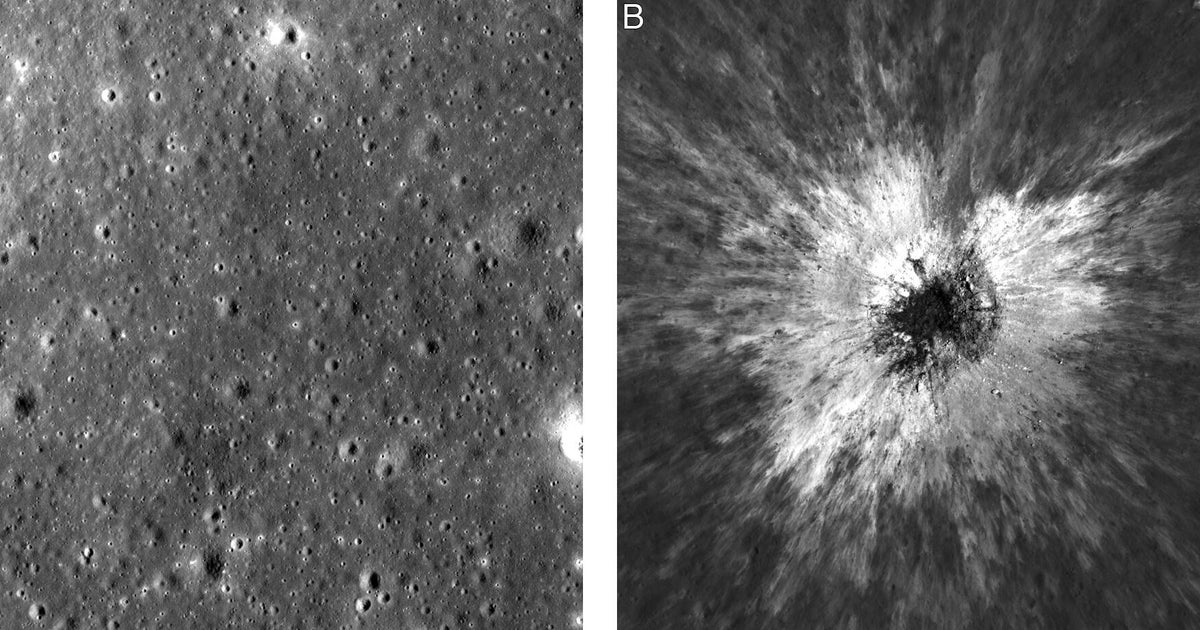
NASA's Lunar Reconnaissance Orbiter has found the largest freshly made crater ever documented anywhere in the solar system: a hole 728 feet across and up to 141 feet deep, gouged out of the Moon's eastern limb by an asteroid or comet fragment sometime between April 11 and May 22, 2024. No telescope on Earth or in space caught the impact as it happened. Two studies describing the crater were published Wednesday in Science Advances.
The crater is roughly the length of two football fields, deep enough to stack three school buses, and three times wider than the previous record-holder for a new lunar crater, which the same orbiter identified about a decade ago. The object that made it was three to six stories tall. Scientists estimate an impact of this size happens on the Moon about once every 132 years, and they wrote that the event "constitutes a statistically rare, effectively once-in-a-lifetime observation."
It was found by accident. Robert Wagner, an image-processing specialist at Intuitive Machines, was working through routine Lunar Reconnaissance Orbiter Camera data on Oct. 24, 2025, when he noticed a bright new scar in a region the spacecraft had photographed many times before. "I just stopped, dropped everything, and started looking into what that spot was," Wagner said. The team then pulled before-and-after images from the orbiter's wide-angle and narrow-angle cameras to bracket the impact date, gathered detailed images through the fall of 2025, and confirmed the discovery early this year. The International Astronomical Union has named the crater McGetchin, after Thomas McGetchin, a lunar scientist who directed the Lunar and Planetary Institute in Houston.
The impact did far more than punch a hole. Ejecta disturbed the surface over a radius of about 66 miles, and the orbiter's Diviner thermal instrument found a 4-mile-wide "cold spot" surrounding the crater, about 16 degrees Fahrenheit cooler than the neighboring terrain at night. The blast fluffed up the regolith, the Moon's powdery topsoil, so that it holds less heat. Mark Robinson of Intuitive Machines, the chief scientist for the orbiter's cameras and lead author of the main study, and co-author David Paige of UCLA describe such impacts as "gardening the regolith." The second study uses the orbiter's record of more than 1,000 new craters and 100,000 surface changes over 17 years, roughly 140 small craters a year, to estimate that the Moon's top layer of soil is completely overturned about every 80,000 years, faster than earlier models suggested.
The find matters beyond bookkeeping. NASA plans to land astronauts near the lunar south pole later this decade and eventually build a permanent base there, and the rate at which building-sized rocks arrive is a direct input to how much shielding those habitats need. It also means the Moon offers a pristine laboratory for impact physics: McGetchin is being studied before micrometeorites and solar wind have had time to weather it, something no crater on Earth, where erosion and vegetation erase the evidence within centuries, can provide.
Earth is hit by objects of the same size class more often than the Moon, since it is a bigger target with more gravity, but its atmosphere breaks most of them up before they reach the ground. The 2013 Chelyabinsk meteor was about 60 feet across and still injured 1,500 people with its shock wave. The rock that carved McGetchin was several times larger, and on a world with no air to slow it, it arrived intact.
Originally reported by CBS News / AP.