Physicists Film Electrons Making Seemingly Impossible Quantum Jumps in Graphene
A German team watched electrons leap across a forbidden energy gap with up to 100 percent probability when hit with intense light, in a study published in Nature.
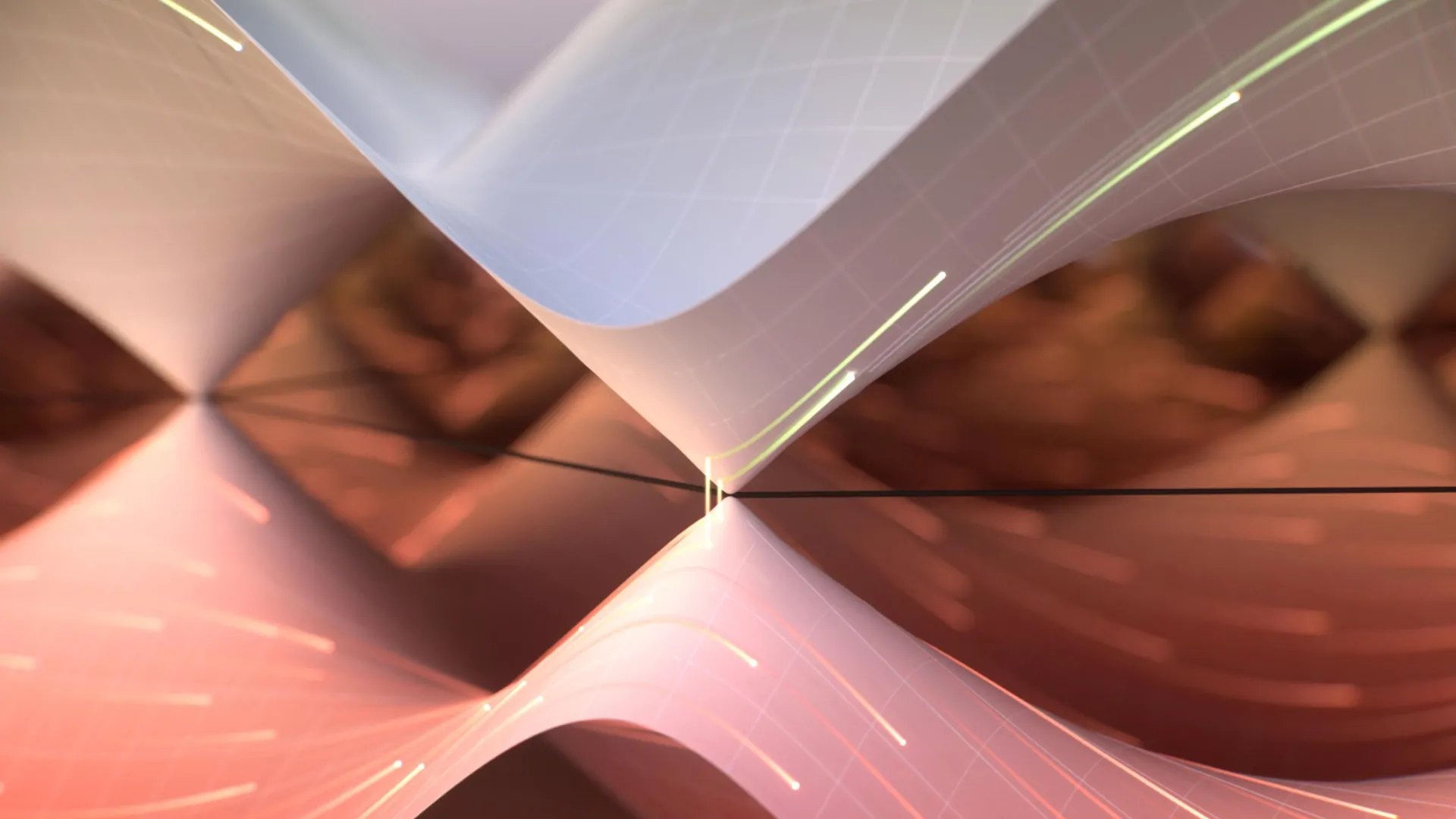
Physicists in Germany have captured what amounts to a movie of electrons jumping across an energy gap in graphene, a quantum leap that classical intuition says should not happen so easily.
The work, published in Nature under the title "Subcycle videography of Landau-Zener-Majorana transitions in graphene," comes from researchers at the University of Regensburg, Philipps-Universität Marburg and Forschungszentrum Jülich. It was released through a Jülich press statement this week.
The effect they filmed is called a Landau-Zener-Majorana transition. When an intense pulse of light drives an electric field through graphene, it accelerates electrons, and some of them switch from one energy band to another by crossing the gap between them. The team found that under sufficiently strong light fields, the probability of the jump reached 100 percent. One analogy from the researchers is an elevator that goes from floor 3 to floor 20, skipping the 17 floors in between.
The jump differs from ordinary quantum tunneling through a physical barrier. It depends on how quickly the electrons approach the gap, which means the speed of the light-driven acceleration controls what happens. The researchers also saw that the electrons start out moving in an orderly way, but interactions with the crystal lattice gradually disrupt that motion.
To see all this, the team combined advanced laser technology with a photoemission momentum microscope, an instrument that measures the energies and motion of electrons and maps how they are distributed across energy states. The samples were ultra-pure, single-atom-thick graphene made at Jülich, including rotated graphene, which made the quantum dynamics easier to read.
First author Vincent Eggers explained why watching many electrons at once matters: "If you want to know who has won a race, you have to watch all participants." Giacomo Inzani of Regensburg said the experiment "opens a panoramic window into the quantum world." Stefan Tautz of Jülich stressed the material itself: "These precision experiments require material that is nearly perfect at the atomic level." Rupert Huber and Ulrich Höfer are among the paper's authors.
The researchers say the approach could help develop ultrafast electronics controlled by light rather than by conventional electrical signals, and that it could be applied to other quantum materials. Electronics that switch on the timescale of light waves would operate far faster than today's chips, though building a practical device from this effect is still a long way off.
For now the result is a measurement milestone. Quantum jumps are usually inferred from before-and-after snapshots. Here the team resolved the transition within a single cycle of the light wave, giving physicists a direct look at how electrons behave when pushed hard enough to leap an energy gap in one go.


