Northwestern Physicists Flip Antiferromagnets With Current in a Newly Found Effect
The 'octupole-driven spin-transfer torque,' reported in Nature, lets electricity write data into magnetic layers at room temperature, a possible route to denser, more robust memory.

Physicists at Northwestern University have found an unexpected way to switch the magnetic state of a class of materials that was thought to be immune to the technique, opening a possible path to faster and more robust computer memory. The work was published in Nature.
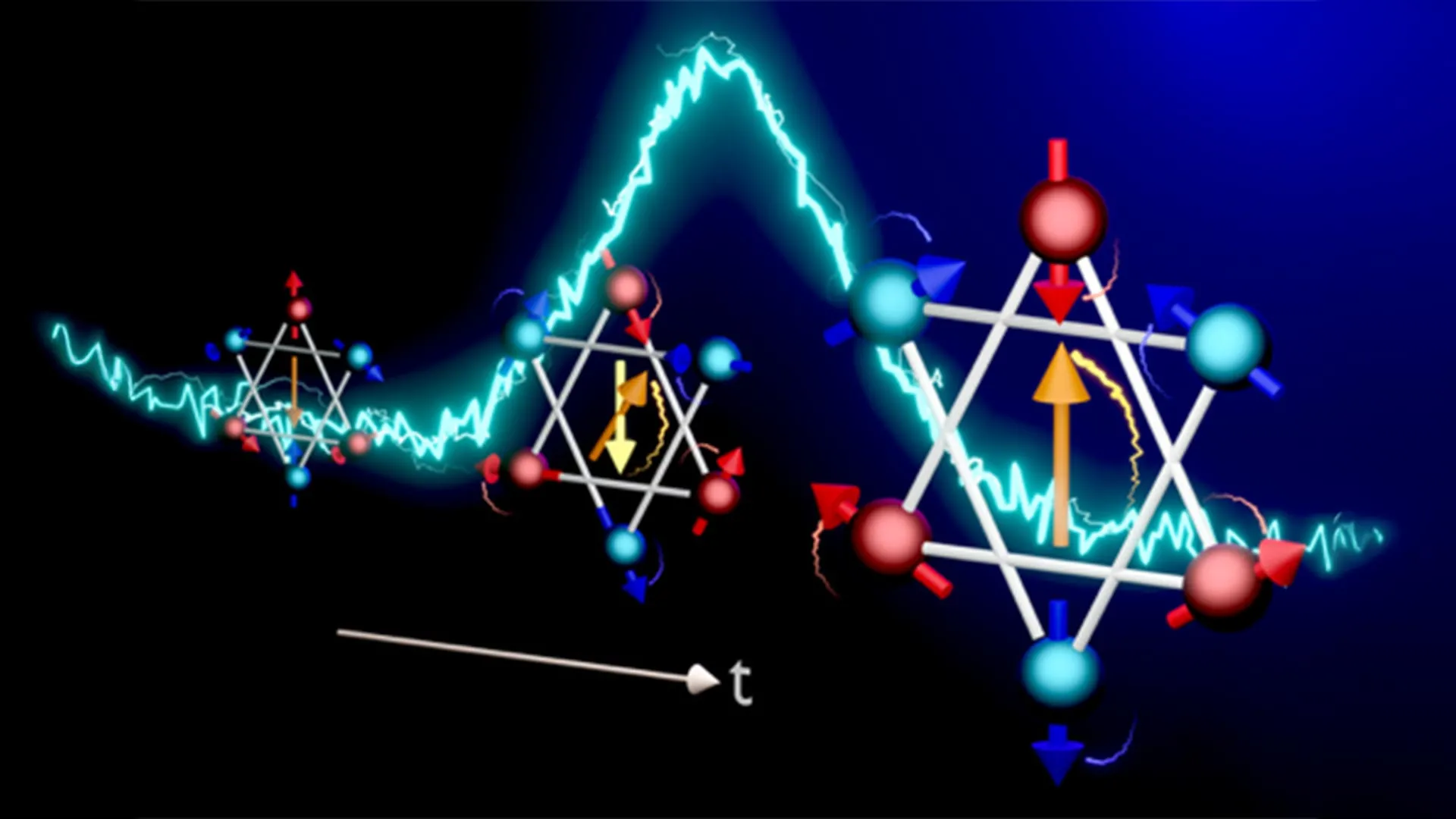
The team, led by Pedram Khalili of Northwestern Engineering, discovered what it calls octupole-driven spin-transfer torque, or OTT. The effect lets an electric current manipulate the magnetic state of noncollinear antiferromagnets. The researchers demonstrated it at room temperature in nanoscale devices built from two antiferromagnetic layers separated by a thin insulating barrier, a structure they call an all-antiferromagnetic tunnel junction.
Modern spintronics uses the spin of electrons, not just their charge, to store and read information. Most devices rely on ferromagnets such as iron, cobalt and nickel, in which spins line up in the same direction and produce a net magnetization with north and south poles. That also means a nearby magnetic field can corrupt the stored data. In antiferromagnets, neighboring spins point in opposite directions and cancel out, so the material has no net magnetization even though its spins are highly ordered. "If you store information in a ferromagnet, a large enough magnetic field nearby can destroy the information," Khalili said. "None of that would happen with antiferromagnets." He pointed to devices such as smartwatches, where magnetic wristbands or connectors create stray fields.
Conventional thinking held that antiferromagnets should not respond to spin-transfer torque, which depends on currents whose spins have a net alignment. "The conventional wisdom was that you should not have spin-transfer torque or giant or tunneling magnetoresistance with these sorts of materials," Khalili said. "And this is basically what we show is not true."
The devices showed two effects. One is a large tunneling magnetoresistance at room temperature, which lets the junction's magnetic state be read electrically. The other is OTT, in which current passing through one antiferromagnet exerts a torque on another and switches it, which writes information. "You can make a tunnel junction with very large tunneling magnetoresistance at room temperature, as large as with ferromagnets, and you can use a current to exert a torque on another antiferromagnet and switch it," Khalili said.
The switching is governed by the material's magnetic octupole, a quantity that describes the more complex spin arrangement in these crystals, rather than by net spin polarization. "We report the first experimental observation, but this torque was really something that had not even been theoretically predicted before," Khalili said. The paper also offers a new theoretical framework to explain it.
Antiferromagnets can also respond on much shorter timescales than ferromagnets, with dynamics that can reach terahertz frequencies instead of gigahertz. Khalili said the effect "could lead to higher-density, more reliable memories, which are very important for applications like AI." The work is a laboratory demonstration of reading and writing in a single junction, not a finished memory chip.