University of Tokyo Scientists Film Electron Spins Flipping Inside an Antiferromagnet in 140 Trillionths of a Second — Revealing Two Hidden Mechanisms
Professor Ryo Shimano's team used ultrafast laser pulses to capture frame-by-frame footage of magnetic switching in manganese-tin — a material that had been almost entirely invisible to physicists — and discovered a heat-free switching pathway that could enable magnetic memory and logic ten times faster than today's best MRAM chips.

Scientists at the University of Tokyo have done something physicists once considered nearly impossible: they directly filmed, frame by frame, the process by which electron spins flip direction inside an antiferromagnet — one of the most challenging classes of magnetic materials to observe. The experiment, led by Professor Ryo Shimano of the University of Tokyo School of Science and published in Nature Materials, used ultrafast electrical pulses and precisely timed laser flashes to capture the switching process in manganese-tin (Mn₃Sn) with a time resolution of 140 picoseconds — 140 trillionths of a second — and in doing so discovered two fundamentally different switching mechanisms, one of which offers a practical roadmap to the next generation of magnetic memory and computing devices.
Antiferromagnets are materials in which neighboring atoms carry magnetic moments pointing in exactly opposite directions, so that the overall magnetic field of the material cancels out to zero. This near-invisibility to conventional magnetic instruments is precisely why antiferromagnets were largely ignored by the spintronics industry for decades, while engineers focused instead on ferromagnets whose fields could be easily detected and manipulated. But antiferromagnets carry a tantalizing advantage: their internal magnetic structure can switch states thousands of times faster than ferromagnets, without the magnetic noise and susceptibility to stray fields that limit ferromagnetic devices. The challenge was that without being able to observe what was actually happening during the switching process, engineers had no way to design devices around it. Shimano's team has now removed that obstacle.
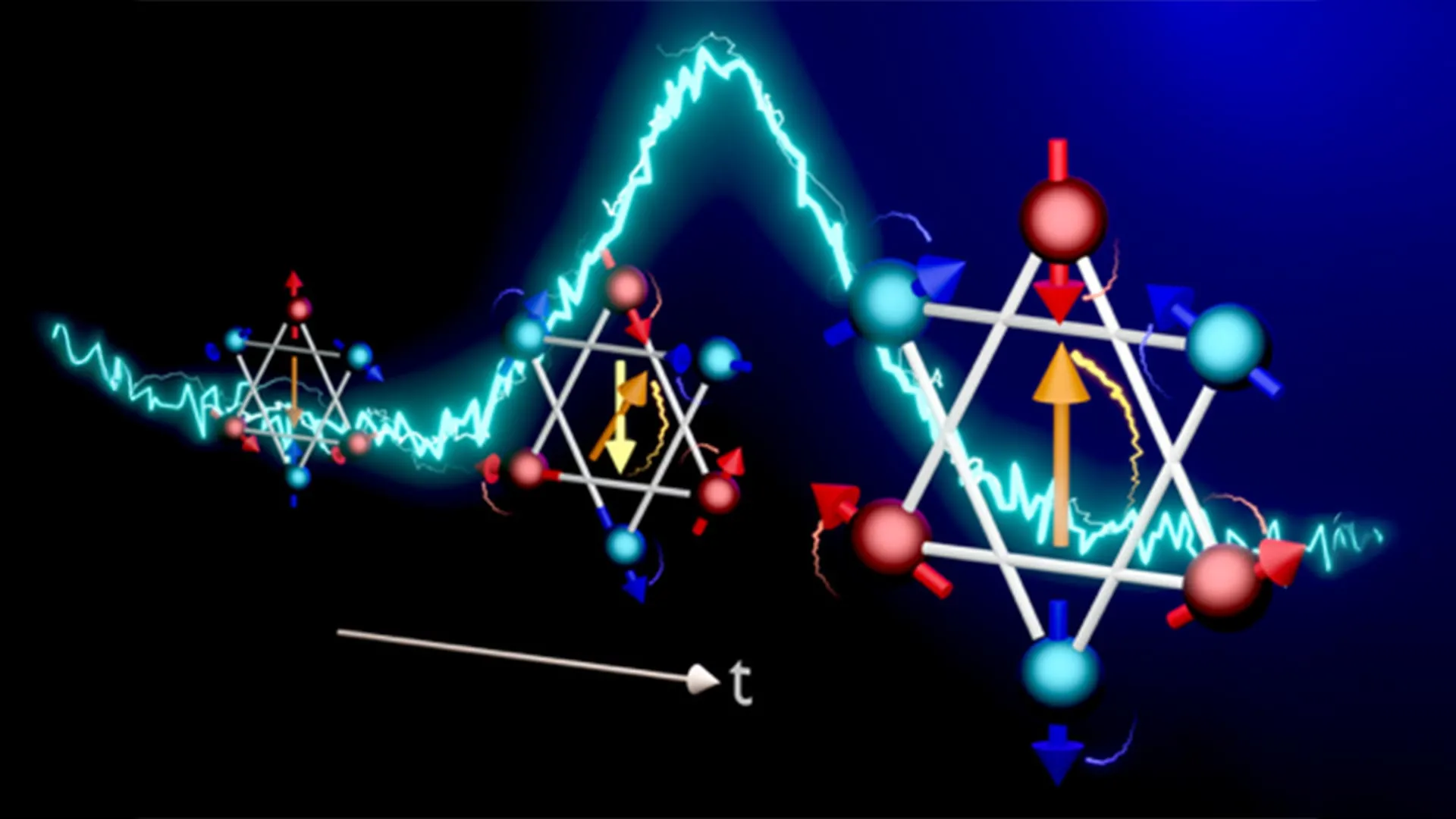
The experimental method the Tokyo team developed is called ultrafast time-resolved optical spectroscopy. They applied brief nanosecond electrical current pulses to a thin film of Mn₃Sn while simultaneously illuminating the sample with precisely timed femtosecond laser flashes. By varying the delay between the current pulse and the light pulse, they captured snapshots of the material's magnetic state at different moments in the switching process — essentially creating a slow-motion movie of a phenomenon that unfolds in less than a millisecond. Mn₃Sn, which has a Kagome-lattice crystal structure of manganese atoms arranged in interlocking triangles, was chosen because its unusual magnetic octupole structure produces a large anomalous Hall effect that makes its state detectable via the polarization of reflected light — a key prerequisite for optical observation.
The most significant finding was the discovery of two distinct switching pathways. In the first, which the team calls "thermal switching," large electrical currents heat the material above its magnetic transition temperature, scrambling the spin order and allowing it to re-solidify in a new configuration when the material cools — essentially melting and re-freezing the magnetic structure. In the second mechanism, observed at lower current densities, the spins flipped with "little to no heating involved," as Shimano described it — a direct interaction between the electrical current and the magnetic structure that circumvents the energy-expensive thermal route entirely. This non-thermal pathway was the key surprise: it is not only more energy-efficient but, the team believes, potentially faster still.
The practical implications are significant. Non-thermal antiferromagnetic switching at 140 picoseconds is already roughly 10 times faster than the fastest commercial magnetic memory technology currently available — MRAM — and the research suggests that the material itself could switch even faster if shorter current pulses were applied. Shimano's group plans to push toward single-digit picosecond switching using optimized device geometries, which would put antiferromagnetic memory speed in the same range as the fastest semiconductor transistors ever built. Combined with antiferromagnets' inherent immunity to external magnetic fields and their zero net magnetization — which means they do not interfere with neighboring memory cells — these findings could eventually form the foundation of spintronic logic and memory that outperforms silicon in both speed and energy efficiency, a potential breakthrough for data centers, AI accelerators, and next-generation computing architectures.