Electrons in Carbon Nanotubes Move as a Crowd, Not as Lone Particles
Researchers in Lithuania, Finland and Israel report that a many-body quantum model explains nanotube networks better than the classical picture used for ordinary metals.

Electrons racing through carbon nanotubes do not behave like independent little balls. They feel one another, and describing them correctly takes a quantum theory built for particles confined to a single line, according to a study by scientists in Lithuania, Finland and Israel.
The team reports that its measurements are described more accurately by the Luttinger liquid model, developed for one-dimensional electron systems, than by the classical Drude model that physics students use to explain how metals conduct. The researchers say it is the first time that has been demonstrated for such material. The paper appears in ACS Applied Materials & Interfaces, where it was featured on one of the journal's covers.
Carbon nanotubes are hollow cylinders whose walls are a single atom of carbon thick. They are roughly 20,000 to 30,000 times thinner than a human hair. Their electrical behavior depends on how the carbon lattice is oriented, so different tubes can act differently. Woven into networks, they form a featherweight, sponge-like material that ranges from grayish to nearly black depending on its thickness.
The Drude picture treats electrons in a metal as particles that interact only weakly with each other, and it works well for many conventional materials. Nanotubes are different. Electrons can travel only through extremely narrow channels, and in a network they are constantly passing from one tube to the next.
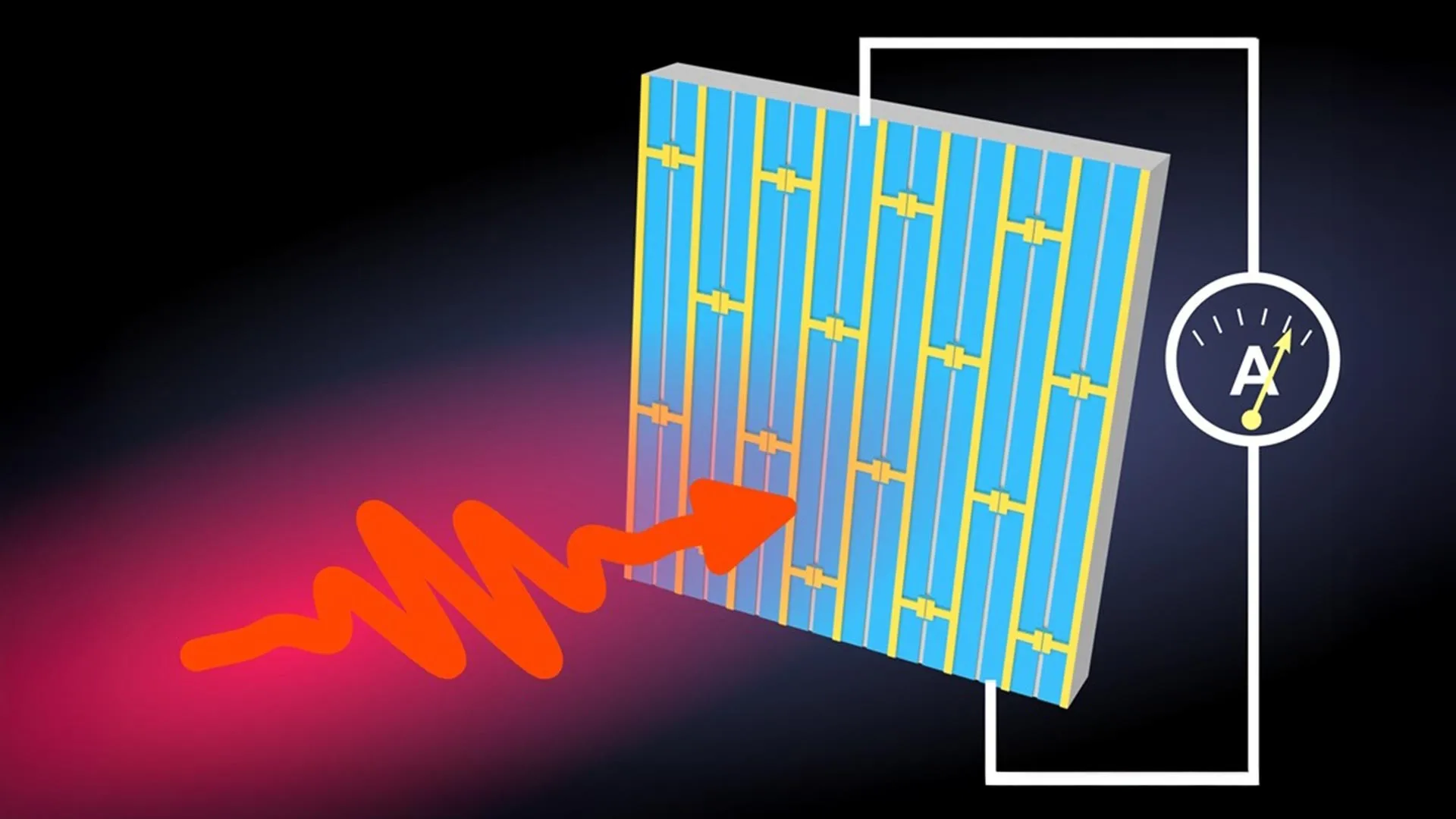
To probe that behavior, the researchers illuminated the material across a wide range of frequencies, from ultraviolet and visible light to infrared and terahertz radiation, which lies between microwaves and infrared. The electrons did not act independently, and the character of their interactions changed with frequency.
"It became clear that in these systems electrons are not entirely independent of one another," said Irmantas Kasalynas, head of the Terahertz Photonics Laboratory at Lithuania's Center for Physical Sciences and Technology. The motion of each particle is influenced by those around it, he explained, so the electrons constantly sense one another.
The result has practical stakes. Nanotube films can conduct electricity while remaining flexible and transparent, which makes them candidates for electrodes in displays, sensors and wearable electronics. Kasalynas's laboratory is especially interested in terahertz sensors that rely on plasmons, collective ripples of electrons that strengthen the interaction between radiation and a material. Such devices could identify substances available only in tiny amounts, including biological molecules and nucleic acids. The group is currently testing lactose and sucrose with samples smaller than a drop of liquid.
A better model lets engineers predict how plasmons will form in nanotubes and how sensitive future sensors might be, the researchers say. It also helps estimate the highest conductivity that nanotube materials could ultimately reach.
Getting clean results depends on high-quality material. Short, tangled or impure tubes introduce effects that muddy the measurements, which is why the Lithuanian group relies on nanotubes produced by partners at Aalto University in Finland. Longer tubes with fewer defects make the underlying physics easier to see.