Scientists Connect 'Time Crystal' to Real Device for First Time in Quantum Breakthrough
Researchers at Aalto University successfully linked a time crystal to an external mechanical oscillator, opening doors to revolutionary quantum technologies and ultra-precise sensors.
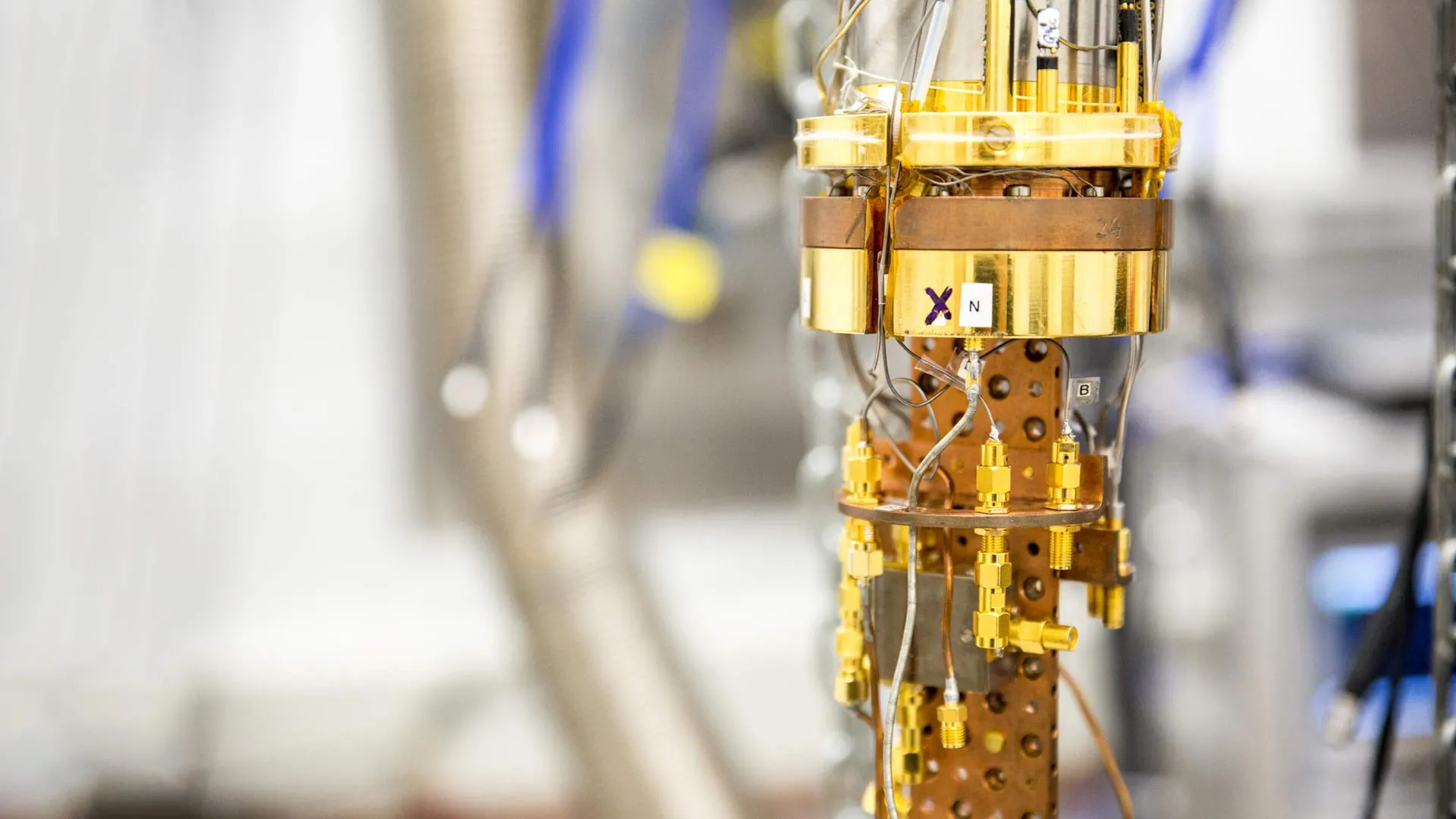
Scientists have achieved a major milestone in quantum physics by successfully connecting a time crystal to an external device for the first time, potentially revolutionizing quantum computing and precision sensing technologies. Researchers at Aalto University's Department of Applied Physics demonstrated how these exotic quantum systems, which maintain perpetual motion without external energy input, can be controlled and manipulated for practical applications.
Time crystals represent one of the most unusual forms of matter in physics, exhibiting constant, repeating motion while existing in their lowest energy state. First proposed by Nobel Prize-winning physicist Frank Wilczek in 2012 and experimentally confirmed in 2016, these quantum systems organize themselves into repeating patterns that continue indefinitely without requiring energy from outside sources. The research team, led by Academy Research Fellow Jere Mäkinen, successfully converted a time crystal into an optomechanical system by linking it to a tiny mechanical oscillator.
The breakthrough required overcoming a fundamental challenge in quantum physics: time crystals can only maintain their perpetual motion when undisturbed by external interactions. "Perpetual motion is possible in the quantum realm so long as it is not disturbed by external energy input, such as by observing it," Mäkinen explained. "That is why a time crystal had never before been connected to any external system. But we did just that and showed, also for the first time, that you can adjust the crystal's properties using this method."
To create their time crystal, the researchers used radio waves to inject magnons into a Helium-3 superfluid cooled to temperatures near absolute zero. Magnons are quasiparticles that behave as individual particles despite being groups of particles. Once the radio wave input was switched off, the magnons organized themselves into a time crystal that continued its motion for up to 108 cycles or several minutes before fading to unmeasurable levels. As the time crystal gradually weakened, it interacted with a nearby mechanical oscillator in ways that depended on the oscillator's frequency and amplitude.
The connection to optomechanics proves significant because these phenomena are already used in advanced technologies such as the Laser Interferometer Gravitational-Wave Observatory for detecting gravitational waves. The researchers demonstrated that changes in the time crystal's frequency are completely analogous to well-understood optomechanical effects, suggesting that optimized versions of their setup could reach near the quantum realm's boundaries. This breakthrough could lead to highly precise sensors, improved quantum computer memory systems, and other revolutionary quantum technologies.