Scientists Connect Time Crystal to Real Device in Quantum Breakthrough
Researchers have successfully linked a time crystal to an external mechanical system for the first time, opening doors to revolutionary quantum technologies including ultra-precise sensors and advanced computing systems.
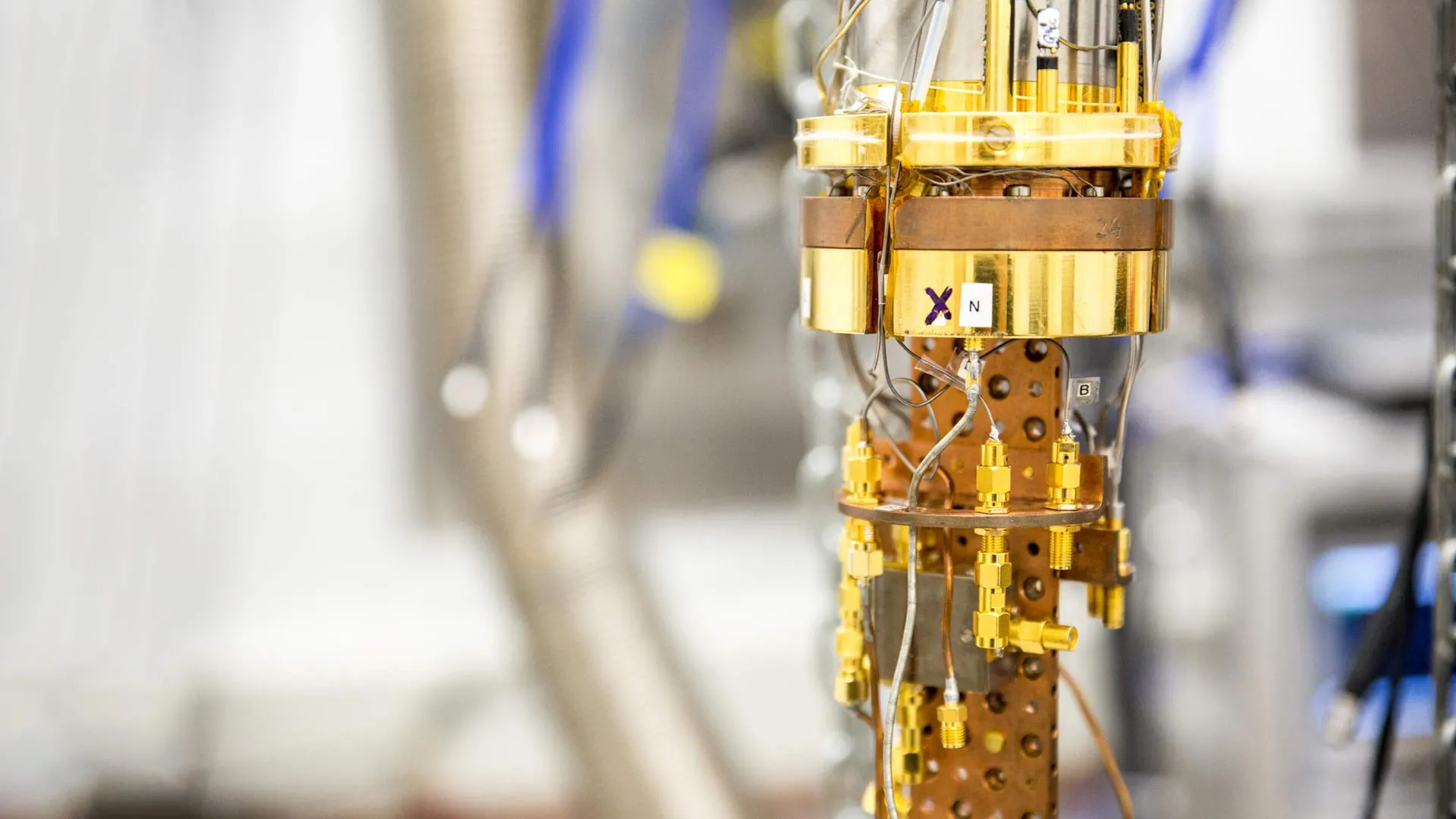
Scientists at Aalto University have achieved a groundbreaking milestone in quantum physics by successfully connecting a time crystal to an external device, marking the first time these mysterious quantum systems have been linked to real-world technology. Time crystals, which exhibit perpetual motion in their lowest energy state without requiring external energy input, have long fascinated physicists since Nobel laureate Frank Wilczek first proposed their existence in 2012.
The research team, led by Academy Research Fellow Jere Mäkinen, created their time crystal by injecting magnons—quasiparticles that behave like individual particles despite being groups of particles—into a Helium-3 superfluid cooled to near absolute zero temperatures. Using precisely controlled radio waves, the researchers were able to organize these magnons into a time crystal that maintained its repeating motion for up to 108 cycles, lasting several minutes before fading below detectable levels.
The breakthrough came when the team successfully coupled the time crystal to a nearby mechanical oscillator, demonstrating that these quantum systems can interact with and influence external devices. This interaction varied depending on the oscillator's frequency and amplitude, providing researchers with a method to control and tune the time crystal's behavior. The achievement represents a crucial step toward practical applications, as previous time crystals existed only in isolated laboratory conditions.
Mäkinen explained that the connection between time crystals and external systems follows principles similar to optomechanical phenomena used in gravitational wave detection at facilities like LIGO in the United States. By optimizing the mechanical oscillator's energy loss and frequency characteristics, the research team believes their setup could approach the quantum realm's boundaries, potentially enabling unprecedented precision in sensing applications.
The successful integration of time crystals with real devices opens possibilities for revolutionary quantum technologies, including ultra-sensitive sensors, improved quantum computer memory systems, and enhanced precision timing devices. These applications could significantly advance quantum computing capabilities by providing more stable and error-resistant quantum states. The research, published in Nature Communications, represents a major step forward in translating exotic quantum phenomena into practical technological solutions that could transform multiple fields of science and engineering.