Aalto Physicists Link a Self-Oscillating Time Crystal to an External Mechanical Device for the First Time, Opening a Path to Quantum Memory Cells That Never Run Down
Working in superfluid helium-3 at less than a ten-thousandth of a degree above absolute zero, Jere Mäkinen's team coupled an eternally ticking time crystal to a nanowire oscillator, turning a theoretical curiosity into a usable quantum component.

Physicists at Aalto University in Finland have for the first time linked a time crystal — a strange quantum phase of matter that ticks forever without any external energy input — to a real macroscopic device, a milestone that opens the door to using these self-perpetuating quantum oscillations as building blocks for precise sensors and for the memory cells of future quantum computers. The result was published earlier this month in Nature Communications.
The concept of a time crystal, first proposed by Nobel laureate Frank Wilczek in 2012, sounds like a thermodynamic impossibility: a system whose lowest energy state is not still but eternally in motion, with its internal structure repeating periodically in time the way an ordinary crystal repeats periodically in space. After years of theoretical debate and a sequence of partial demonstrations on isolated quantum platforms, time crystals have been observed in nitrogen-vacancy diamonds, trapped-ion chains and superconducting qubit arrays. Until now, however, they remained essentially academic curiosities — observable but disconnected from any external system that might use them as a clock or a sensor.
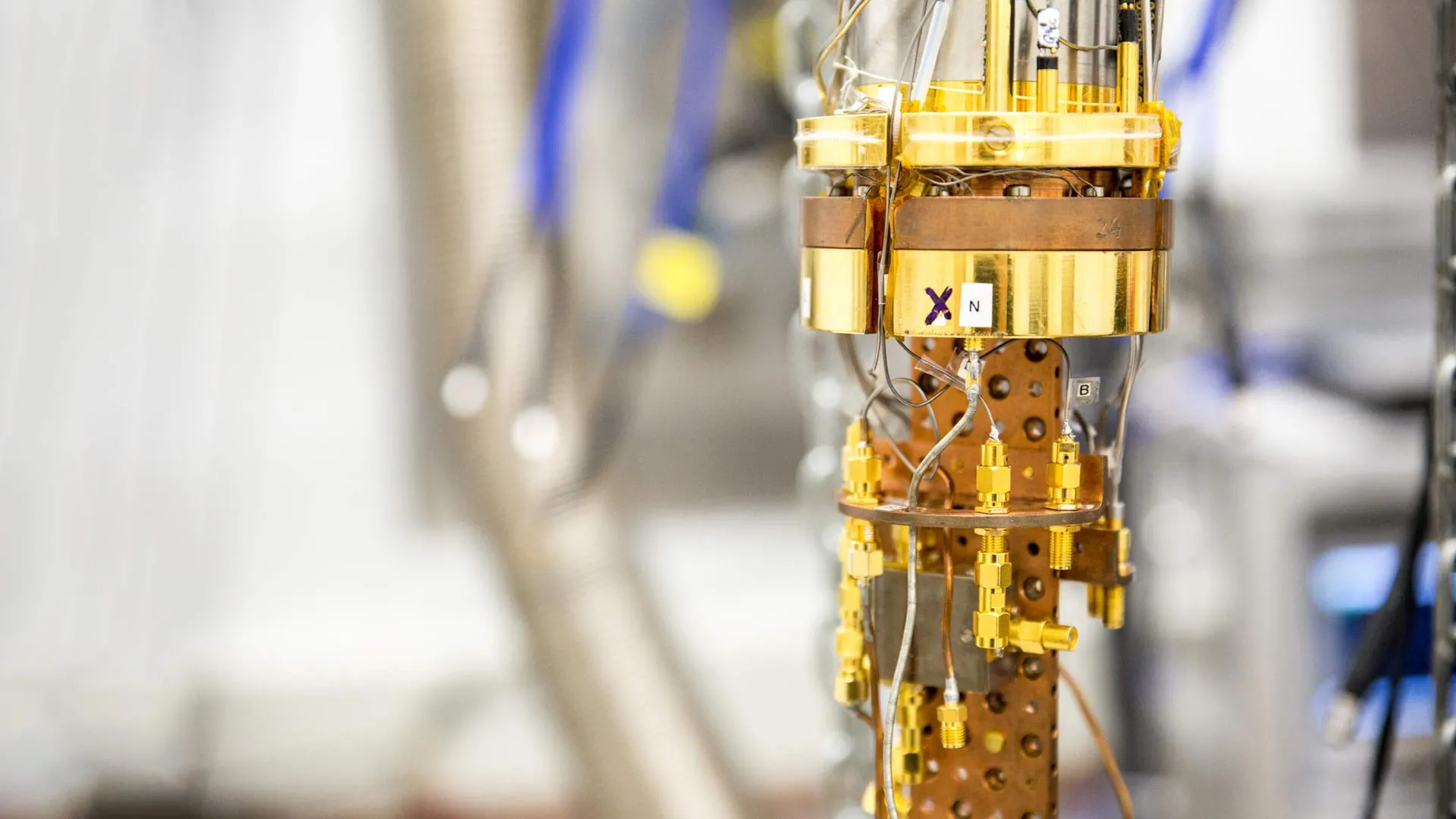
The Aalto team, led by Academy Research Fellow Jere Mäkinen at the Department of Applied Physics, solved that problem by realizing a time crystal in a superfluid helium-3 sample held at temperatures of less than one ten-thousandth of a degree above absolute zero, and then coupling that time crystal to a tiny mechanical oscillator — a freestanding nanowire that vibrates at radio frequencies. The combined system is what physicists call an optomechanical system: a quantum oscillator linked to a mechanical degree of freedom whose motion can be read out and, crucially, fed back to control the quantum object. By measuring the nanowire's response, Mäkinen and colleagues demonstrated that they can both probe the time crystal's behavior in real time and steer it, something no previous experiment has achieved.
The practical payoff could be considerable. Time crystals oscillate coherently for orders of magnitude longer than the artificial qubits used in today's quantum computers, where coherence times of milliseconds are considered exceptional. If a time crystal can serve as a high-fidelity quantum memory, it could relieve one of the central engineering bottlenecks in the field, where the brevity of qubit lifetimes forces operations to be packed into ever-shorter pulses and limits the depth of any practical quantum algorithm. The Aalto group is already exploring designs in which time crystals act as long-lived bus elements between fast-but-fragile superconducting qubits.
Beyond computing, the optomechanical coupling demonstrated in the paper hints at a new class of precision sensors. Because the time crystal's oscillation frequency is set by intrinsic many-body physics rather than by any external drive, a sufficiently isolated device could in principle outperform atomic clocks for certain measurements of gravitational gradients, ultralight dark matter candidates and fundamental constants. Researchers at the University of Lancaster, the Royal Holloway London ultra-low-temperature laboratory and the Max Planck Institute for the Physics of Complex Systems have already announced collaborations to replicate and extend the Aalto result, and Mäkinen said his group is now working to scale up the experiment to networks of coupled time crystals.