Scientists Connect 'Time Crystal' to External Device in Quantum Breakthrough
Aalto University researchers achieve first-ever coupling of perpetually moving quantum system to mechanical oscillator, opening door to new technologies.
Researchers at Aalto University have achieved a historic milestone in quantum physics by successfully connecting a time crystal to an external mechanical device for the first time. This breakthrough represents a major step toward practical applications of one of the most exotic forms of matter ever discovered, potentially leading to revolutionary advances in quantum computing, precision sensing, and memory storage technologies that could transform multiple scientific fields.
Time crystals, first proposed by Nobel Prize-winning physicist Frank Wilczek in 2012 and confirmed experimentally in 2016, represent a fundamentally different kind of order that exists in time rather than space. Unlike regular crystals that have atoms arranged in repeating patterns through space, time crystals exhibit repeating motion that continues indefinitely without requiring external energy input. They exist in their lowest energy state while still displaying constant, periodic behavior—a form of perpetual motion that is possible only in the quantum realm.
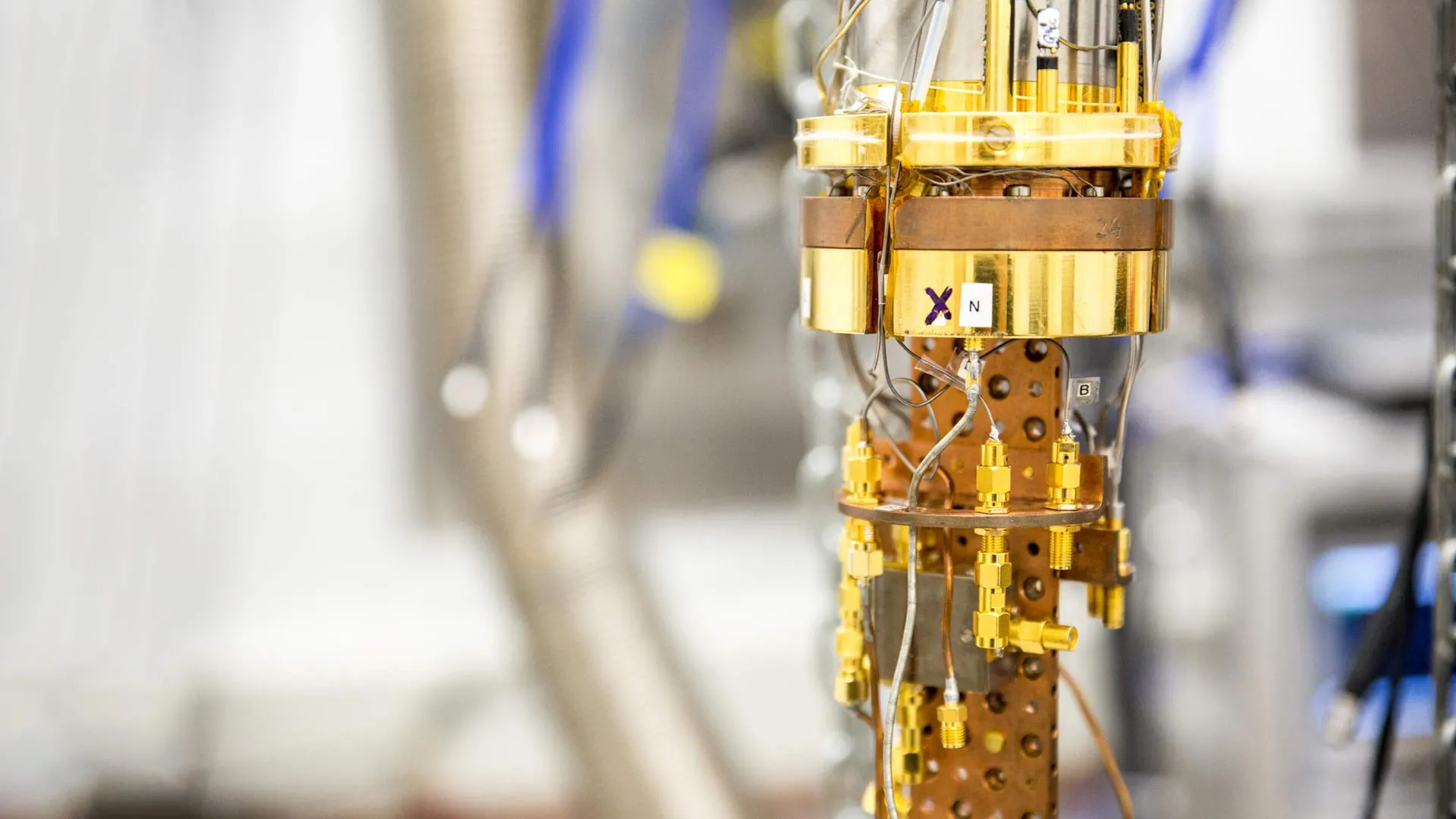
The Aalto team, led by Academy Research Fellow Jere Mäkinen, created their time crystal by injecting magnons into a Helium-3 superfluid cooled to temperatures near absolute zero using radio waves. Once the radio wave input was switched off, the magnons organized themselves into a time crystal that continued its motion for up to 108 cycles or several minutes before fading to unmeasurable levels. This represents an unusually long-lasting time crystal that maintained its coherent behavior far longer than typical quantum systems.
"Perpetual motion is possible in the quantum realm so long as it is not disturbed by external energy input, such as by observing it," Mäkinen explains. "That is why a time crystal had never before been connected to any external system. But we did just that and showed, also for the first time, that you can adjust the crystal's properties using this method." The team accomplished this by coupling the time crystal to a nearby mechanical oscillator, with the nature of their interaction depending on the oscillator's frequency and amplitude.
The researchers discovered that their system behaves according to optomechanical principles, the same physics used in detecting gravitational waves at the Laser Interferometer Gravitational-Wave Observatory. This connection opens up possibilities for creating highly precise quantum sensors and improved memory systems for quantum computers. By reducing energy loss and increasing the mechanical oscillator's frequency, the team believes their setup could be optimized to operate near the quantum realm's fundamental limits, potentially enabling technologies that were previously thought impossible.