Dutch Team Flips a Single Atom's Nuclear Spin With Radio Waves, Defying Theory
Delft physicists found they could control the magnetism of an atom's nucleus with a scanning tunneling microscope, something they thought should not work.

Researchers at Delft University of Technology in the Netherlands have controlled the magnetism in the nucleus of a single atom using radio waves, a result that surprised them. Until now, physicists believed this nuclear spin could not be manipulated directly with their technique. The findings, published in Nature Communications, could open new ways of storing and reading quantum information.
In metals such as iron and nickel, every atom is slightly magnetic, and inside each atom tiny magnetic "compass needles," known in quantum mechanics as spins, are at work. "By far the strongest magnetism comes from the electrons," said lead researcher Sander Otte. "But in some atoms, the nucleus also carries a spin. That spin is much weaker, but it is also much better shielded from the outside world."
That shielding is exactly what makes nuclear spins attractive for holding quantum information securely. It also makes them hard to work with. Otte's group uses a converted scanning tunneling microscope, which can direct electrical signals at a single atom with extreme precision. In the past they focused on the electron spin, the easiest to read out. The nuclear spin appeared only indirectly through the hyperfine interaction, which slightly entangles the nucleus and the electron.
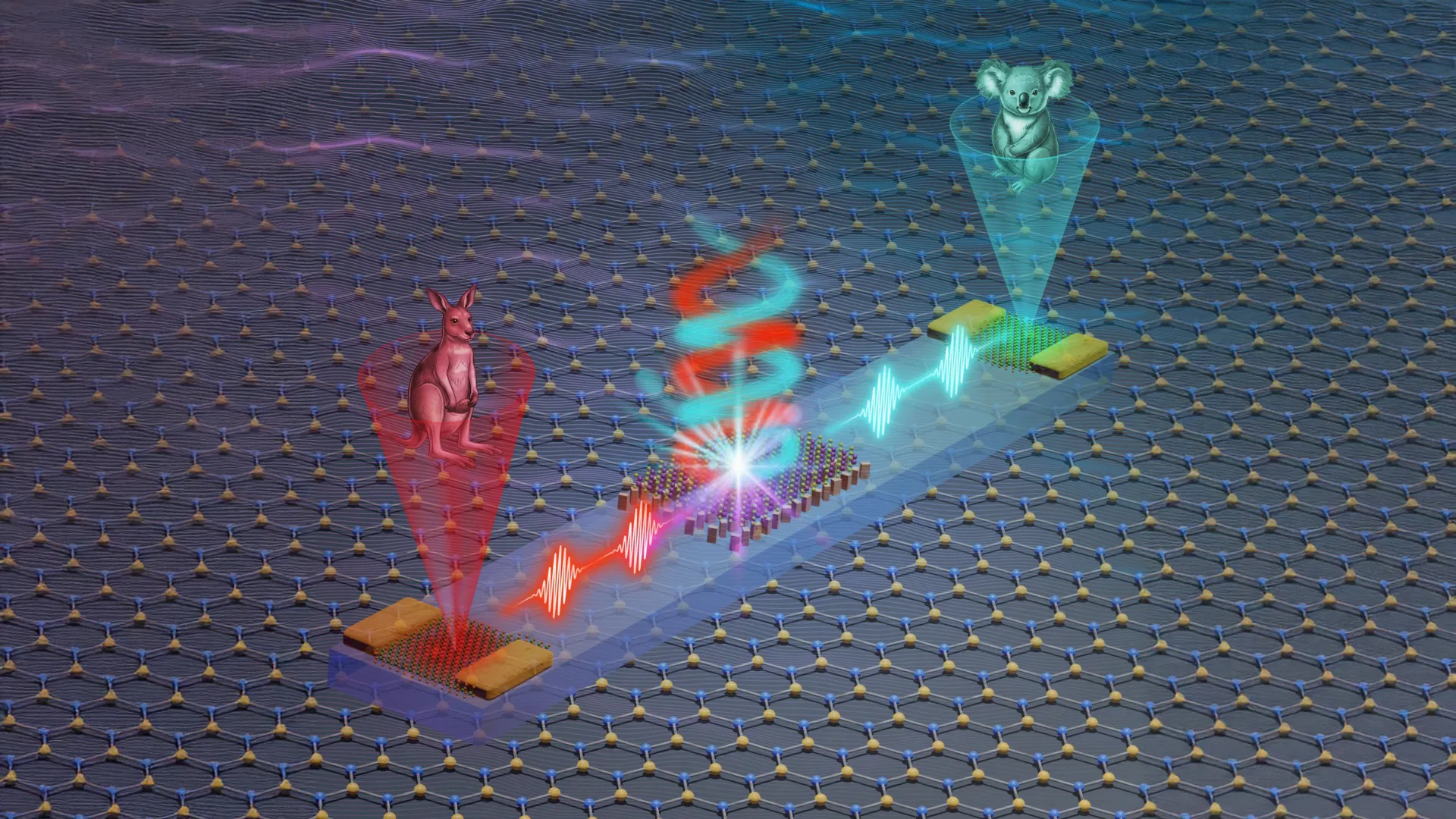
In the new experiment, first author Hester Vennema and colleagues sent two different signals to an atom at the same time, one aimed at the electron and one at the nucleus. That let them study the influence of each independently. They found they could flip the nuclear spin even when the two spins were largely disentangled.
"According to our simple understanding, this should not really happen," Otte said. "The nuclear spin should not be sensitive at all to the electrical signals from a scanning tunneling microscope."
To get there, the team refined a technique called double magnetic resonance for use on a single atom, which allowed them to address the nucleus and an orbiting electron separately. In magnetic resonance, a wave signal changes the orientation of a spin, and quantum mechanics allows only a limited set of rotations, so the signal has to match exactly the right frequency. "You can compare it to the strings of a guitar," Vennema said. "Each possible spin rotation is like a string with its own note. You have to play precisely the right note." The notes of a nuclear spin are a hundred to a thousand times lower than those of an electron spin.
The paper, titled "Nuclear magnetic resonance on a single atom with a local probe," is also on arXiv. For now, the practical payoff is still ahead. The researchers say the result mainly raises new questions about what mechanism is driving the nuclear spin when the microscope's signals should not be able to reach it.
"Back to the drawing board, then," Otte said. "That is really how science works. There is always something new left to figure out." If the mechanism is understood and can be controlled, single atoms could become a place to store and read quantum information with far better protection from outside noise than electron spins provide.