Delft–Intel Team Teleports Quantum Information Between Silicon Spin Qubits With 99% Two-Qubit Gate Fidelity
The Nature paper demonstrates the first 'shuttling' of paired electron spins across a silicon chip and quantum teleportation across 320 nanometers — a foundational step toward a manufacturable quantum computer.
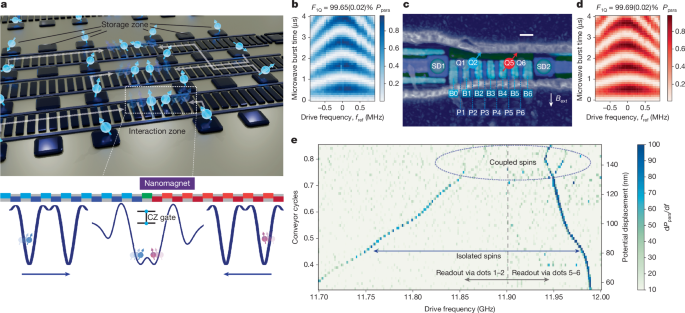
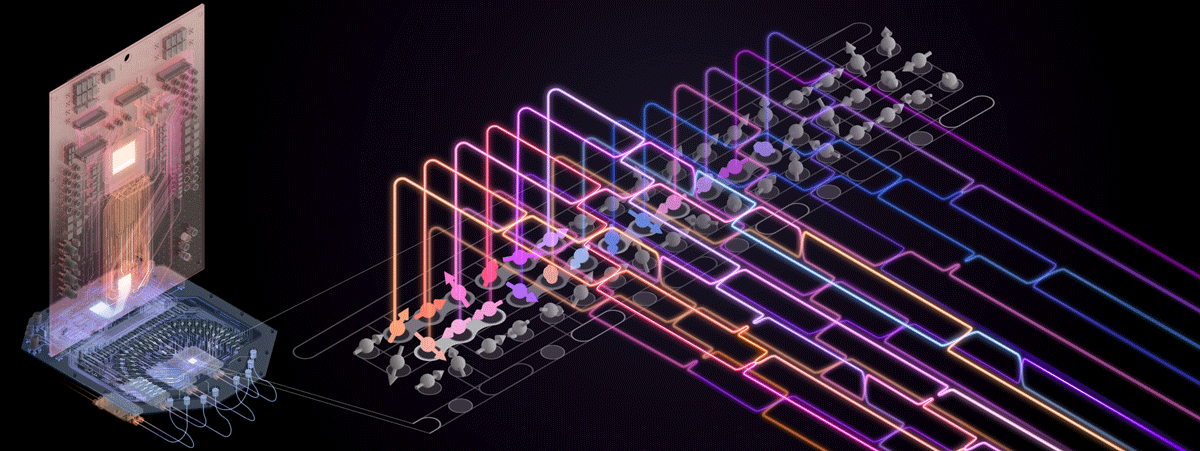
Physicists have demonstrated for the first time that pairs of electron-spin qubits can be physically shuttled together across a silicon chip, executed as a two-qubit logic gate with 99% fidelity, and then used to teleport quantum information between distant locations on the same wafer — a result that lifts one of the longest-standing engineering barriers to building a scalable, manufacturable quantum computer.
The work, published May 6 in Nature by a collaboration of researchers from Delft University of Technology, QuTech and the chipmaking giant Intel, describes a device architecture in which individual electron spins are trapped in silicon quantum dots, then conveyed along a one-dimensional array using carefully timed gate voltages. Crucially, the team showed that two electrons can be shuttled in tandem and remain coupled long enough to execute a controlled-NOT gate — the basic logical primitive of quantum computing — at average fidelities of 99.07% for single-qubit operations and 98.9% for two-qubit gates.
The figure that has the field most excited is what comes next. Using post-selected teleportation, the team teleported a quantum state between two qubits separated by 320 nanometers with an average gate fidelity of 87% — the first time spin qubits have been teleported across a silicon device, and a foundational step toward the kind of long-distance quantum interconnects that any scalable processor will require. "Until now, you could either move electrons around the chip or you could entangle them, but not both at high fidelity," said co-lead author Dr. Stephan Philips of QuTech. "What this paper shows is that the two functions are no longer in tension."
The stakes for industry are significant. Silicon spin qubits run at temperatures near 100 millikelvin, but unlike the much more developed superconducting qubits favored by IBM and Google, they are millions of times smaller and could in principle be patterned with the same lithography that manufactures conventional CMOS chips. That makes them the leading candidate for the eventual fault-tolerant machine, which experts believe will require somewhere between a few hundred thousand and a few million physical qubits. "Shuttling is the closest thing the silicon community has to a smoking gun for scalability," said Dr. Maud Vinet, who runs the quantum-computing program at France's CEA-Leti. "If you can move a qubit while preserving its coherence, then you can use sparse arrays rather than dense ones, and that changes the entire engineering problem."
The Nature paper extends a series of incremental advances by the Delft–Intel collaboration that began with the demonstration of high-fidelity single-spin shuttling last year. Independent groups at the University of New South Wales, RIKEN in Japan and Princeton University all replicated the single-qubit shuttling result within months, but no team had until now demonstrated coupled two-qubit transport, which is far more difficult because the spins must remain coherent and correctly phased while the electrons themselves are moving. The new device uses an architecture the team calls "baton passing," in which successive gate electrodes hand off the electron between adjacent quantum dots with sub-nanosecond timing.
More work remains before the technique is ready for industrial deployment. Fidelities of 99% are roughly an order of magnitude below the threshold most error-correction codes assume, and the 87% teleportation fidelity will need to climb substantially before the protocol can be chained across the millions of operations a real algorithm demands. But the qualitative leap is unmistakable: silicon spin qubits have crossed a threshold their competitors crossed years ago, and the timeline most academic and industry road maps publish for a useful, error-corrected quantum machine has just compressed by what one Intel research director described as "at least two years."