Black Holes Grow Without Galaxy Mergers, Oxford Study of 2,435 Galaxies Finds
Galaxies with no central bulge, which have never had a major collision, host supermassive black holes as heavy as their stellar mass predicts, pointing to slow, steady feeding.

A new survey of more than 2,400 galaxies suggests that supermassive black holes can reach enormous sizes without help from violent galaxy collisions, upending a long-held assumption about how the biggest objects in the cosmos get fed.
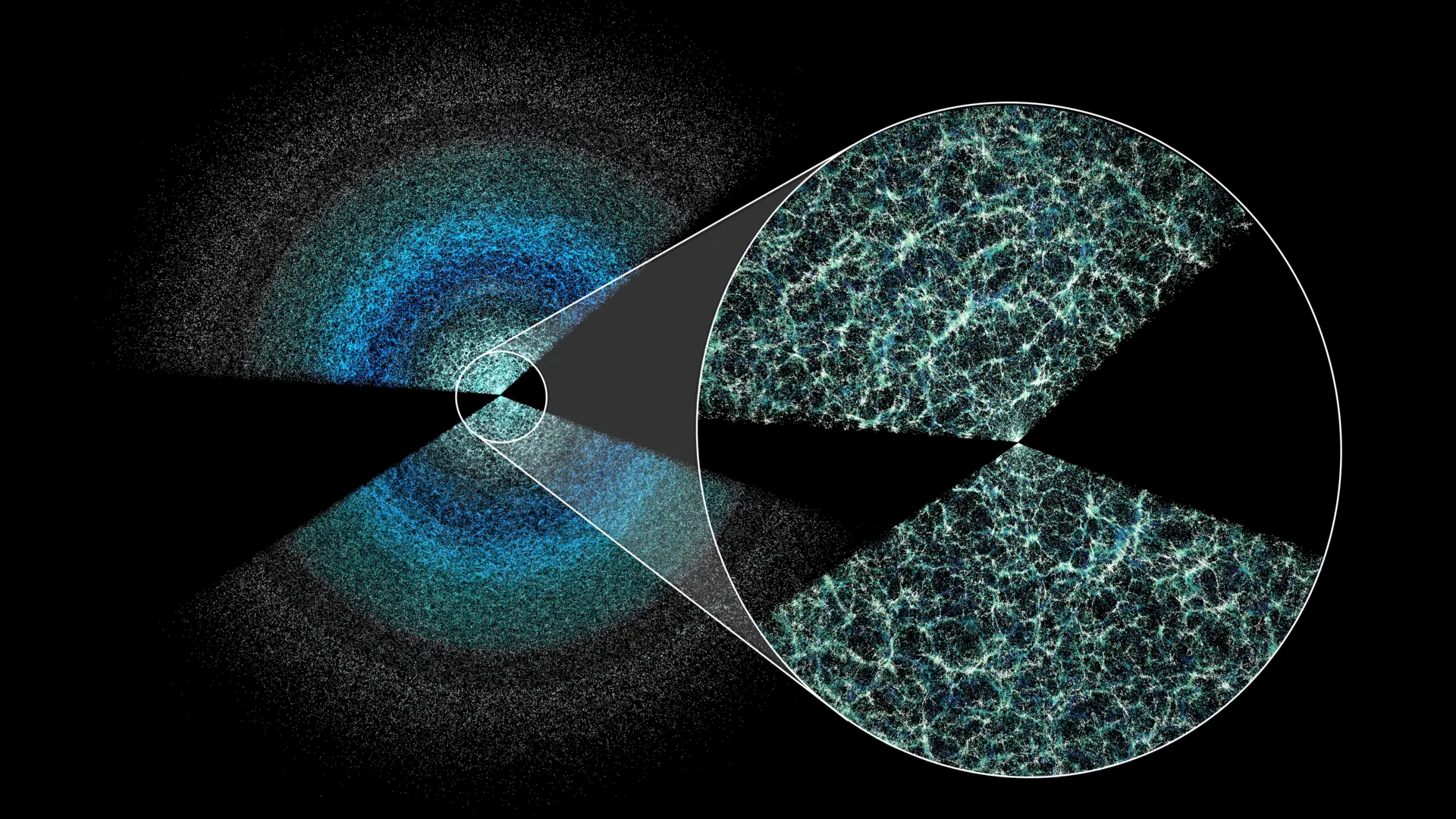
The study, led by Sophie Jewell and colleagues at the University of Oxford, was published in the Monthly Notices of the Royal Astronomical Society. The team examined 2,435 galaxies that host actively feeding black holes, using data from the Dark Energy Spectroscopic Instrument, or DESI.
For decades, astronomers have tied black hole growth to mergers. When two galaxies collide, gas is flung toward the center, where it can feed the black hole and also build up a central bulge of stars. That picture predicts that galaxies without bulges should have undersized black holes, because they have no history of major mergers.
The Oxford team tested that directly. Out of the sample they identified 546 "bulgeless" galaxies, systems that lack a central stellar bulge. They used an automated imaging pipeline called GALFITM to split each galaxy's light into components, and estimated each black hole's mass from the strength of its hydrogen-alpha emission line.
The result runs against the merger story. "Bulgeless galaxies still show a black hole-to-stellar mass relation consistent with galaxies that have bulges," the authors report. Put simply, the bulgeless galaxies have black holes just as massive, for their size, as galaxies that did have collisions. The team concludes that "major mergers are not required to grow the vast majority of the BHs to their observed masses within a reasonable time."
If collisions did not do the feeding, something else did. About two-thirds of the galaxies in the sample contain bars, the elongated stripes of stars across a galaxy's center, and most show spiral arms. Those structures can steer gas inward over long periods. Astronomers call this kind of gradual, non-merger growth "secular" evolution, and the study suggests it is enough to build black holes to their observed masses.
The finding does not mean mergers never matter. The most extreme black holes, and the brightest quasars in the early universe, may still depend on them, and the study covers the overall population rather than every case. What it shows is that the typical black hole does not need a catastrophe to grow.
That has consequences for how scientists model the universe. Simulations of galaxy formation often build black hole growth around mergers, and the Oxford result implies those models may overstate how often collisions are needed. It also supports the idea that black holes and their host galaxies evolve together, each steadily regulating the other.
The sample leaves room for follow-up. Future DESI data and higher-resolution imaging should show whether the same relationship holds at greater distances, where galaxies were younger and mergers were more common.