A Dark Matter Detector Under an Italian Mountain Just Caught the Sun’s Faintest Neutrinos at 17,000 Electron Volts
XENONnT pushed the direct detection threshold for neutrinos lower than anyone has managed before. The signal comes from the proton-proton fusion that powers the Sun.

Tens of billions of neutrinos from the Sun pass through every square centimeter of your body every second, and essentially none of them touch anything. That is what makes them so hard to study, and it is why a result announced on August 31 at Italy's Gran Sasso National Laboratory matters: the XENON Collaboration reported the first observation of low-energy solar neutrinos scattering off electrons, reaching down to about 17 keV — the lowest energy threshold ever achieved for direct neutrino detection.
The signal is dominated by what physicists call pp neutrinos, produced in the proton-proton fusion reactions that generate almost all of the Sun's energy and the overwhelming majority of its neutrino output. These are the most abundant neutrinos the Sun makes and among the least energetic, which is precisely why they had never been seen scattering off electrons in a detector of this type. The findings are posted as a preprint on arXiv.
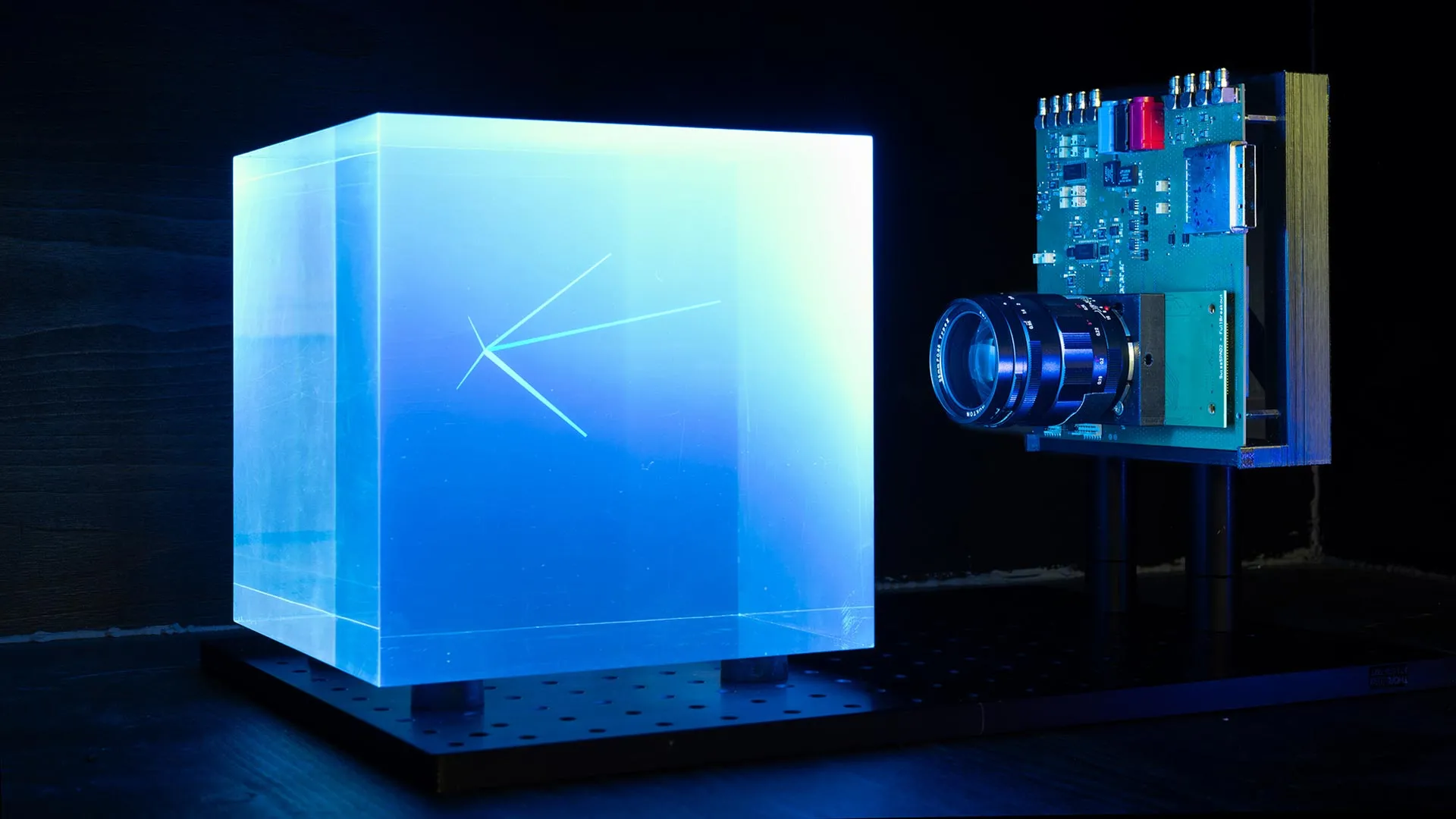
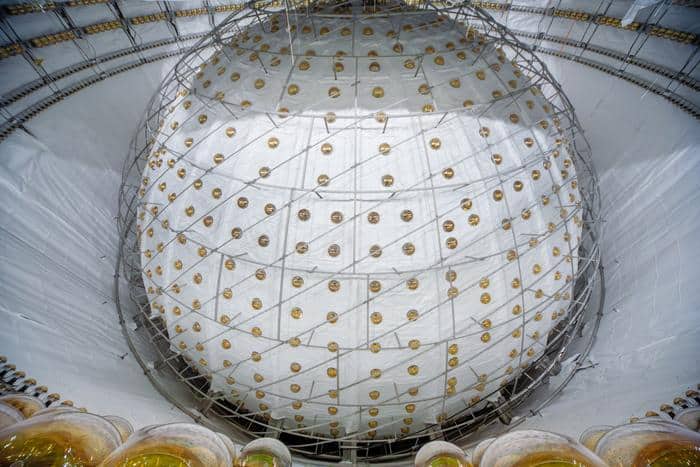
The detector itself sits 1,400 meters beneath the Gran Sasso massif, shielded by rock from the cosmic rays that would otherwise swamp any signal. At its heart is a dual-phase time projection chamber holding 5.9 metric tons of ultrapure liquid xenon. When a neutrino kicks an electron loose, the chamber records both a prompt flash of light and a delayed electron signal, and the pair together fix the energy and position of the event. About 30 research institutions take part in the collaboration, including the University of Zurich.
XENONnT was not built for this. It was designed to hunt for particle dark matter in the Milky Way, and its recent detection of coherent elastic neutrino-nucleus scattering from higher-energy solar neutrinos was already a demonstration that the machine could double as a neutrino observatory. This measurement extends that reach into a new regime. "This result shows that these technologies are also sensitive to extremely low-energy neutrinos produced in the sun," said Laura Baudis, professor of experimental physics at the University of Zurich.
The overlap is not an accident. "The same detector properties that make these technologies so powerful in the search for dark matter — in particular, the low-energy threshold and the precise control of all background components — allow us to study solar neutrino physics in a new energy range," said Florian Jörg, a postdoctoral researcher in Baudis's group who worked on the analysis.
That dual use cuts both ways. Solar neutrinos scattering off electrons and nuclei are an irreducible background for dark matter searches — the so-called neutrino fog that the next generation of detectors will have to see through. Measuring that background precisely, in the exact instrument that has to contend with it, is the only way to know what a genuine dark matter signal would have to look like to stand out. It also gives solar physicists a direct count of the fusion rate in the Sun's core, taken right now, rather than inferred from the light that took a hundred thousand years to work its way to the surface.