Thawing Permafrost Is Dumping Ancient Carbon Into the Arctic Ocean. The Seafloor Is Burying About 90% of It.
Sediment cores from Canada's Herschel Island show that bacteria largely ignore the old permafrost carbon in favor of fresher algal material — keeping most of it out of the atmosphere.
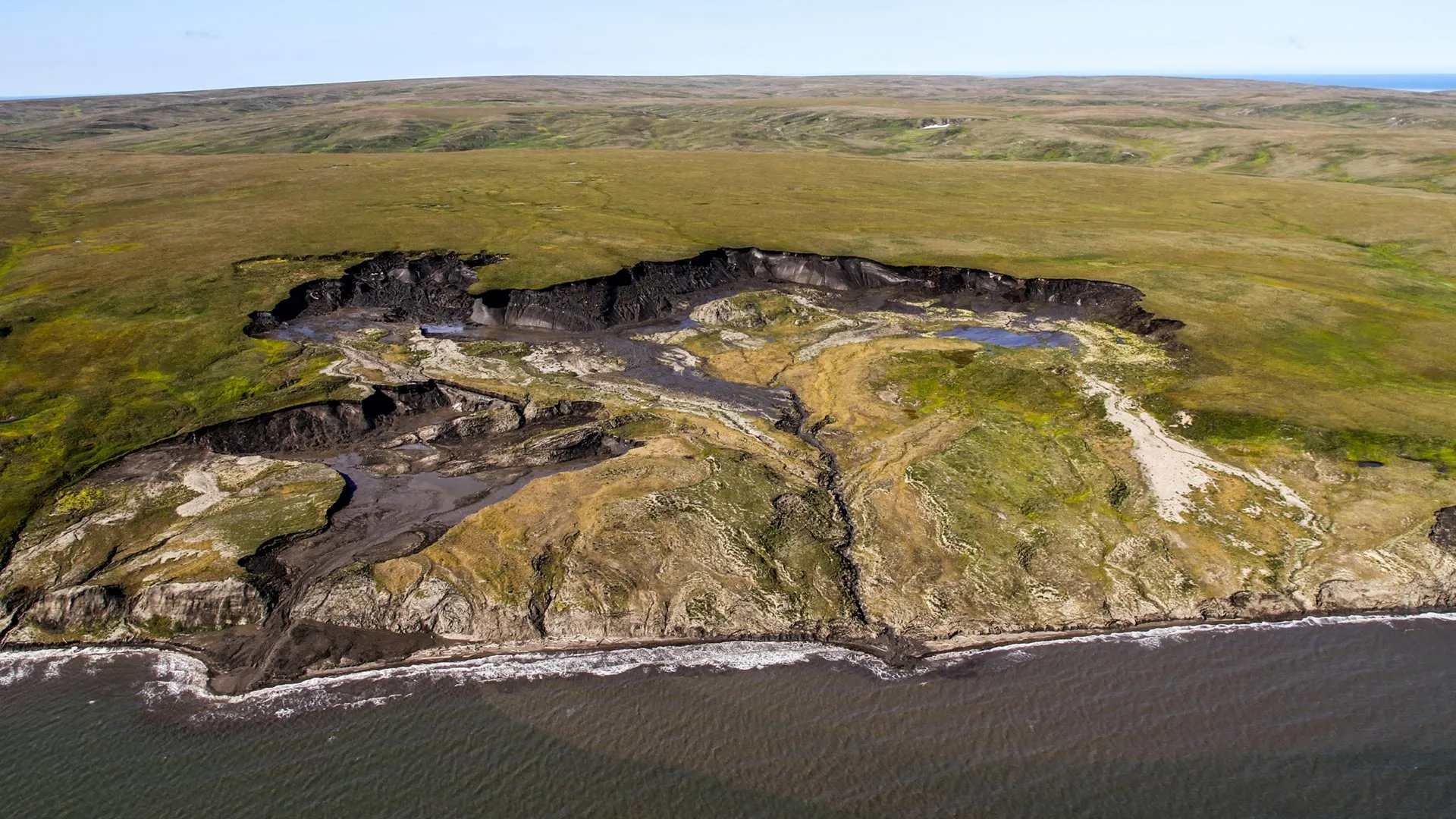
One of the more alarming feedback loops in climate science works like this: Arctic permafrost thaws, coastlines erode, thousands of years of frozen organic carbon wash into the sea, bacteria eat it, and the carbon comes back out as carbon dioxide and methane. A study published in Nature Geoscience finds that the last step largely does not happen.
Researchers at the Alfred Wegener Institute, the Helmholtz Centre for Polar and Marine Research, pulled sediment cores from the seafloor off Herschel Island, along Canada's rapidly eroding Yukon coast, and traced where the permafrost carbon ends up. Roughly 90 percent of it stays buried in seafloor sediments. Only about 10 percent is converted into greenhouse gases.
"Although the sea here carries away huge quantities of organic carbon from the coast, surprisingly little of it ends up in the ocean's active carbon cycle," said Dr. Manuel Ruben, the study's lead author.
The team worked out the fate of the carbon using isotopes. Carbon from permafrost that has been frozen for millennia carries a different isotopic fingerprint than carbon from algae that grew last season, and the bacteria living in the sediment record which one they have been eating. "Carbon isotopes represent our atomic indicators that can identify the food source of the microorganisms," Ruben said.
The answer was that the microbes are picky. "The sediment is home to 'gourmet' bacteria that apparently prefer fresh carbon stemming from, for example, more recent algal remains over the 'old' carbon from permafrost deposits," said Prof. Gesine Mollenhauer, a geochemist at the institute and a co-author. Permafrost carbon has spent thousands of years locked in ice; what remains is chemically tough and energetically unrewarding compared to a recent phytoplankton bloom settling out of the water column. Given a choice, the bacteria take the fresh material and leave the old carbon to be buried under successive layers of sediment.
The volumes involved are substantial and growing. About 0.02 gigatonnes of permafrost-derived organic carbon currently enters the Arctic Ocean each year as coastlines collapse into the water, and that flux is projected to rise 70 to 150 percent by 2100 as warming accelerates thaw and storms chew harder at unfrozen shorelines.
The finding does not remove permafrost from the list of climate risks. Carbon released directly to the atmosphere from thawing ground on land — as opposed to carbon washed into the ocean — remains a major concern, and the study covers a single nearshore Arctic setting rather than the whole coastline. But it does suggest that the marine leg of the permafrost carbon feedback is weaker than models have generally assumed.
The paper, by Ruben, Bingbing Wei, Anabel von Jackowski and colleagues, is titled "Limited remineralization of Arctic permafrost-derived organic carbon in nearshore marine sediments."
Originally reported by ScienceDaily.