27 Million Tons of Seaweed Are Smothering Caribbean Beaches, and Mexico Can Only Scoop Up 1,200 Tons a Day
University of South Florida satellite data recorded 27 million metric tons of sargassum across the Atlantic, Caribbean and Gulf in July, following a record 40 million tons in 2025 that never fully dispersed. Quintana Roo businesses report sales down 30 percent.
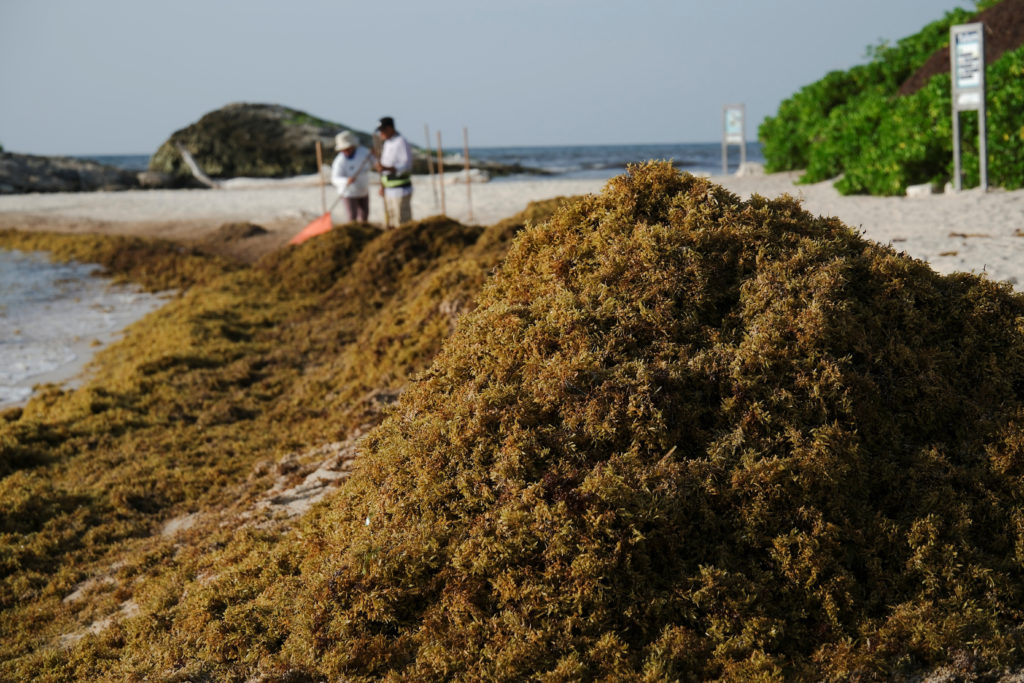
Satellite measurements recorded 27 million metric tons of sargassum floating across the Atlantic, Caribbean and Gulf of Mexico in July, according to the University of South Florida's Optical Oceanography Lab — the tail end of a bloom season that peaked at 34 million tons in June and that follows a 2025 season so large it never fully dissipated.
"None of this is normal. Every year is a little bit of a new story," said Brian Barnes, a marine scientist and research assistant professor at the lab. The 2025 bloom hit 40 million tons, shattering the previous record of 22 million tons set in 2022. Its residue became the seed for what followed. "The 2025 bloom was so big it never really left," Barnes said. "It was enough to start a new bloom locally."
The Gulf of Mexico saw 5 million tons in June alone, nearly double the previous year's record for that basin. On the worst days, 9,000 tons of the brown macroalgae wash onto Mexico's Caribbean coastline. Mexico has invested $115 million in barriers, collection vessels and beach machinery, and can currently remove about 1,200 tons a day — roughly an eighth of peak arrival. Martinique has collected 11,500 tons so far this year. In Quintana Roo, the state that contains Playa del Carmen and Tulum, hotels and businesses reported sales down 30 percent in the first half of 2026.
The ecological damage runs deeper than the smell. Decomposing mats strip oxygen from nearshore water, smother mangrove roots, and block sunlight from reaching coral and seagrass beds. Sea turtle hatchlings cannot cross the piles to reach the water, and the heavy machinery brought in to clear beaches destroys nests in the process. As the algae rots it releases ammonia and hydrogen sulfide, which have caused nausea, headaches and lung irritation among residents and cleanup crews.
"I don't recall ever having that much concentration in so many places at once," said Waldemar Quiles, Puerto Rico's natural resources secretary, whose island has seen heavy accumulation around La Parguera. Amy Dempsey, an environmental consultant in the U.S. Virgin Islands, has tracked similar arrivals across that territory.
Researchers attribute the growth to a combination of agricultural runoff feeding the water with nutrients, warming ocean temperatures, and shifts in wind patterns, currents and rainfall that determine where the mats drift. A NOAA analysis using machine learning found macroalgae blooms increasing about 13 percent annually between 2003 and 2022, covering 16.9 million square miles in total. "It's not a one-off event anymore. It's becoming a growing hazard," said Emmanuel Maldonado González, an environmental sociologist at East Carolina University. Barnes put the infrastructure problem plainly: "The coastlines are not built for this."
Originally reported by PBS NewsHour.