Rubin Observatory Finds First Permanent Trojan Asteroids Trailing Neptune
Queen's University Belfast astronomers confirmed two stable asteroids and one candidate, doubling the known long-lived population in Neptune's trailing cloud.

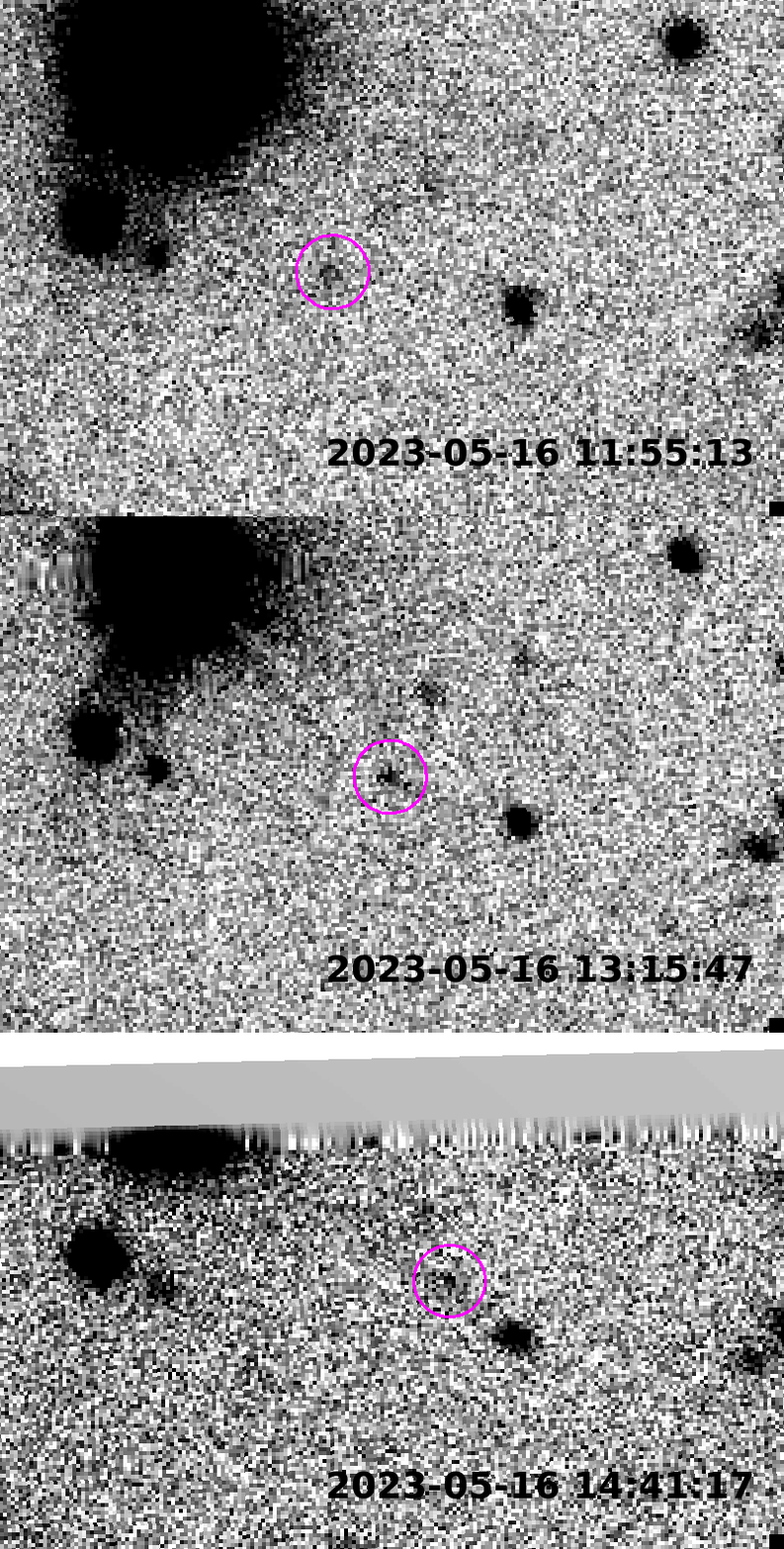
Astronomers have identified two asteroids, and a third candidate, that share Neptune's orbit and are stable enough to stay there for the long haul. The objects sit in the planet's trailing Trojan cloud, a region that had resisted study for years, and the find doubles the number of known objects there on long-lived orbits.
The team was led by Meg Schwamb, an astronomer and lecturer at Queen's University Belfast's Astrophysics Research Centre, with collaborators across institutions including the Planetary Science Institute, the DiRAC Institute, the Johns Hopkins University Applied Physics Laboratory and NSF NOIRLab. The paper, in The Astrophysical Journal Letters, is titled "NSF-DOE Vera C. Rubin Observatory's First View of the Neptune Trojan L5 (Trailing) Cloud: Two New Long-term Stable Trojans."
Trojans are asteroids that share a planet's path around the Sun, gathered at two gravitationally stable points, one leading the planet and one trailing it. Jupiter's Trojans were first seen in 1906. Similar groups have been found at Saturn and Uranus, but until now the trailing group at Neptune had been hard to pin down.
The reason is the sky behind it. For about 10 years the trailing cloud has been in front of the dense star fields of the Milky Way's center, which swamps faint objects. It is now moving out of that region. The researchers used early test observations from the Vera C. Rubin Observatory in Chile, whose 8.4-meter telescope and LSST Camera, described as the largest digital camera ever built, can survey the sky quickly. The observatory began operations in June 2025.
"These early observations have provided our clearest view yet of Neptune's trailing Trojan cloud," Schwamb said. "We've been able to double the number of known objects in this population on long-lived orbits."
Multiband images also showed that the leading and trailing Neptune Trojans have similar surfaces, a hint that the two groups formed from the same material rather than being captured separately. That bears on a long-running question about how Neptune's companions arrived and whether they were swept up during the early migration of the giant planets.
This is only the start. Rubin's nine-year Legacy Survey of Space and Time is expected to find tens to hundreds of Neptune Trojans, along with tens of thousands of icy bodies in the trans-Neptunian region and the Kuiper Belt. Each new orbit helps astronomers test models of how the outer solar system took shape.
Trojans are also useful as time capsules. Because they have shared a planet's orbit for billions of years, their numbers, sizes and colors preserve a record of the conditions in the young solar system, and the new Neptune objects give astronomers a fresh sample to compare against Jupiter's well-studied swarm.