A Newly Found Frozen World Beyond Neptune Deepens the Planet Nine Mystery
The distant object 2023 KQ14, spotted by Japan's Subaru Telescope, follows a surprisingly stable orbit that complicates the case for a hidden ninth planet.
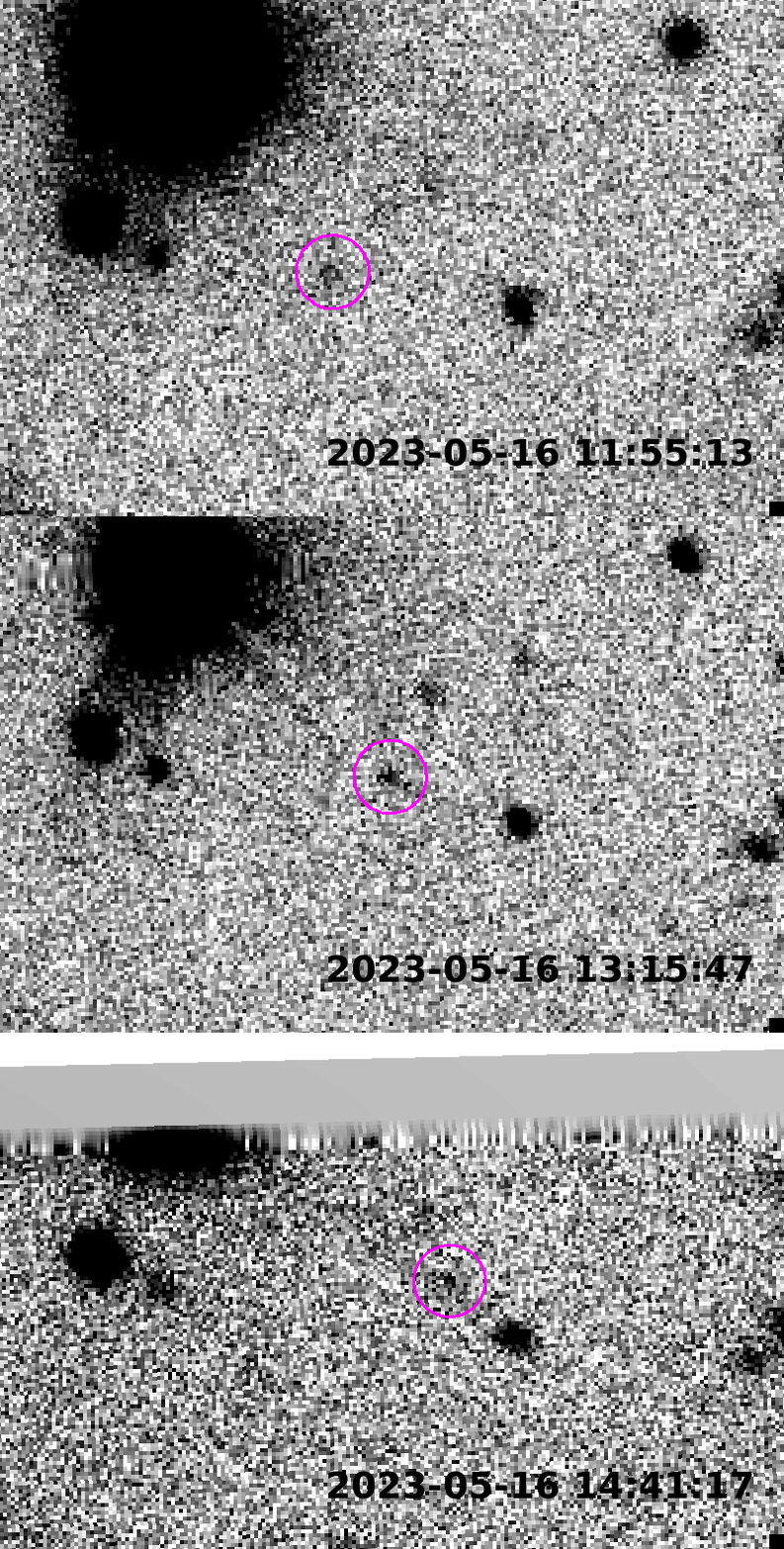
Astronomers hunting for the elusive Planet Nine have turned up something that complicates the search rather than confirming it: a distant, icy world whose orbit is far more stable than the hidden-planet theory would predict. The object, designated 2023 KQ14 and nicknamed a "sednoid," was discovered using the Subaru Telescope in Hawaii and is forcing scientists to reconsider just how far away a ninth planet would have to be — if it exists at all.
For nearly a decade, the Planet Nine hypothesis has offered an elegant explanation for a puzzle in the outer solar system. A handful of trans-Neptunian objects appear to cluster their orbits in a way that seems too coordinated to be coincidence, and in 2016 Caltech astronomers Konstantin Batygin and Mike Brown proposed that the gravity of an unseen planet several times the mass of Earth was herding them into alignment. The idea has driven one of the most intense planetary searches in modern astronomy.
But 2023 KQ14 doesn't fit neatly into that picture. The object swings from a closest approach of about 71 astronomical units from the Sun out to a distant 433 AU — one AU being the Earth-Sun distance — and its motion is markedly more stable than the clustered orbits that first suggested a shepherding planet. It is now one of four known sednoids, and the discovery of these comparatively settled paths suggests that if Planet Nine is real, it must lie much farther out than originally thought, perhaps beyond 500 AU, where it would be extraordinarily faint and difficult to detect.
The finding does not kill the theory, and its champions remain undeterred. "There are currently no other explanations for the effects we see, nor for the myriad other P9-induced effects we see on the solar system," Brown has argued, maintaining that an unseen planet is still the best fit for the broader pattern of orbital oddities beyond Neptune. The Kuiper Belt, which begins around 30 AU past Neptune, is littered with dwarf planets and frozen debris whose movements continue to defy explanation by the known planets' gravity alone.
What could finally settle the debate is now coming online. The Vera C. Rubin Observatory in Chile, with its enormous digital camera and sweeping survey of the southern sky, is expected to dramatically expand the catalog of distant solar system objects over the next few years. If Planet Nine exists, the observatory may be powerful enough to spot it directly — or to map enough new sednoids to determine, one way or another, whether the architecture of the outer solar system demands a hidden world.