Plasma Simulations Explain Why Black Hole Jets in Centaurus A Glow Brightest at the Edges
A Würzburg team reproduced the Event Horizon Telescope image by modeling electrons spiraling along twisted magnetic fields in the jet of the nearest active galaxy.

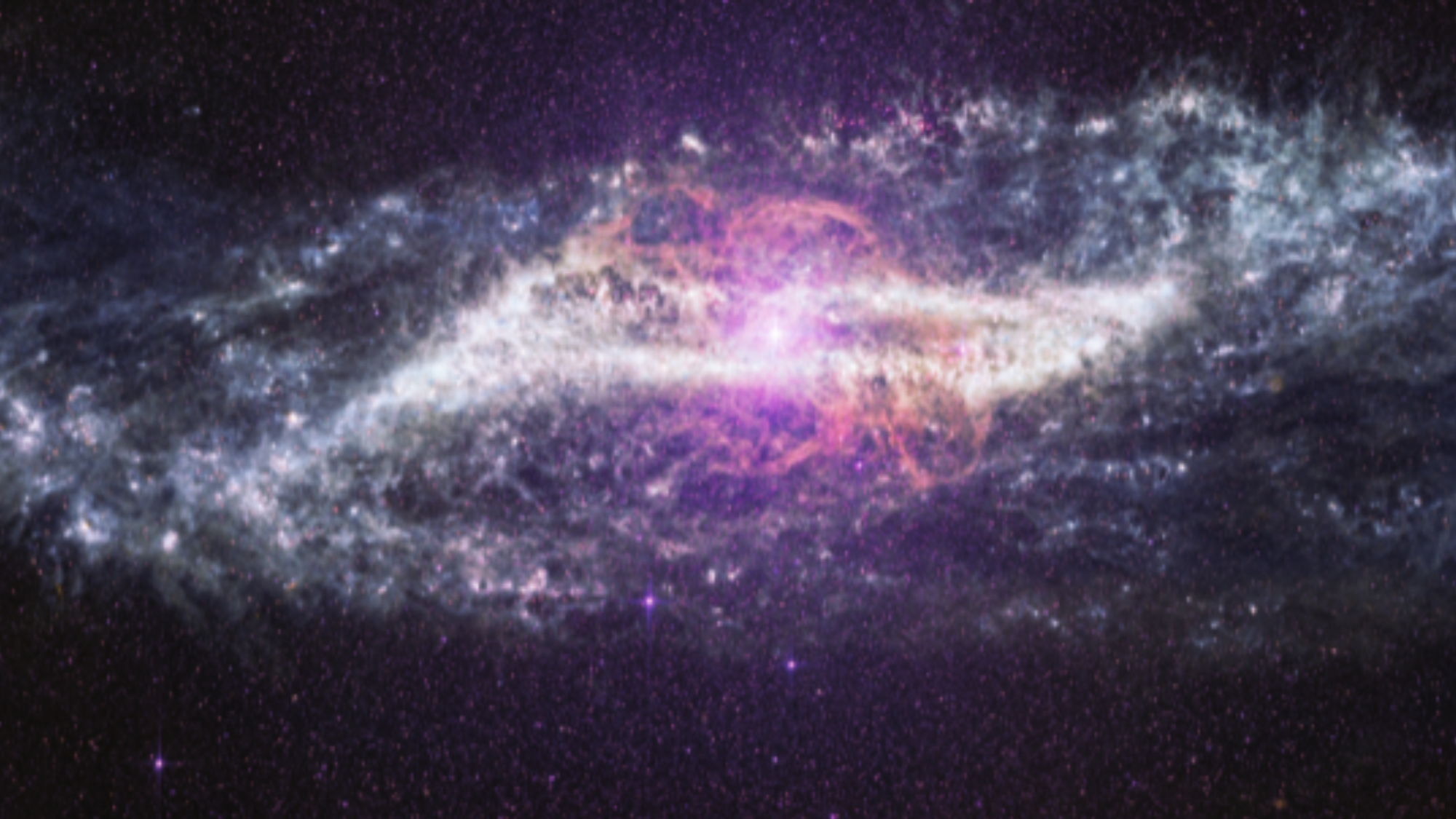
About 12 million light-years away, the supermassive black hole at the heart of the galaxy Centaurus A is firing two enormous jets of plasma into space at nearly the speed of light. Those jets are brighter at their edges than at their centers. Why has been unclear for decades. A team from the Chair of Astronomy at the University of Würzburg now says it has an explanation.
Centaurus A is the closest active galaxy to Earth, and its black hole is about 60 million times the mass of the sun. Its closeness lets astrophysicists see the jets in unusual detail, which makes it what the researchers call a unique laboratory for the most extreme conditions in the universe.
In principle, a jet should be brightest along its middle. But observations with the Event Horizon Telescope at a wavelength of 1.3 millimeters show the opposite. In Centaurus A the edges glow and the core is comparatively dark, a pattern known as limb brightening.
The Würzburg explanation lies in how the plasma behaves. In the jet's extremely strong magnetic fields, fast electrons move along the field lines, and that changes how they emit light: their brightness depends on the orientation of the magnetic field. Because the jet's magnetic field has a complex, twisted structure, the result is bright edges and a dim core, exactly as the telescope sees.
The simulation links very different scales. It follows particle-level processes and connects them to structures spanning several light-days. It reproduces the bright-edge pattern and agrees closely with the EHT images, according to the team. A three-dimensional model shows the hot gas flowing around the black hole, the jets, the magnetic field lines and the paths of accelerated particles.
"Cen A is our closest window into the physics of relativistic jets," said Felix Glaser, a master's student and lead author. "The fact that our plasma-informed model reproduces the observed edge brightening suggests that we are capturing an important piece of the underlying physics. These processes may not be unique to Cen A, but could be common in relativistic jets throughout the universe."
Dr. Christian Fromm, who leads the Computational Astrophysics Group, said microscopic plasma effects can shape structures on vastly larger scales, and that future observations will reveal more such signatures, making realistic plasma physics increasingly important in models. The work belongs to the German research unit "Relativistic Jets in Active Galaxies."
Better data is coming. New millimeter telescopes, including the planned Wetterstein Millimeter Telescope on the Zugspitze, will sharpen observations, and projects such as the next-generation Very Large Array and the Square Kilometre Array should add more detail. Prof. Karl Mannheim noted that a black hole and a fusion reactor may sound unrelated, but both are governed by plasma physics, and that Centaurus A lets researchers study plasma under conditions that cannot be made on Earth.