Ötzi the Iceman Is Still Carrying Yeasts From the Glacier That Buried Him 5,300 Years Ago — and They're Alive
Researchers separated the microbes that lived in the mummy's body from those that arrived later and found cold-loving organisms related to Antarctic strains, some apparently feeding on the chemical used to clean him.
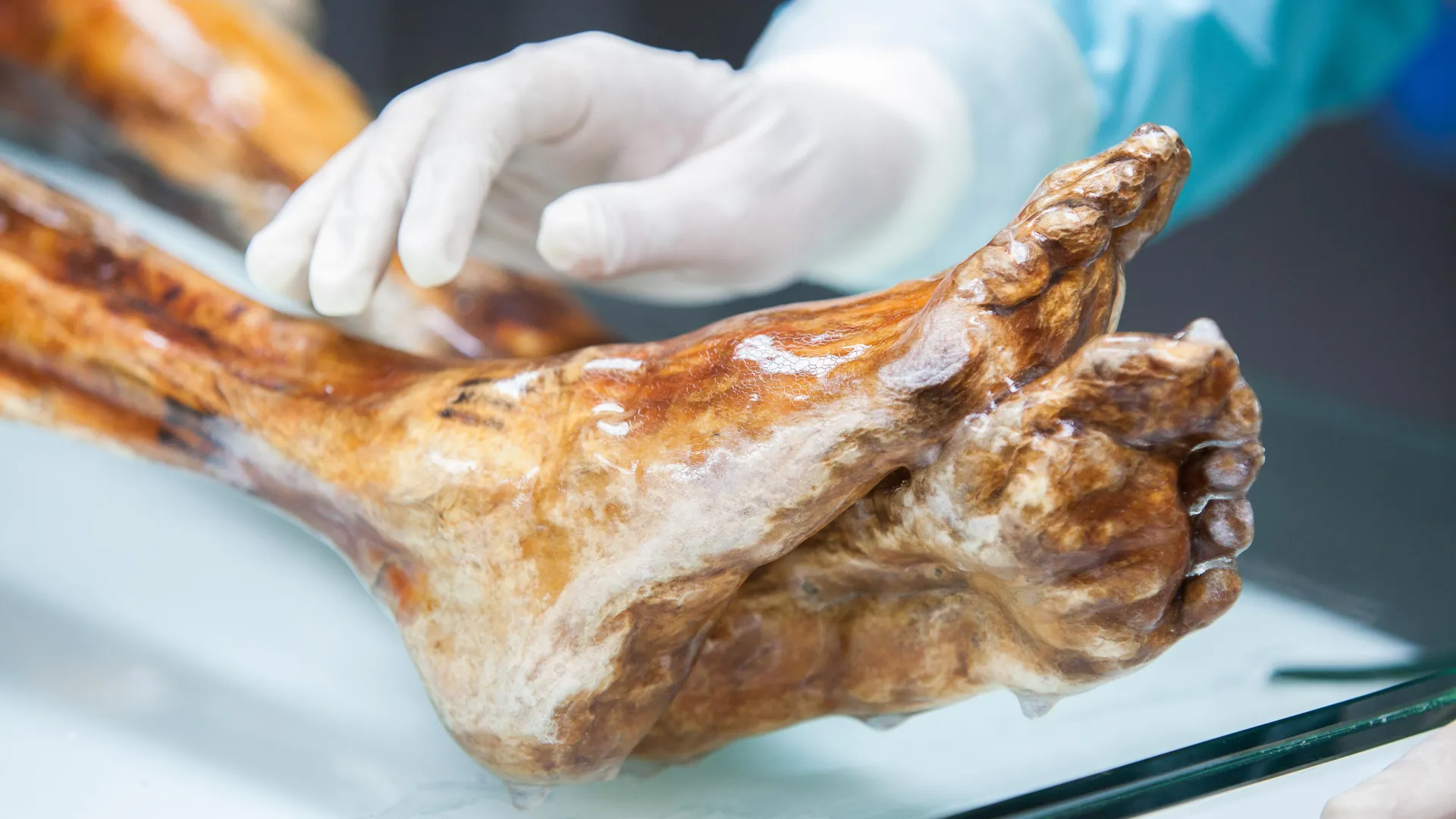
Ötzi the Iceman, the 5,300-year-old mummy found frozen in the Alps in 1991, is not the inert artifact he appears to be. A new study in the journal Microbiome reports that his body still hosts a working mix of ancient and modern microorganisms — including cold-adapted yeasts that appear to have ridden along with him inside the glacier and survived into the present.
The hard problem in mummy microbiology is telling the passengers apart. Some microbes lived inside the person while he was alive. Some colonized the corpse as it decomposed. Some came from the ice that entombed it. And some were introduced by the humans who have handled and conserved the body for more than three decades. A team led by Eurac Research in Bolzano attacked the problem by sampling widely: ice from the mummy's surface, meltwater from inside the body, swabs across the skin, plus previously collected data from intestinal tissue and stomach contents. As an environmental control they used a soil sample taken at the discovery site during Ötzi's recovery in 1991, which had been kept frozen ever since.
Inside the intestinal tract and stomach contents, they found genetic evidence of Ötzi's original gut microbiome — the community first documented in a 2019 study with Eurac Research. It resembles the small number of known microbiomes from early human populations, and includes bacteria that are rare or absent in people living in modern industrialized societies. That makes the mummy an unusually direct window onto what the human gut looked like before agriculture reshaped diet and antibiotics reshaped everything else.
The surprise came from the yeasts. Recovered from skin samples, internal meltwater and stomach contents, four species turned out to be highly specialized cold-environment organisms, genetically related to strains found in places as extreme as Antarctica — evidence that they originated in the glacier rather than in the man. The researchers detected both heavily degraded ancient DNA and well-preserved modern DNA from these organisms, which indicates they are not simply chemical residue left over from the Copper Age. They persist under the mummy's current storage conditions of minus six degrees Celsius and 99% relative humidity, some likely in a dormant state.
"We see continuity here," said Frank Maixner, director of the Institute for Mummy Studies at Eurac Research. "These yeasts have accompanied Ötzi on his long journey through the millennia." The mummy, he said, is "not a static relic, but a dynamic biological system." One finding suggests the conservation work itself may have fed the survivors: three of the four yeast species carry the genetic machinery to break down phenol, the compound applied to the mummy's surface after its recovery to kill off fungal growth. The yeasts may have been metabolizing the disinfectant.
The most common microbes on Ötzi's outer tissues, by contrast, are thoroughly modern — Methylobacterium and Sphingomonas, both introduced by human handling. "A mummy's microbiome is unique because we are dealing with microbes that are over 5,000 years old and, at the same time, with modern microbes that have been introduced since the discovery," said microbiologist Mohamed S. Sarhan, the study's lead author. The South Tyrol Museum of Archaeology, which oversees the body, says conditions are stable and monitored closely. Scientists still do not fully understand how glacial mummies survive millennia of freezing at all — and the cold-loving yeasts, adapted to work at temperatures where most enzymes stall, may turn out to have industrial uses of their own.