A Fisherman's Scanner Showed a Rock 150 Feet Down. It Was a 2,100-Year-Old Roman Wine Ship
Divers off Mazara del Vallo, Sicily, found a 70-foot merchant vessel with its cargo of hundreds of amphorae still stacked where it sank. Italy's culture minister called it one of the most important underwater finds in years.
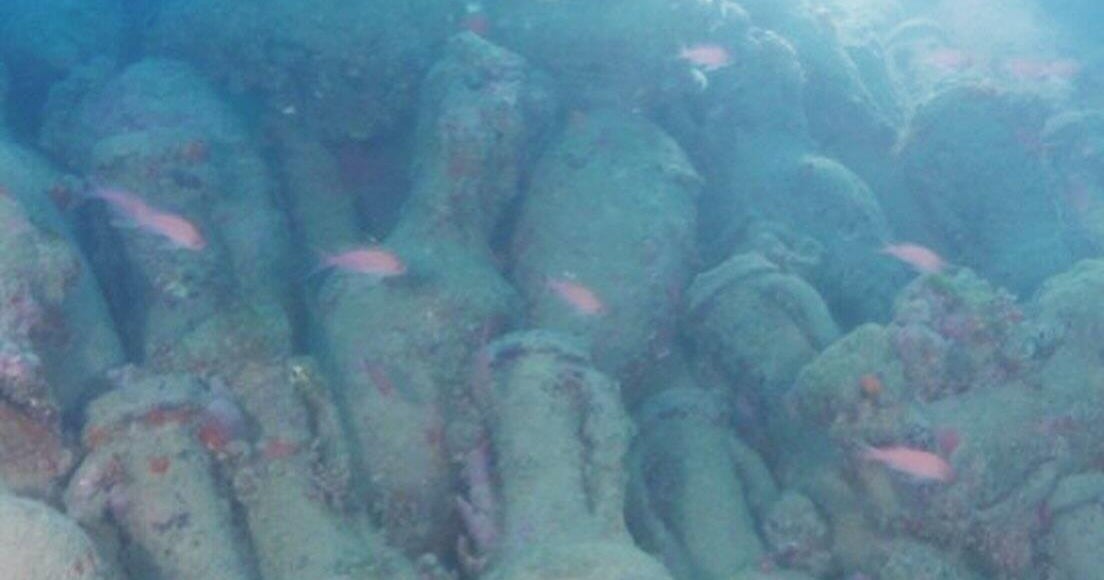
An underwater fisherman off the coast of Sicily saw what looked like a rock on his boat's sonar, dove down to check anyway, and found a Roman merchant ship that had been sitting on the seabed for about 2,100 years with its cargo still stacked in the hold.
Giacomo De Mola made the dive roughly three miles off Mazara del Vallo, on Sicily's southwestern coast, following a tip from local fishermen whose nets had been snagging in the area. At about 150 feet down he found what he described as "a vast expanse of amphorae" — "the most incredible discovery of my life," he said. He reported the position to regional authorities rather than touching anything, and divers from the cultural heritage division of the Palermo police formally documented and confirmed the wreck on Saturday.
The vessel measures roughly 21 meters long and 6 meters wide — about 70 by 20 feet — which puts it in the middle range of Roman coastal freighters, big enough for a serious commercial run but not one of the grain giants that supplied the capital. Its cargo is overwhelmingly Dressel 1A amphorae, the tall cylindrical clay jars with a long neck and a spike at the base that Roman shippers used for wine. That type is tightly dated: Dressel 1A was in production from roughly the late 2nd century BC into the 1st century BC, which places the sinking in the last decades of the Roman Republic.
Italy's culture minister, Alessandro Giuli, called it "one of the most important underwater archaeological discoveries of recent years."
What makes the find valuable to archaeologists is not the jars themselves — Dressel 1A amphorae turn up regularly around the western Mediterranean — but the fact that they are still in position. A cargo that sank intact and was never salvaged records how a specific ship was loaded: how many jars, stacked in how many tiers, packed with what, and in what proportion of shapes and sizes. Wrecks that have been picked over by treasure divers lose that information permanently, which is why the location has not been made public in detail and why the site is being treated as a protected archaeological area.
The wine in those jars would have come from the Tyrrhenian coast of Italy, most likely Campania or Latium, and moved west and north into Gaul and Iberia along a trade route that Dressel 1 amphorae have been used to map for decades. Roman wine exports to Gaul in this period were enormous — archaeologists have recovered the type by the tens of thousands from riverbeds and settlement sites in France — and each new wreck adds a fixed point to the network.
The waters off Mazara del Vallo have produced significant finds before, most famously the Dancing Satyr, a Greek bronze pulled up in a fishing net in 1998 and now displayed in the town. This wreck sits in an area heavily worked by the local fishing fleet, and officials said the tip that led to it came from the same fishermen who had been avoiding the snag for years.