Orcas Filmed Shattering a Giant Sunfish Into Thousands of Pieces in the Gulf of California
One whale holds the carcass. Another lets go at the last second and rams it at speed. Researchers say it is the first documented case of orcas using collision as a butchering technique.
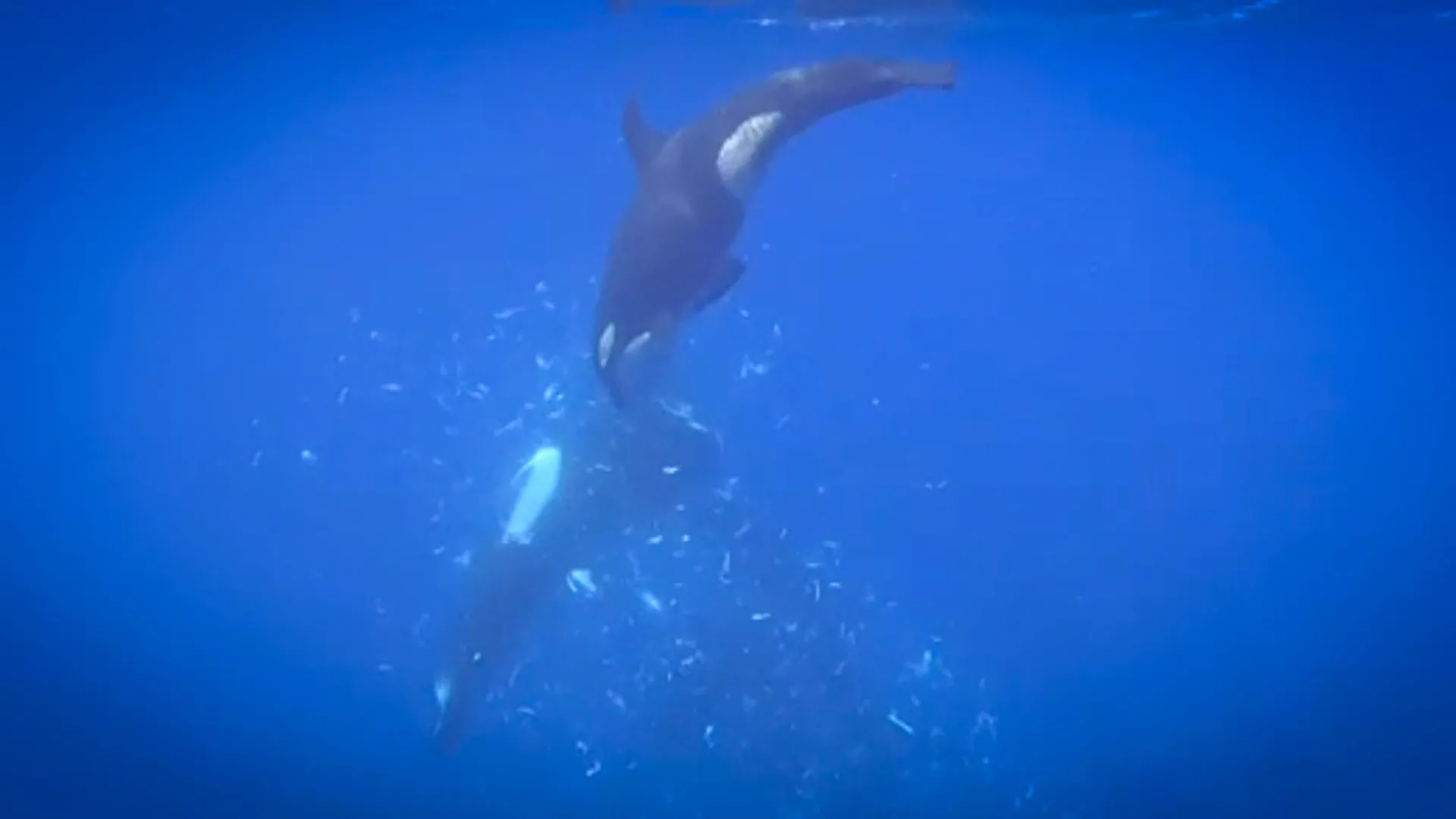
Researchers working in the Gulf of California have filmed orcas doing something no one had recorded before: deliberately smashing a dead sunfish apart by ramming it at high speed, in what the team describes as a previously unknown method of processing prey.
The behavior, described in the journal Frontiers in Ethology, follows a consistent script. One orca takes the sunfish carcass in its mouth and holds it in the water column. A second animal accelerates toward it. At the last possible moment the first whale releases its grip, and the second hits the body at speed, blowing the tissue apart into what the researchers counted as thousands of fragments drifting through the water.
"We document how one orca holds the sunfish and lets go just before another orca hits it at high speed, causing the tissue to break apart," said Dr. Kathryn Ayres of Beneath The Waves, the ocean-health nonprofit that led the study. The team recorded two separate events, in July 2024 and September 2025 — slightly more than a year apart, which the authors take as evidence that this is a repeated technique rather than a one-off accident.
The choice of prey makes the strategy less strange than it first sounds. Ocean sunfish are among the most awkward carcasses in the sea: they can exceed three meters and 2,000 kilograms, with a thick, rubbery, collagen-dense hide that resists tearing. An animal that hunts by biting has a genuine engineering problem opening one. Delivering several tonnes of momentum through a fixed target solves it in a single stroke.
The researchers offer three non-exclusive explanations for why the whales bother. Fragmenting the body may simply be how the pod feeds calves and juveniles that cannot yet tear through hide themselves — a distribution mechanism as much as a butchering one. The pieces may also expose the group to bacteria from the sunfish's gut and skin, seeding or reinforcing their own microbiomes in ways that carry nutritional or immune benefits. And in a species that famously plays with its food, the ramming may be partly social: coordinated, timed, and pointless unless two animals agree on what happens next.
Whatever its function, the behavior belongs to a growing catalog of orca traditions that are local rather than universal — the Antarctic pods that generate waves to wash seals off ice floes, the Norwegian groups that stun herring with their tails, the Iberian animals that took to snapping the rudders off yachts. Each is learned, passed between individuals, and confined to a particular population. The Gulf of California ramming now joins that list as the first case in which collision itself is the tool.