Scientists Film the Elusive Goblin Shark Alive in the Deep for the First Time — Nearly 2,000 Meters Down
Cameras captured the pink, blade-snouted 'living fossil' in its natural habitat off Jarvis Island and in the Tonga Trench — the deepest sighting ever of any white shark, extending its known range by 700 meters.

For the first time, scientists have filmed a living goblin shark gliding through its natural deep-sea habitat — a rare, unguarded look at one of the ocean's most elusive and bizarre-looking predators, a creature so seldom seen alive that it has been called a living fossil.
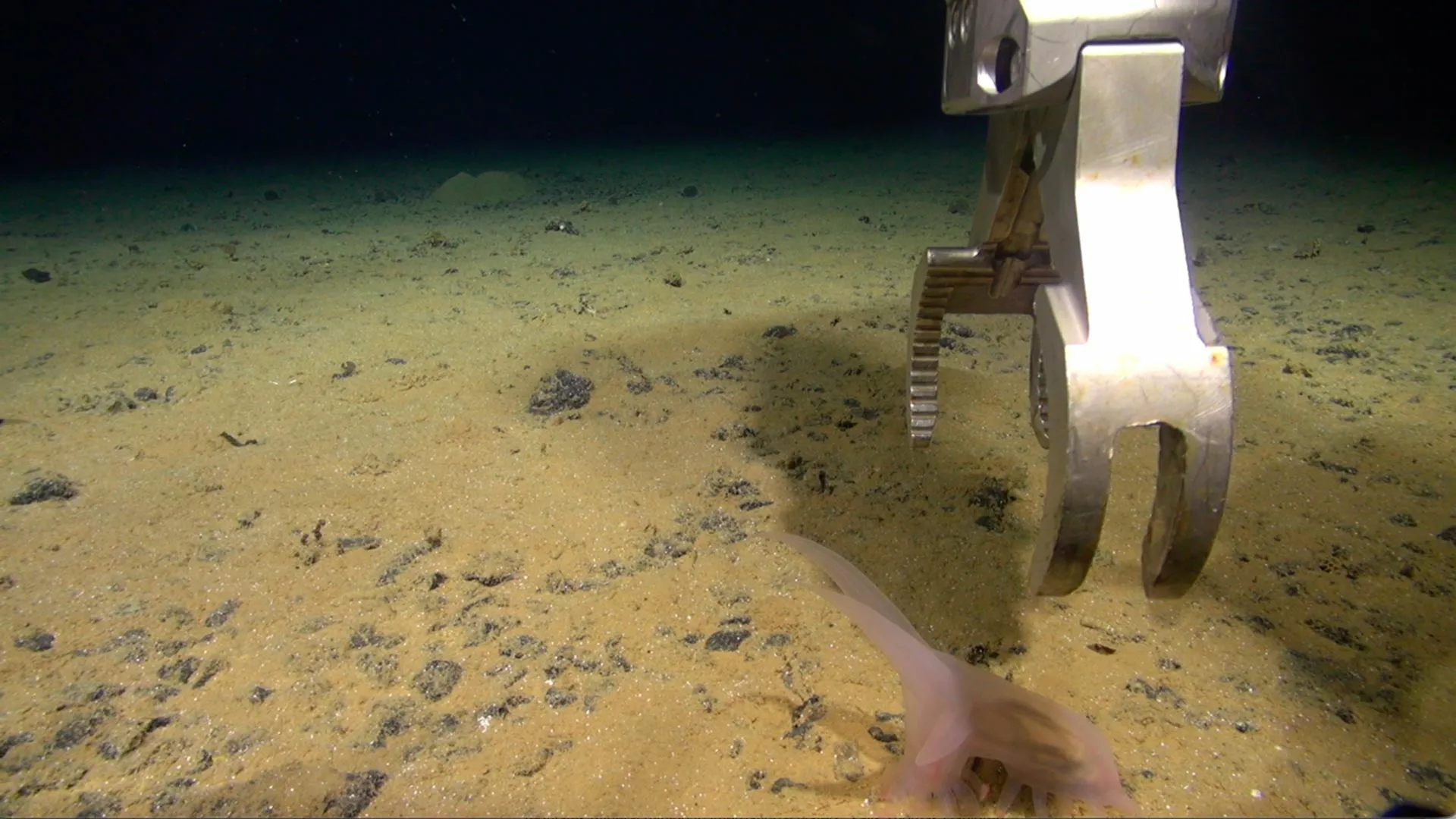
The footage, described in the Journal of Fish Biology, documents two separate encounters with Mitsukurina owstoni in the Central Pacific. The first came in 2019, when a camera mounted on the remotely operated vehicle Hercules captured a goblin shark at 1,237 meters near an unnamed seamount north-west of Jarvis Island. The second, in 2024, was recorded by a baited camera on a bottom lander during the Inkfish Open Ocean Expedition aboard the R/V Dagon, which filmed an individual at 1,997 meters on the slope of the Tonga Trench.
That deeper sighting is a record-setter. At nearly 2,000 meters, it lies roughly 700 meters below the species' previously documented range, making it the deepest confirmed observation of any member of the white shark order. The find extends both the known depth and geographic reach of a shark that scientists have struggled for more than a century to study in the wild.
Until now, virtually every confirmed look at a live goblin shark came only after the animal had been accidentally hooked on a fishing line and hauled to the surface — stressed, disoriented and far from its natural environment. Seeing one healthy and behaving normally in the deep is an entirely different scientific opportunity, offering clues about how the shark moves, hunts and survives in the crushing dark.
"Seeing the most iconic of all the deep-sea sharks alive and looking healthy in its natural habitat is a unique honor," said Aaron Judah of the University of Hawaii at Manoa, who led the analysis with colleagues from the Minderoo-UWA Deep-Sea Research Center. "I was also very surprised about how deep this species was found." He added that "new discoveries like this demonstrate that there is still so much to explore in our deep ocean home."
The goblin shark is instantly recognizable — and, to many, unsettling. It sports a long, flattened, blade-like snout studded with sensory organs that detect the faint electrical fields of prey, and a set of protrusible jaws that can shoot forward out of its face to snatch fish and squid. Its pinkish, translucent skin, a product of blood vessels showing through, has earned it a reputation as one of the strangest animals in the sea. The new footage, researchers say, is a reminder that some of Earth's most alien-looking life is not on distant planets but thousands of meters beneath the waves, still waiting to be seen.