Divers Probe the Ocean's 'Twilight Zone' Off Brazil and Surface 31 Species New to Science
A Schmidt Ocean Institute expedition aboard the research vessel Falkor (too) catalogued dozens of previously undescribed midwater creatures and captured a first-ever 3D image of a living cell at sea.
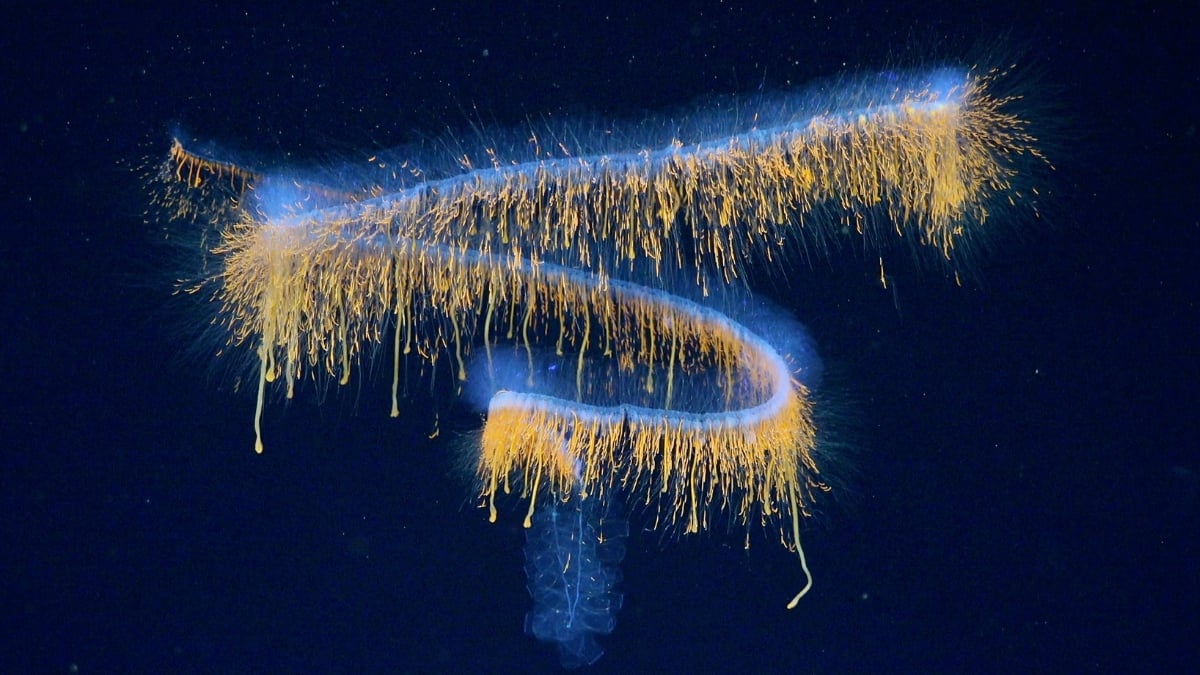
In the vast, dimly lit water column between the sunlit surface and the deep seafloor lies one of Earth's least-explored habitats — the ocean's "twilight zone." A recent expedition into those midwaters off the coast of Brazil has returned with an extraordinary haul: 31 species new to science, glimpsed by researchers in creatures few humans have ever seen alive.
The discoveries were made aboard the Schmidt Ocean Institute's research vessel Falkor (too), where an international team of taxonomists — including scientists from Japan, Australia and Brazil — worked alongside advanced imaging systems and onboard genome sequencing. The combination let the researchers confirm 31 previously undescribed species within a matter of days, an unusually fast pace for a field where naming a single new animal can take years of painstaking study.
Among the finds were delicate Tomopteris worms that swim with rhythmic, paddle-like limbs and translucent comb jellies that propel themselves with shimmering, finger-like rows of cilia. The team also documented larvaceans — tadpole-shaped animals that spin elaborate mucus "houses" around their bodies to strain tiny food particles from the water, then discard and rebuild them as the filters clog. Such gelatinous, fragile organisms rarely survive collection intact, which is part of why the midwater realm has remained so poorly catalogued.
The voyage also produced a scientific first at sea: researchers captured a three-dimensional image of the living cellular structure of a single-celled organism, imaging it in detail aboard the ship rather than waiting to return samples to a distant laboratory. That capability hints at how rapidly the science of the deep is changing, as tools once confined to shore-based labs migrate onto research vessels.
Speed matters in this kind of work. Because midwater animals are so fragile, traditional methods often reduce them to unidentifiable fragments by the time they reach the surface, and the backlog of undescribed specimens in the world's museums can stretch for decades. By pairing high-resolution imaging of animals in their natural state with rapid genetic analysis at sea, the team compressed that timeline dramatically, describing creatures while the memory of seeing them alive was still fresh.
The twilight zone is not just a biological curiosity. The midwater teems with life that forms a crucial link in the ocean's food web and plays an outsized role in drawing carbon from the surface into the deep. Yet it remains, in the words of the expedition team, among the planet's largest and least-understood frontiers — one that each such voyage maps a little further, revealing creatures that have drifted unseen through the dark for millions of years.
Originally reported by ScienceAlert.