Hydrogen Chloride Leaking From Cracks on Mars Hints at a Still-Warm Volcano
An orbiter spotted the gas rising from fresh-looking fractures on Alba Mons in early summer, suggesting magma may still sit beneath the Red Planet's surface.
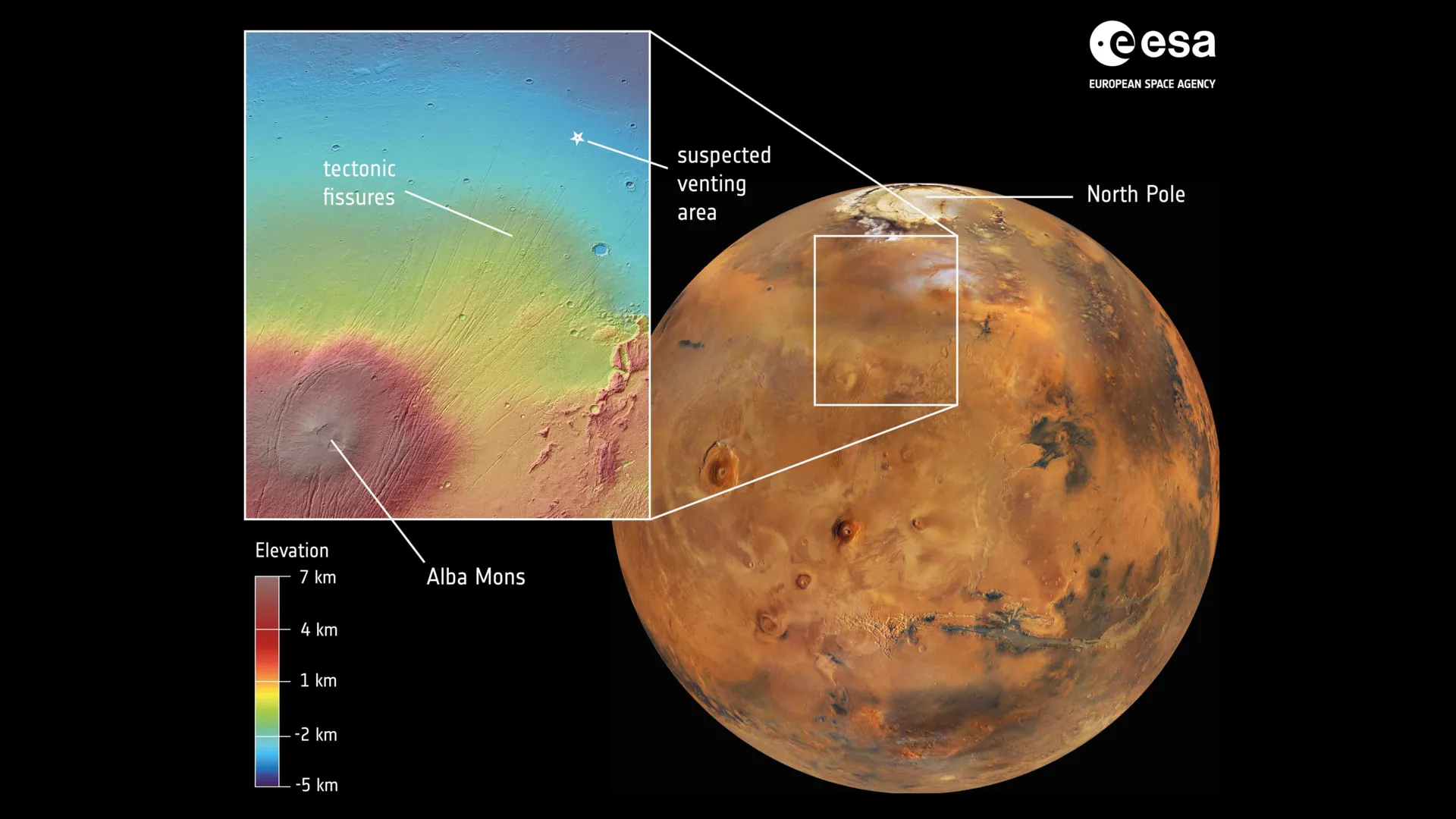
Mars may not be as geologically dead as it looks. A team using the European Space Agency's ExoMars Trace Gas Orbiter reports that hydrogen chloride gas is seeping from fractures on the flanks of Alba Mons, one of the planet's giant volcanoes, a pattern the researchers say is best explained by heat and magma still active deep below.
The study, published in Science Advances, was led by Alexander Trokhimovskiy, with Daniel Mège of the Space Research Centre of the Polish Academy of Sciences as co-lead author. Hydrogen chloride on Mars normally follows a seasonal cycle, peaking in northern winter and falling to very low levels in summer, a pattern tied to the planet's dust and water cycles. The orbiter's Atmospheric Chemistry Suite, an infrared spectrometer, found an exception: elevated levels repeatedly appeared in early summer over a small area at Alba Mons, shortly after winter frost disappeared.
The team then turned to the orbiter's CaSSIS camera, which showed narrow fractures that looked relatively fresh, some extending hundreds of meters, with unusual color changes around them. "The Trace Gas Orbiter was able to find the smoking gun," Mège said. "It was like looking for a needle in a haystack. It's truly amazing that it spotted a handful of molecules from a perhaps intermittent source, whilst moving continuously along its orbit."
The researchers propose that gas from a dormant magma chamber is rising through the cracks, much like fumaroles, the volcanic vents seen on Earth. Mars's brutally cold winters, when temperatures can fall to about minus 120 degrees Celsius, could seal the fractures with ice. When the ice sublimates in early summer, it would open pathways and let the gas escape. The discoloration around the cracks may be minerals deposited by the escaping gases, as is common around fumaroles on Earth. The orbiter first detected hydrogen chloride in the Martian atmosphere in findings reported in 2021.
Ruling out other explanations took most of the effort. "A huge part of the work consisted of examining all the possible chemical processes going on in the Martian atmosphere," Mège said. "We needed to be rigorous, critical and creative." Having tested chemistry unrelated to volcanism, the team concluded that magma-driven degassing fit the data best. "Our findings suggest that Mars has retained enough internal heat to support volcanic activity until recently, and possibly still does," he said.
The result is a strong hint, not a confirmed eruption. Mars hosts the largest volcanoes in the solar system, and orbital images show some erupted within the past few million years. Landers have also recorded marsquakes, a sign of continuing seismic activity. But scientists have never directly watched a new eruption or fresh lava flow on the planet. If the Alba Mons signal holds up, it would show that internal heat and volcanic gases still reach the surface, and it would bear on how Mars lost its thicker, warmer atmosphere and whether it once supported conditions suitable for life.