Black Holes Throw Back Nearly as Much Matter as They Eat, a Warwick Team Found by Watching One Fade
Observations of Swift J1727.8−1613 with the Very Large Telescope caught powerful outflows still running after the system had dimmed to a hundredth of its peak brightness.
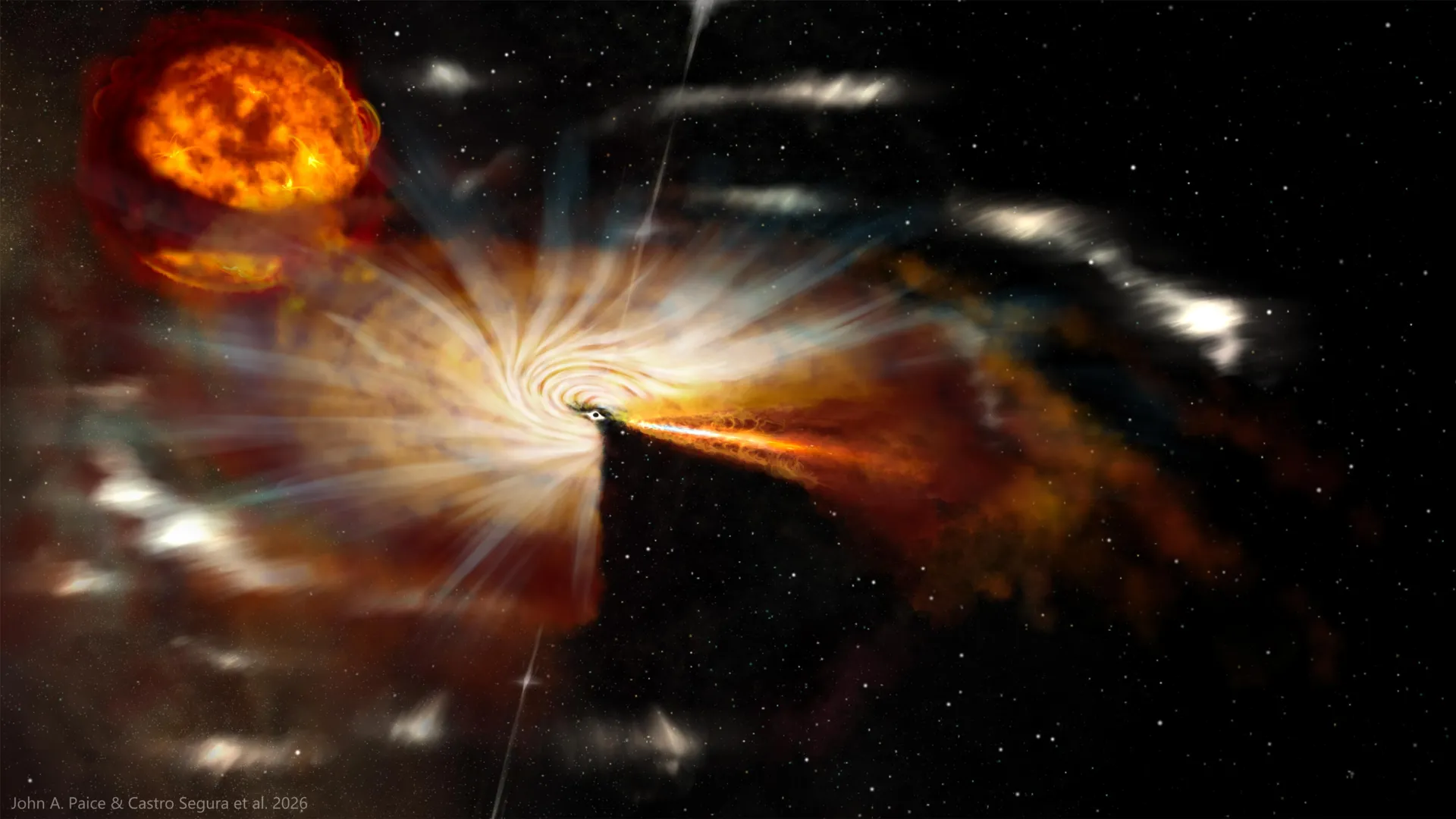
A black hole is supposed to be the one place in the universe from which nothing comes back. New observations suggest that as a system, it is far leakier than that — expelling an amount of matter that may come close to matching what it takes in.
The finding comes from a team led by Dr. Noel Castro Segura, a postdoctoral fellow at the University of Warwick, working with Kyle Solomons of the University of Cape Town and an international group of astronomers. They tracked the black hole system Swift J1727.8−1613 through its 2023 eruption using the European Southern Observatory's Very Large Telescope in Chile. The results appear in Monthly Notices of the Royal Astronomical Society, volume 550, issue 4.
Swift J1727.8−1613 is an X-ray binary: a black hole locked in orbit with a companion star, pulling gas off its partner into a superheated accretion disk that spirals inward. Systems like this brighten dramatically when the rate of infalling material surges, then fade over months as the supply runs down. The eruption gave the team a full cycle to watch.
The critical observation was not the peak. It was the tail. Conventional models expect that once the accretion rate collapses, the machinery that launches jets and winds should shut down with it — the outflows are powered by the inflow, so when the meal ends, the exhaust stops. Instead, the team found powerful outflows still streaming from the system after its brightness had fallen to roughly one-hundredth of its peak. The engine kept running long after the fuel gauge said it should have stopped.
"Matter falls in, the system processes it, and a surprising amount is expelled again," Castro Segura said.
Adding up the mass carried away in the jets and winds against the mass that crossed the event horizon, the team concluded that black holes behave less like bottomless pits and more like cosmic digestive systems — grossly inefficient eaters that spray most of their meal back into the surrounding space.
That inefficiency has consequences well beyond the object itself. Binary star evolution models assume a certain fraction of transferred mass ends up inside the black hole, and those assumptions determine predicted orbital changes, final black hole masses and the population statistics that gravitational-wave detectors are now measuring directly. If the retained fraction is substantially smaller than assumed, the models need adjusting. The expelled material also does not vanish: it deposits energy and enriched gas into the interstellar medium, feeding back into the galaxy that hosts it and influencing where the next generation of stars can form.
Originally reported by ScienceDaily.