Antarctic Ozone Hole Grows to Its Biggest in a Decade, but the Layer Is Still Healing
NASA and NOAA say an unusually strong polar vortex stretched the 2026 hole to 10.5 million square miles; without the Montreal Protocol it would have been far larger.
The Antarctic ozone hole grew to its seventh-largest size in 48 years of observations in 2026, NASA and NOAA scientists reported, reaching proportions not seen in a decade. The agencies say the cause is weather, not a setback in the long recovery of Earth's protective ozone layer.
Between Sept. 7 and Oct. 13, when depletion peaked, the hole averaged about 9.6 million square miles, more than twice the area of the United States. It reached its maximum extent on Sept. 18 at 10.5 million square miles, roughly 90% of the largest hole ever measured, which occurred on Sept. 9, 2000.
"The annual ozone hole has been forming later in the season in recent years, which tells us the ozone layer is healing," said Paul Newman, a senior scientist at the University of Maryland who has long led NASA's ozone research team at Goddard Space Flight Center. "But an unusually powerful polar vortex has extended ozone depletion in the Antarctic this season, allowing the hole to grow to proportions we haven't seen in a decade."
The polar vortex is a seasonal band of strong winds circling Antarctica. It traps extremely cold air, which lets special stratospheric clouds form. Chlorine and bromine atoms, freed from human-made chemicals by ultraviolet light, react on those cloud particles and destroy ozone. A stronger or wider vortex lets those conditions persist over a larger area.
This year the weather systems that normally weaken the vortex were unusually quiet. "The polar vortex was unusually large this year in part because planetary-scale weather systems that typically well up from the lower atmosphere and break up the vortex were especially weak in August and September," said Amy Butler, a research scientist at NOAA's Chemical Sciences Laboratory. The weak wave activity kept the strongest vortex winds several degrees of latitude farther from the South Pole, creating a larger zone ripe for ozone loss.
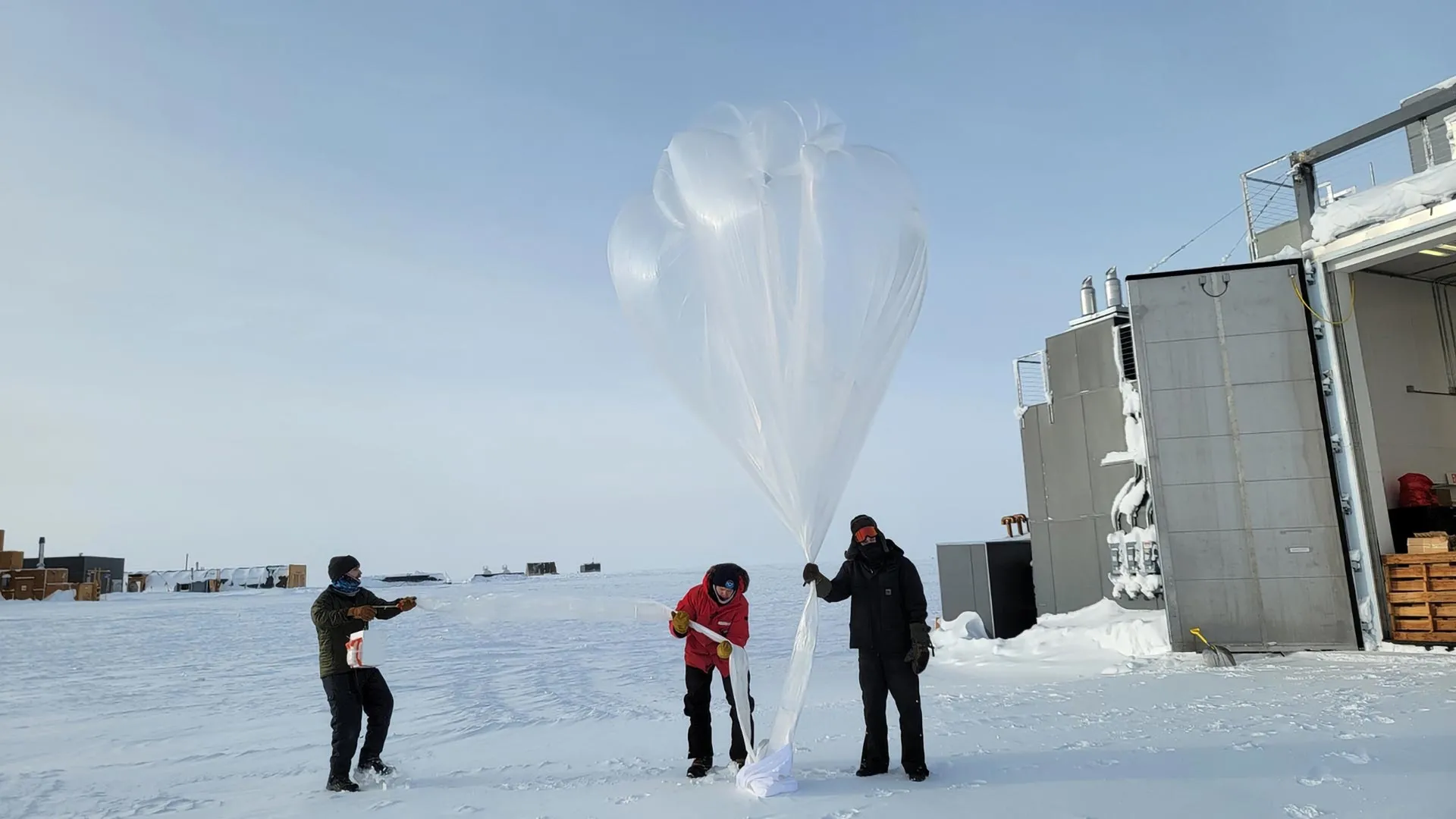
Despite the size, the 2026 hole did not match the extreme depth of loss seen in record years 10 or 20 years ago. NOAA researchers flew ozone-measuring instruments on weather balloons from the South Pole Baseline Atmospheric Observatory and also used a Dobson spectrophotometer. Ozone over the pole bottomed out on Oct. 17 at 105 Dobson units. The lowest ever recorded there was 92 Dobson units, in October 2006. A reading of 100 units equals a layer about 1 millimeter thick, roughly a dime, if all the ozone in the column were compressed at sea level.
Satellites supplied further data, including NASA's Aura, NOAA-20, NOAA-21 and the Suomi NPP satellite, continuing observations that began in 1979.
Scientists say the numbers show the 1987 Montreal Protocol is working. Stephen Montzka, a senior scientist at NOAA's Global Monitoring Laboratory, said chlorine in the Antarctic stratosphere tied to ozone-depleting chemicals has fallen about one-third from its 1980s peak. "The 2026 ozone hole is large but could have been 1 to 2 million square miles larger if ozone-depleting substances were as prevalent in the atmosphere today as they were at their year 2000 peak," Newman said.
The chemicals, including chlorofluorocarbons once common in refrigerators, air conditioners and insulation, can linger in the atmosphere for decades, and old equipment and landfill waste can still release them. NASA and NOAA say the ozone layer remains on track to heal later this century.