A Three-Foot Giant Salamander From 3.5 Million Years Ago Turns Up in Three Japanese Vertebrae
Kyoto University researchers say fossils from Oita prefecture belong to a new genus, only the sixth ever described in the giant salamander family, and suspect other museum specimens have been misfiled for years.
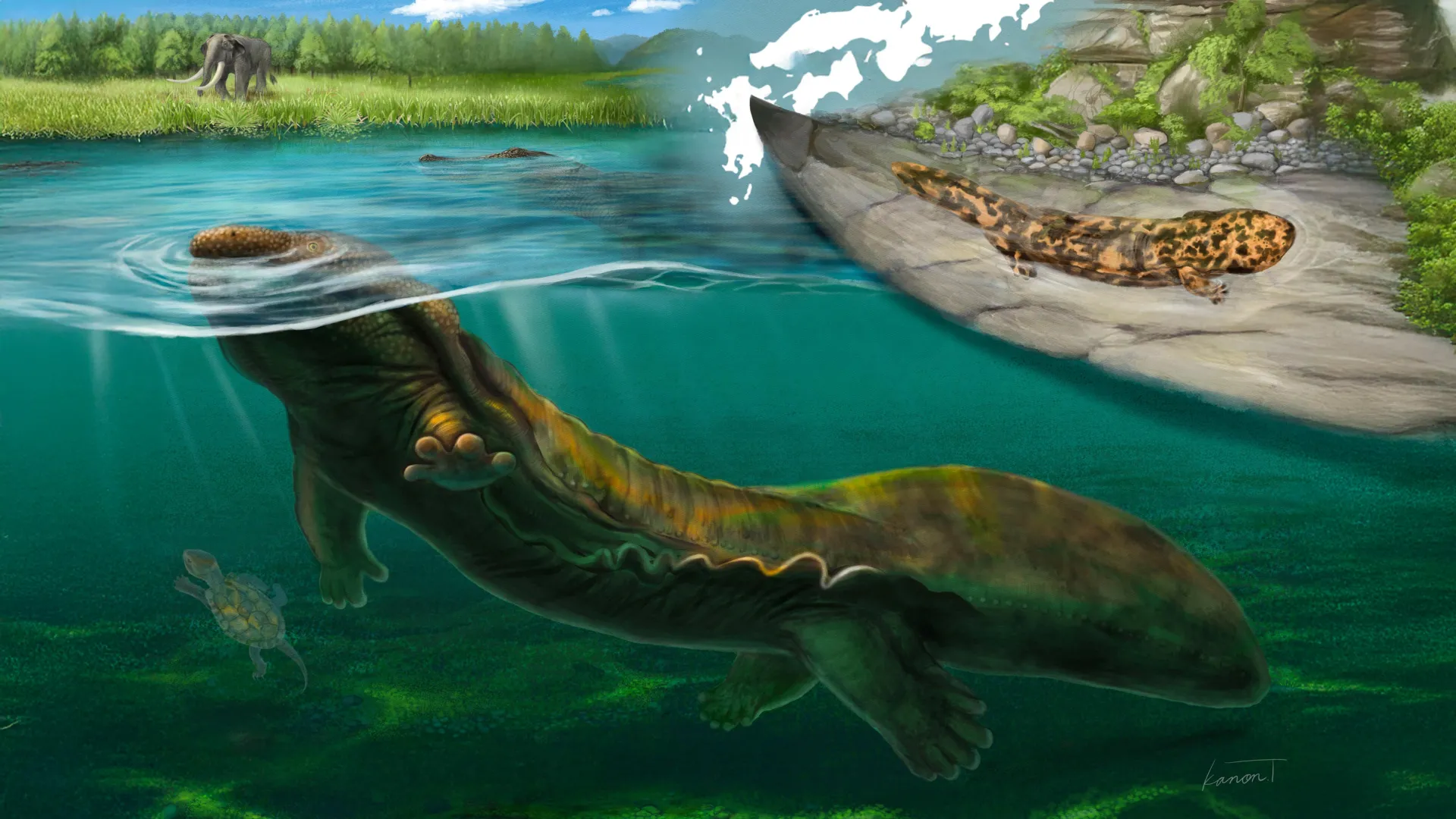
Three fossil vertebrae recovered from the Ajimu area of Oita prefecture, on the Japanese island of Kyushu, have been identified as a previously unknown giant salamander that grew to about 1.1 meters and lived roughly 3.5 million years ago. Researchers at Kyoto University have named it Limnospondylus ajimuensis, and they say it represents not just a new species but a new genus, only the sixth ever described within Cryptobranchidae, the family that contains the world's largest living amphibians.
The material is sparse by the standards of vertebrate paleontology: an anterior trunk vertebra, a mid trunk vertebra and a sacro-caudal vertebra. But the mid trunk bone carried a combination of anatomical features that does not match any known giant salamander, living or extinct, which is what forced the erection of a new genus rather than the assignment of the fossils to an existing one. Masahiro Noda led the study, with Masafumi Matsui and Kanto Nishikawa. The description appears in PeerJ, volume 14, article e21362.
The finding carries an implication beyond the single animal. Fossil giant salamanders have routinely been assigned to Andrias, the living genus that includes the Japanese and Chinese giant salamanders, largely because the material is fragmentary and Andrias was the obvious default. The Kyoto team argues that a number of those specimens sitting in collections may in fact belong to unrecognized genera, and that the family's fossil record has been quietly compressed by that habit. Reexamining old material with the diagnostic features they identified is the natural next step.
Pliocene Kyushu was warmer and more humid than Japan is today, and Limnospondylus ajimuensis would have lived in the freshwater lakes and marshes that covered the region. Giant salamanders are almost entirely aquatic, absorbing most of their oxygen through folded skin along their flanks, and they depend on cool, well-oxygenated water. That dependence narrows their tolerance considerably, and the researchers attribute the animal's extinction to the cooling and habitat reorganization of the Pliocene-Pleistocene transition, when Japan's climate swung toward the glacial cycles of the last two and a half million years.
Modern giant salamanders are a conservation problem in their own right. The Japanese giant salamander, Andrias japonicus, reaches about 1.5 meters and is protected as a Special Natural Monument, but its populations have been fragmented by river dams and weirs that block the upstream migration to spawning grounds, and it now hybridizes extensively with introduced Chinese giant salamanders in parts of western Japan. The Chinese species, Andrias davidianus, is critically endangered in the wild, largely emptied out by the farming trade.
A fossil record with more genera in it than previously recognized changes how deep the family's history looks and how much of its diversity has already been lost, which is the frame conservation biologists use when arguing how much of what remains is worth the expense of saving.