100-Million-Year-Old Bug With Crab-Like Claws Unlike Any Modern Insect Discovered in Amber
The bizarre ancient creature represents only the fourth known case of crab-like pincers evolving independently in insects.
Scientists have discovered a remarkable 100-million-year-old insect preserved in Myanmar amber that possessed crab-like claws unlike anything seen in modern insects. The finding, published in the journal Insects, represents an extraordinary example of convergent evolution and provides new insight into the diversity of ancient forest ecosystems during the age of dinosaurs.
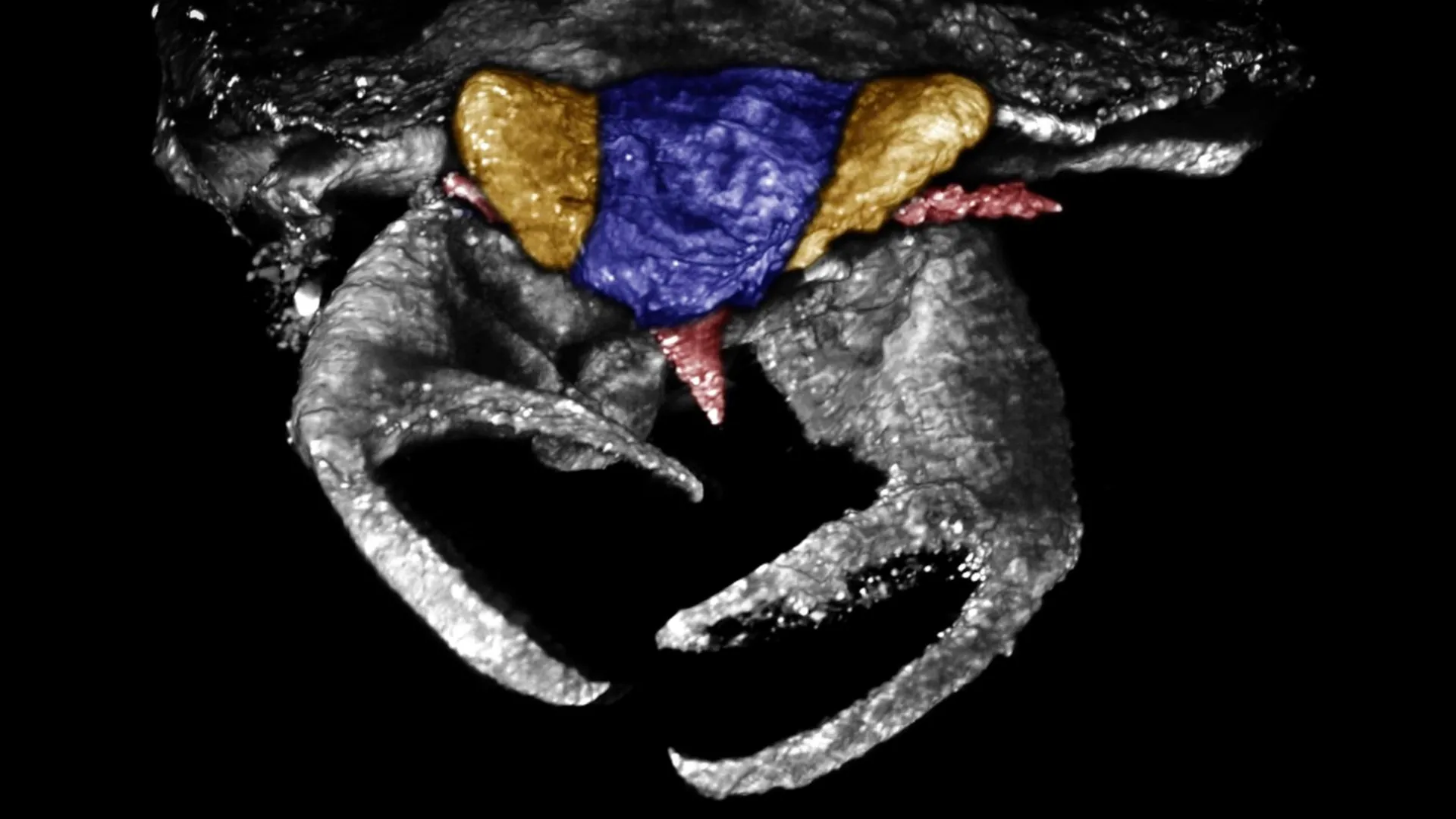
The newly identified true bug, scientifically named Carcinonepa libererrantes, featured large claw-like structures called chelae on its front legs that functioned much like the pincers of crabs and lobsters. These appendages are extremely rare among insects, with researchers noting that this fossil represents only the fourth known case of such structures evolving independently in the insect world. The discovery was made by an international team from Ludwig Maximilian University Munich, the University of Rostock, and the University of Oulu in Finland.
Using advanced micro-computed tomography, the research team created detailed 3D images that allowed them to examine the insect's anatomy with unprecedented precision. They conducted a comprehensive morphological comparison involving more than 2,000 chelae and similar grasping appendages from both living and extinct species. Surprisingly, their analysis showed that the fossil bug's claws more closely resembled those of distant arthropods like crabs and shrimp rather than other insects.
The species name "libererrantes" pays tribute to the K-pop group Stray Kids, chosen because the fossil's claw posture resembles the group's trademark pose. Lead researcher Carolin Haug from LMU explained that "the name seemed fitting because the posture of the fossil's chelae strongly resembles the group's trademark pose. Stray Kids, I should add, is the favorite band of one of the paper's authors, Fenja Haug."
Based on its preserved anatomy, researchers believe Carcinonepa libererrantes lived as a predator in Cretaceous forest environments, possibly near coastal areas. The insect's body structure suggests similarities to modern toad bugs, which are land-dwelling predators. The oversized chelae on its front legs were likely used to capture and hold small insect prey, making it a formidable hunter in its ancient ecosystem. The discovery adds to growing evidence that insect diversity during the Cretaceous period far exceeded what scientists previously understood.