Trump Wants a 30-Foot 'Washington Colossus' Where the Smithsonian's 'Infinity' Sculpture Has Stood Since 1967, an 11-Foot Bronze in Flag Hall by Constitution Day, and a Five-Year Exhibit Running to Washington's 300th Birthday.
In two late-night Truth Social posts the president called José de Rivera's stainless-steel sculpture 'strange' and said it 'tells visitors nothing about America.' The Smithsonian's Board of Regents, not the White House, controls the museum, and its secretary, Lonnie Bunch, has already announced he will leave at the end of the year.
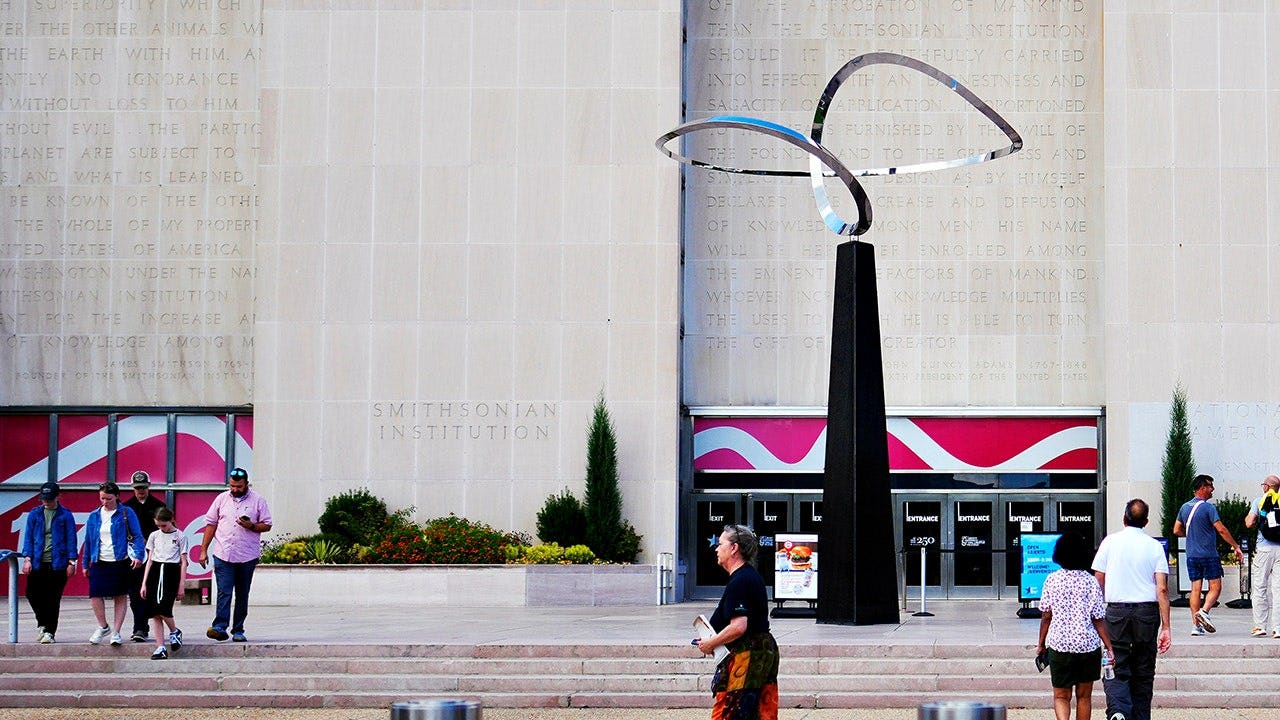
President Trump has told the Smithsonian Institution to tear out the abstract sculpture that has stood in front of the National Museum of American History for nearly 60 years and replace it with a 30-foot statue of George Washington, the latest and most concrete demand in his long campaign to remake how the nation's museums tell the country's story. In two Truth Social posts late Friday, Trump laid out three requirements: an 11-foot bronze of Washington installed in the museum's Flag Hall by Constitution Day on September 17, a special exhibition on the first president running through February 22, 2032, the 300th anniversary of his birth, and, "as soon as it is ready," a "30-foot Washington Colossus where 'Infinity' stands today."
"Infinity," a rotating loop of polished stainless steel by the New York sculptor José de Rivera, was commissioned by the federal government and installed on the museum's Constitution Avenue plaza in 1967. Trump called it a "strange modernist sculpture" that "tells visitors nothing about America, inspires no one," and wrote that Washington, "more than anyone else, says everything about America." He accused the museum of paying insufficient attention to the Founding Fathers, to Washington's crossing of the Delaware on the night of December 25-26, 1776, and to the victory at Trenton that followed, and said too much of the institution's energy goes to those who suffered oppression rather than those who "triumphed over great oppression, against great odds." He also called for the Smithsonian's Center for Restorative History to be renamed a "Center for American Heroes."
Whether the president can compel any of it is an open question. The Smithsonian is a trust instrumentality created by Congress in 1846 and governed by a 17-member Board of Regents that includes Chief Justice John Roberts, Vice President JD Vance and members of both chambers. It receives about two-thirds of its budget from federal appropriations but is not an executive agency, and no president has previously directed the placement of specific artworks on its grounds. The museum did not respond to requests for comment over the weekend.
The demand arrives at a moment of maximum leverage. Smithsonian Secretary Lonnie Bunch III, the founding director of the National Museum of African American History and Culture, announced last month that he will step down on December 31 after repeated public attacks from the White House. Trump signed an executive order in March 2025 assigning Vance to purge "improper ideology" from the institution, followed in July of this year by a 162-page White House critique branding the American History museum a nest of "radical activists" and an order to post signs outside it warning visitors that certain exhibits are inaccurate. The signs have not gone up.
The Washington statue fits a pattern of monumental projects the president has pushed in his second term, including a proposed "Garden of American Heroes" and the ballroom and triumphal arch he has planned for Washington, D.C. The 2032 date ties the exhibit to the semiquincentennial celebrations Trump has made a centerpiece of his cultural agenda, which began with the July 4, 2026 anniversary of the Declaration of Independence.
De Rivera, who died in 1985, was a Works Progress Administration artist whose sculptures sit in the Museum of Modern Art and the Whitney. "Infinity" was chosen in the 1960s precisely because it made no representational claim about the country, a decision museum officials at the time framed as an invitation for visitors to draw their own conclusions. Sixty years later, the president has drawn his.
Originally reported by Fox News.