Superheat a Magma and Its Crystals Stop Forming for Eight Hours. That May Be Why Some Volcanoes Fountain.
Manchester researchers watched magma from La Palma's 2021 eruption crystallize inside an X-ray-transparent pressure vessel, and found extra heat dissolves the seeds new crystals need.
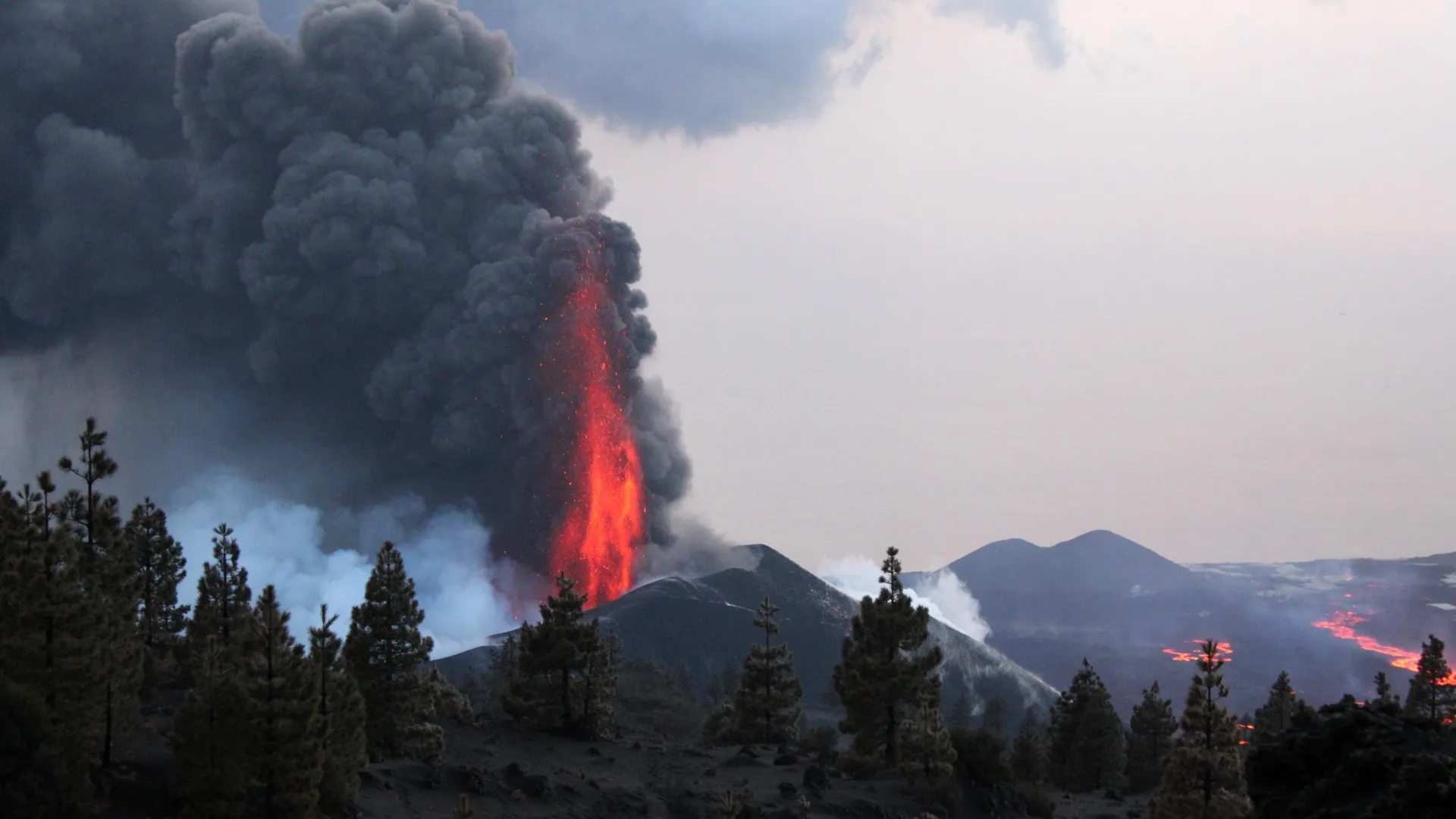
Two volcanoes can hold chemically similar magma and erupt in completely different ways. One sends a lava fountain hundreds of meters into the air; the other oozes. A study published in Nature Communications argues that part of the answer is a variable that eruption models have largely ignored: how hot the magma got on its way up, and when.
An international team led by the University of Manchester worked with magma collected from the 2021 Tajogaite eruption on La Palma, in Spain's Canary Islands, and tested what happens when that magma is "superheated" — pushed hotter than the temperature at which its crystals remain stable. The finding is that superheating dissolves the tiny pre-existing crystals that normally act as seeds for new crystal growth, and reorganizes the melt at a microscopic level into a structure that is more uniform and less hospitable to new crystals forming.
The delay is not subtle. Magma that had not been superheated started forming crystals after roughly 20 minutes. Strongly superheated magma went more than eight hours without forming any.
To watch it happen, the researchers used a newly developed X-ray-transparent pressure vessel at Diamond Light Source, the UK's synchrotron, combined with X-ray microtomography — effectively a CT scan of magma held at volcanic temperature and pressure, running in real time. Complementary experiments in Prague let the team follow the same samples over longer periods.
"The history of crystal and bubble growth can dramatically control how a magma erupts; in particular, as more crystals grow, they eventually have a dramatic effect on magma viscosity," said lead author Dr. Barbara Bonechi, a research associate at Manchester. "Until now, we did not fully understand the dynamics of crystal growth for magmas that received an injection of superheat just before ascent. But using our exciting and newly developed X-ray transparent pressure vessel combined with synchrotron X-ray microtomography, we can actually observe these processes in situ."
Feeding those measured delays into numerical models of magma ascent produced a clean split. Magma that stays crystal-free stays fluid, and fluid magma rises fast — fast enough to arrive at the surface still charged with gas and blow out as a lava fountain. Magma that starts crystallizing early thickens, rises slowly, and gives its dissolved gas time to escape along the way, which produces the gentler effusive flows that creep rather than jet.
The practical target is forecasting. "Current volcanic hazard models typically focus on magma chemistry, gas content and pressure changes," said co-author Dr. Margherita Polacci, a senior lecturer in volcanology at Manchester. The suggestion is that a volcano's pre-eruptive thermal history — whether a hot batch of magma was injected into the system shortly before ascent — belongs in that list, because it can flip the eruption style without changing the chemistry monitoring stations are watching.
Tajogaite is a useful test case precisely because it did both. The 2021 eruption ran for nearly three months on La Palma, destroying roughly 3,000 buildings and burying banana plantations under lava, and it alternated between violent fountaining and slower effusive output over that span. A mechanism that explains how the same volcano switches modes is exactly what monitoring teams need to interpret the signals they already collect.
Originally reported by ScienceDaily.