South Korea's President Said on Live TV There Will Be 'No Deployment Involving Participation or Intervention in the War.' Trump Had Complained He Asked Seoul for 'a Little Hand' in Hormuz and Was Told 'No Thanks.'
Lee Jae Myung said Seoul will instead consider expanding its anti-piracy naval unit off Somalia and may offer patrol aircraft, mine-disposal teams and supply ships. He also said he will not seek a second term and that the $350 billion U.S. investment deal is close to done.
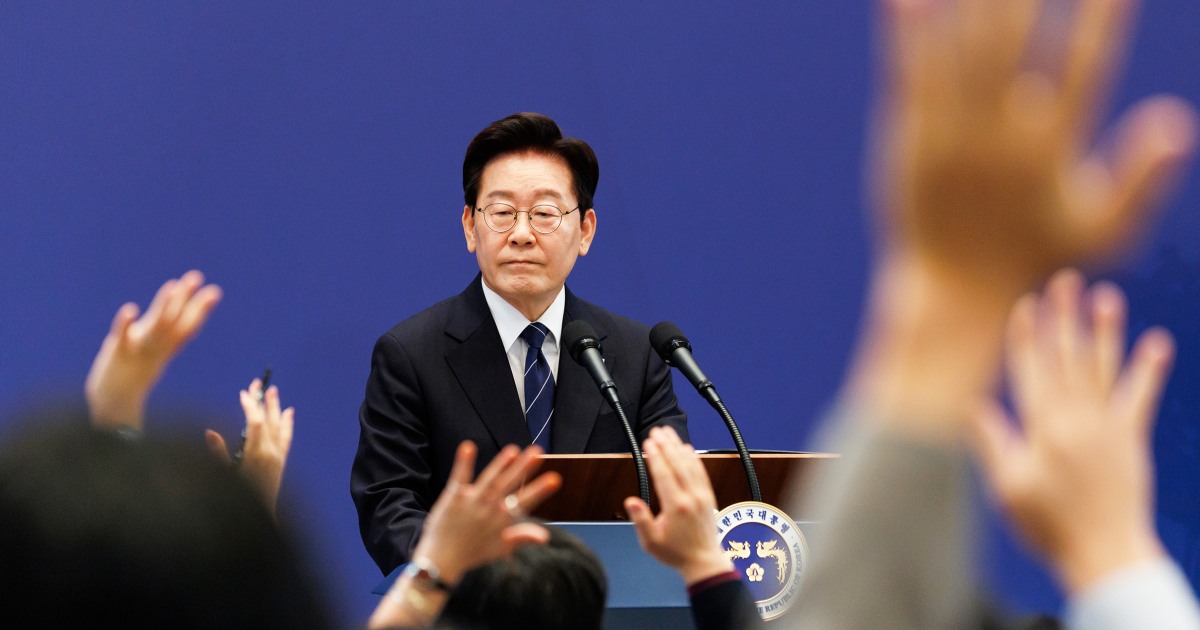
South Korean President Lee Jae Myung told a televised news conference in Seoul on Friday that his country will not send troops or military hardware into the Iran war, drawing a line under weeks of pressure from Washington to help reopen the Strait of Hormuz. "There won't be deployment that would involve or enter war. I can tell you that very clearly," Lee said at the Blue House. "There will be no deployment involving participation or intervention in the war."
The statement was an answer to President Trump, who has publicly criticized Seoul for declining to join the American effort in the strait and has recounted the exchange himself. "I said, 'Would you like to give us a little hand?'" Trump said of his conversation with Lee. "He said, 'No thanks.'" Trump has since scaled back joint military exercises between the two allies, a step that carries weight in a country that hosts roughly 28,000 American troops and relies on the U.S. security guarantee against North Korea.
Lee did not shut the door entirely. He said South Korea must carry out "the minimum level of activities" that other countries perform to protect their own citizens and the crude-oil shipping lanes that feed a heavily import-dependent economy. The country's Cheonghae naval unit already operates off Somalia on anti-piracy duty and escorts commercial vessels, and Lee said his government was "deliberating on and considering ways to strengthen these efforts." A South Korean fact-finding team recently returned from the United Arab Emirates after surveying conditions in the region. Options under review, according to officials, include maritime patrol aircraft, naval mine-disposal teams and logistics support ships, none of which would put Korean forces in a shooting role.
Any Hormuz mission is a hard sell at home. Public opinion in South Korea runs strongly against involvement in the Middle East, and Lee's Democratic Party won its parliamentary majority in part by promising a more independent line from Washington. South Korea's foreign minister was in Washington this week for talks that covered both the Hormuz question and the stalled effort to restart U.S.-North Korea dialogue.
Lee used the same news conference to close off two other lines of speculation. He said he has no intention of seeking a consecutive term, which is barred by South Korea's constitution, even though his party holds the votes to attempt an amendment. He also said negotiations over the $350 billion investment pledge that South Korea made to secure its trade agreement with the United States are nearing a resolution, despite what he called concerns about the commercial viability of some projects.
On North Korea, Lee said it would be "far easier to restart dialogue between North Korea and the United States than between the two Koreas," and he signaled openness to a Trump-Kim Jong Un meeting, adding that coordination with Washington on the subject continues. Lee's careful wording, ruling out war-fighting while leaving room for escort and support missions, is likely to become the template other allies use when the White House asks them the same question.
Originally reported by NBC News.