Sixty Years of Radiation-Belt Data May Have Been Read Wrong, and the Culprit Is Blurry Spacecraft Vision
A study in Physical Review Research shows that highly organized particle motion looks nearly identical to random scattering once a spacecraft's limited resolution smears out the fine structure.

Earth is wrapped in two doughnut-shaped regions of high-energy particles trapped by the planet's magnetic field — the Van Allen radiation belts. For more than 60 years, physicists have interpreted spacecraft measurements of those belts through models built on diffusion: the assumption that particles are being randomly scattered by plasma waves and spreading out the way a drop of ink spreads through water. A new study argues that a large share of those measurements may look like diffusion without any diffusion having occurred.
The work, published in Physical Review Research by an International Space Science Institute team led by the University of Birmingham and the Czech Academy of Sciences, shows that entirely predictable, highly structured particle motion produces spacecraft data almost indistinguishable from random scattering. The reason is resolution. A localized population of energetic particles drifting through a magnetic field folds itself into finer and finer filaments over time. A spacecraft sampling that population sees only a coarse average — and a coarse average of intricate structure looks smooth.
"For more than 60 years, spacecraft observations have often been interpreted using diffusion-based models," said lead author Dr. Adnane Osmane of the University of Helsinki. "Our results show that some observations may also be explained by a fundamentally different process. The key message is not that diffusion does not occur, but that observations alone may not always distinguish between diffusive and nondiffusive transport."
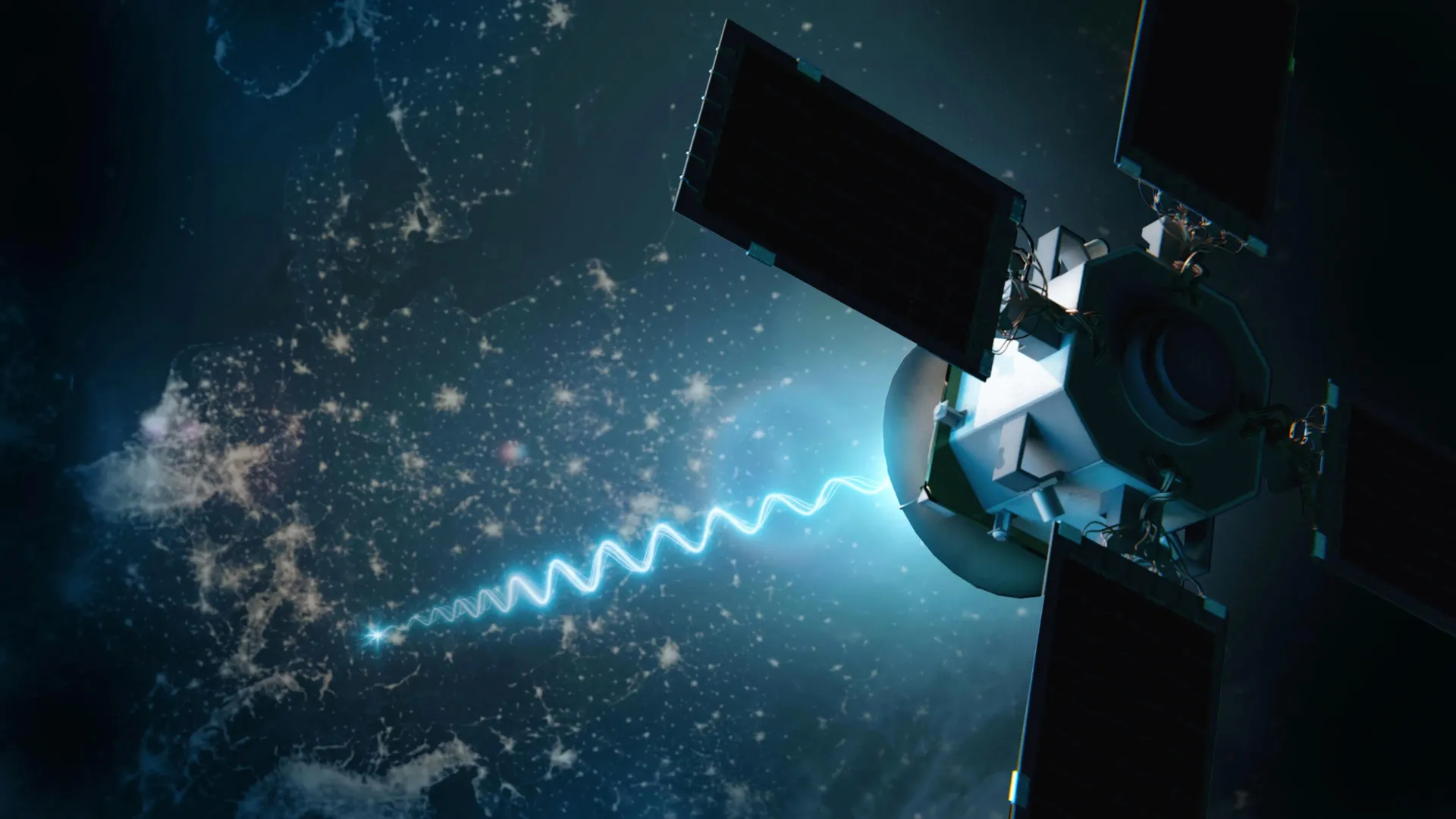
The mechanism is straightforward once stated. As a spacecraft travels through the belts, it samples particles orbiting the planet at slightly different speeds. Those speed differences shear an organized structure into something that, sampled at limited resolution, mimics exactly what random wave scattering would produce. The team offers an art-history analogy: a Jackson Pollock canvas is a dense web of distinct lines and splatters, a Mark Rothko is smooth fields of color, and a Pollock viewed at low enough resolution becomes a Rothko — without a single brushstroke changing.
The consequences are not academic. "Radiation belts contain highly energetic particles that can damage satellites, disrupt communications and affect space missions," said co-author Dr. Oliver Allanson of the University of Birmingham. "Our findings challenge these assumptions about how radiation belts work — suggesting we may need to rethink how we model and predict hazardous space environments." Space-weather forecasts that warn operators when to safe-mode a satellite are built on diffusion coefficients extracted from exactly the observations now in question.
The reach extends past Earth. Radiation belts surround Saturn, Jupiter and its moon Ganymede, and have recently been detected around ultracool brown dwarfs. Every one of those environments has been characterized with the same interpretive toolkit. The study does not claim diffusion is absent; it claims that two fundamentally different physical processes can generate the same observational signature, and that distinguishing them will require either higher-resolution instruments or measurements designed specifically to tell them apart.