NASA Satellites Watch Earth's Newest Island Struggle to Rise in the Bismarck Sea
An underwater eruption near Papua New Guinea has been spewing steam and staining the ocean since May, and scientists are waiting to see whether a new island will be born.
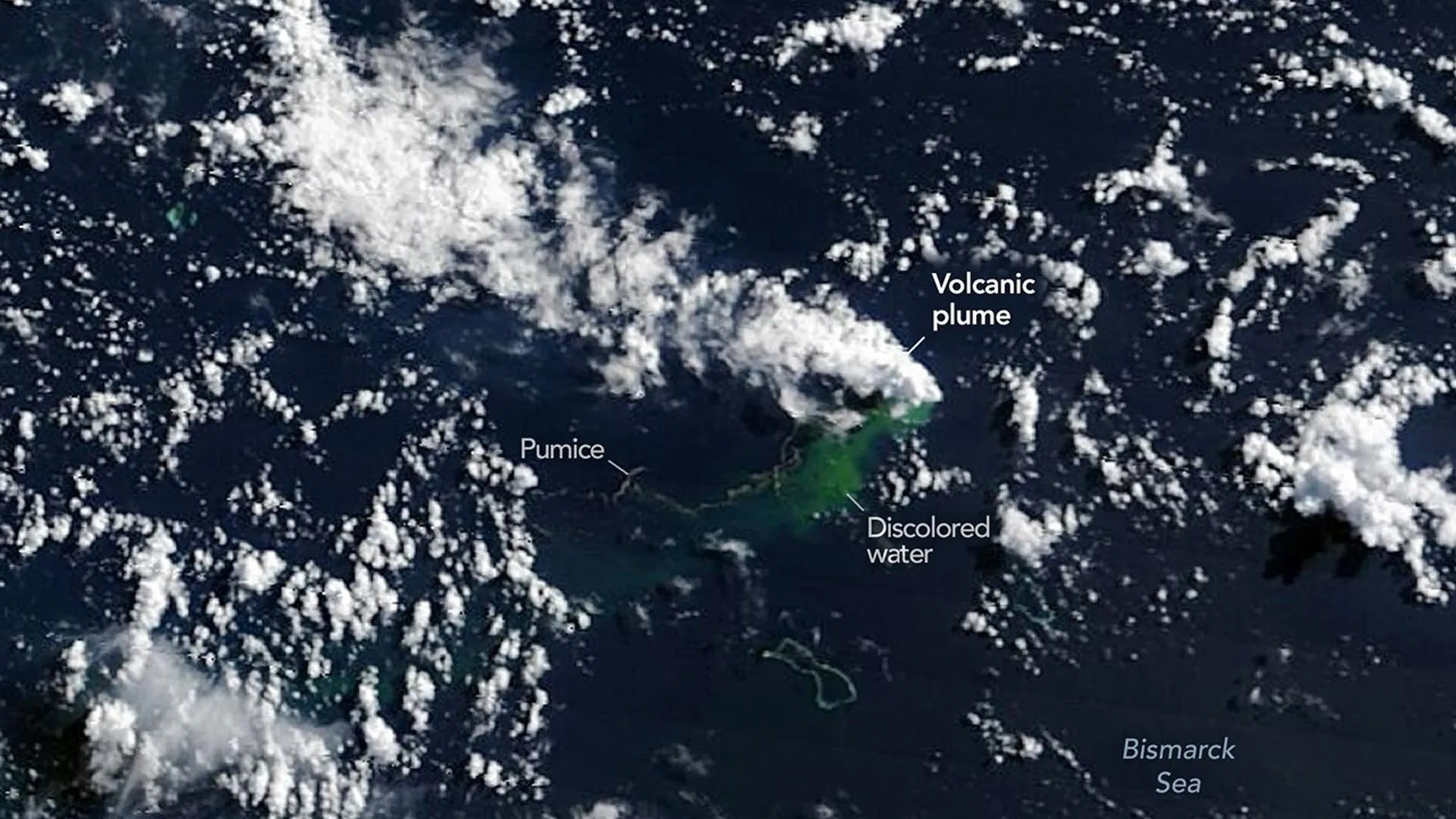
A volcano erupting on the floor of the Central Bismarck Sea has been staining the ocean and belching steam for weeks, and NASA scientists are now watching from orbit to see whether the eruption will give rise to Earth's newest island. The activity, off the coast of Papua New Guinea, offers a rare chance to observe the violent birth of new land almost in real time.
The underwater eruption began on May 8, 2026, along a submarine feature known as Titan Ridge, roughly 16 kilometers southeast of Papua New Guinea. A day later, on May 9, satellites began capturing telltale signs of the upheaval: white, steam-rich volcanic plumes rising from the sea surface and large patches of discolored water spreading across the area, evidence of superheated rock and volcanic material meeting the ocean.
Several NASA satellites — including Terra, Aqua and the newer PACE mission — have trained their instruments on the site, building a growing record of the eruption's progress. So far the volcano has not yet pushed a permanent landmass above the waves, and researchers say it remains unclear whether one will emerge. Whether a new island forms depends on a delicate balance between how much material the eruption piles up and how quickly the restless sea erodes it away.
Jim Garvin, chief scientist at NASA's Goddard Space Flight Center, is helping lead the monitoring effort and framed the eruption as a scientific opportunity. It offers, he said, "huge opportunities to explore and learn using both government and commercial satellite platforms," allowing researchers to track the process with a density of observations that would have been impossible only a decade ago. The site currently has no official name.
Newborn volcanic islands are often short-lived. History is littered with examples of freshly formed land that crumbled back beneath the surface within months as waves and currents dismantled the loose ash and rubble. Others, like Iceland's Surtsey, which rose from the North Atlantic in the 1960s, endured to become natural laboratories for studying how life colonizes barren ground. The 2022 eruption of Hunga Tonga demonstrated just how explosive — and consequential — undersea volcanism can be.
For now, scientists are content to watch and wait as the Bismarck Sea churns. Each satellite pass adds to the picture of an eruption still unfolding, and with it the tantalizing possibility that a patch of brand-new Earth may soon break the surface — however briefly it might last.